Posted on July 6, 2024 by Yoram Gat
 It turns out that there is a rather interesting yearly report called “Democracy Perception Index” which has been published since 2019. The report is based on opinion surveys conducted in more than 50 countries and in which people are asked about the perceptions of democracy and of the government of the country in which they live.
The report is contains various pieces of information of interest. One of the interesting findings in the 2024 edition is that majorities in Japan, in almost all European countries, and in all American countries with the exception of Mexico, see their governments as serving “a small group of people in my country”. In Asia, in contrast, majorities in most countries (with the notable exception of Iran) see their governments as serving “most people in my country”.
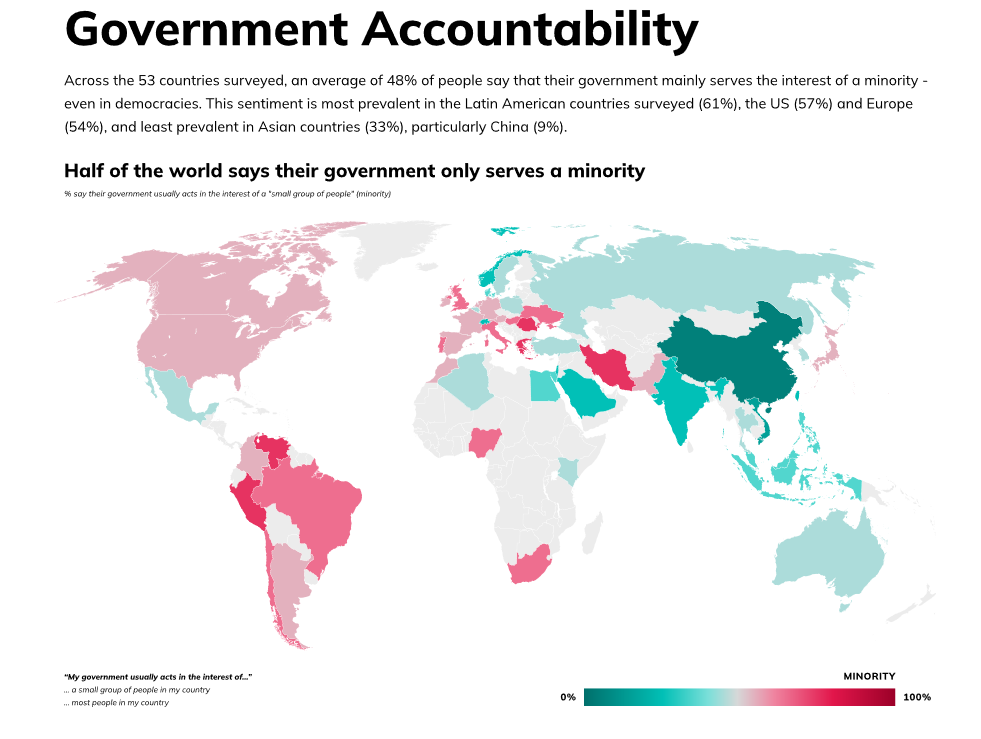
Also interestingly, some light is shed on the way people use the under-defined term “democratic”. The criterion people use for stating that their country is democratic is rather more lax than the question of whether the government serves most people. Since majorities in many countries in Europe and America say that their government is democratic, it seems that quite a few Western and South American people are willing to assert both that their government is democratic and that it serves a small group of people at the same time. In China the situation is the opposite: More people assert that the Chinese government serves most of the people in the country than assert that China is democratic, implying that quite a few of the Chinese see China as undemocratic despite asserting that its government serves most people.
Rather bemusingly, the report uses the terms “democratic”, and “free” as factual labels (as opposed to reflecting perceptions) to refer to the Freedom House classification of countries. This follows the convention of referring to [Western] expert opinions as scientific fact, while delegating people’s perceptions of their governments to mere opinion.
Filed under: Opinion polling | 2 Comments »
Posted on July 6, 2024 by Yoram Gat
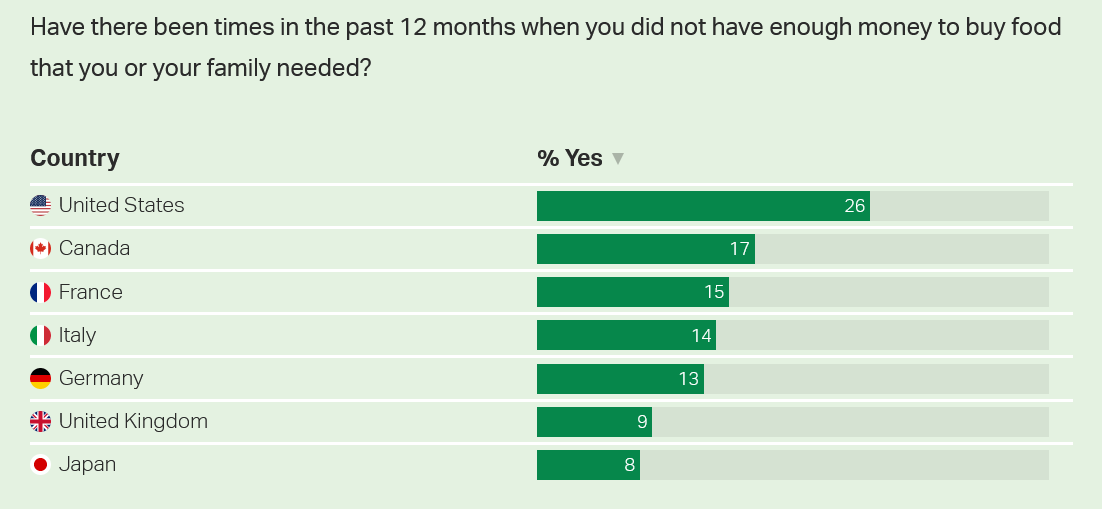
A Gallup poll finds that the inability to afford food is common within Western nations.
Effects of electoralism is a new category of posts is that is devoted to documenting the social and political effects of the elections-based system of government. The aim is to generate a steady stream of up-to-date items that can be easily referred to in order to highlight the fact that the system is inherently anti-democratic. Discussion of the persistent failure of the system to serve those ruled under it is studiously avoided not only by those who overtly promote the status quo but also by many supposed reformers who express concern about people losing confidence in the system, but rarely discuss the underlying causes for this loss of confidence.
Filed under: Effects of electoralism, Opinion polling | 3 Comments »
Posted on June 19, 2024 by Yoram Gat
Back in 2017, after a minor campaign of harassment, Guardian columnist George Monbiot weighed in on sortition. At the time his verdict was that the idea was nothing short of “a formula for disaster” and instead he offered his readers the usual electoral fixes such as campaign finance reforms, voter education and proportional representation. Well, seven years later, Monbiot has had a significant change of heart:
General elections are a travesty of democracy – let’s give the people a real voice
Our system is designed for the powerful to retain control. Participatory democracy and a lottery vote are just two ways to gain real representation
[G]eneral elections such as the one we now face could be seen as the opposite of democracy. But, as with so many aspects of public life, entirely different concepts have been hopelessly confused. Elections are not democracy and democracy is not elections.
Continue reading →
Filed under: Books, Elections, History, House of Lords, Press, Sortition | Tagged: democracy, elections, george-monbiot, politics, sortition | 7 Comments »
Posted on June 3, 2024 by Yoram Gat
 Gina Goldenberg, writing for the Ash Center for Democratic Governance and Innovation in the Harvard Kennedy School, has produced a highly purified specimen of the “deliberative democracy” narrative. The article is a useful condensed aggregation of the clichés of the “deliberative democracy” genre, notable for what it does not say more than for what it does. Other than the canned vocabulary, the tropes and the omissions, another noteworthy point is the intimate/inspirational style which focuses on the personalities of supposedly brilliant elite actors on whose insights and initiative our future depends (including professionally-staged pictures, of course).
In the excerpt below, I underline terms and phrases that are typical to the genre. I find it a useful exercise to consider what those terms and phrases mean and what alternative phrasings they were chosen over. Also, to reduce the mental burden on the readers, I elide some of the intimate/inspirational verbiage.
Could deliberative democracy ameliorate democratic backsliding? Two HKS students believe it might.
As concerns for the health of democracy mount, Medha Uniyal and Kartikeya Bhatotia consider one particular “experimental democratic practice” that could increase connectivity between citizens and decision-making processes.
In their PAE [Policy Analysis Exercise], [Medha Uniyal and Kartikeya Bhatotia, students at Harvard Kennedy School (HKS)] responded to the sentiment of global democratic decline by looking for untraditional and innovative mechanisms to increase civic engagement and collect deeper citizen input through deliberative democracies. By concentrating on the deliberative model, Uniyal and Bhatotia hope to address some of the challenges that aggregate democracies face today, like extreme polarization and decreased connectivity.
Continue reading →
Filed under: Academia, Deliberation, education, Participation, Sortition | 4 Comments »
Posted on May 24, 2024 by Yoram Gat
 Drawing Lots: From Egalitarianism to Democracy in Ancient Greece, a new book by Irad Malkin and Josine Blok, has just been published by Oxford University Press. The book is a major landmark in the study of sortition and its association with democracy. The book aims to show, via a review of the history of the application of allotment in the ancient Greek world, that Greek democracy grew out of an egalitarian mindset, a mindset that was expressed, as well as presumably reinforced, by the widespread application of allotment in different contexts over a centuries-long period.1
Before the lot became political, drawing lots and establishing a mindset of equal chances and portions were already ubiquitous during the centuries before Cleisthenes laid the foundations for democracy in 508. They touched upon a whole spectrum of life and death, both private and public. They expressed values of individuality, fairness, and equality.
Malkin considers his new book as the first comprehensive treatment of classical allotment. He points out a rather astounding fact – allotment, “a significant institution that permeated the lives of Greeks during the archaic period and impacted how they saw human society and structured their expectations and behaviors”, has received very little attention by classicists.
Continue reading →
Filed under: Academia, Athens, Books, Elections, History, Sortition | Tagged: democracy, greece, History, politics | 2 Comments »
Posted on May 18, 2024 by Yoram Gat
Richard Rorty, 1931–2007, was a fairly prominent Left-Liberal American philosopher. He saw himself as a pragmatist and a disciple of John Dewey and is known for promoting wide-ranging relativist views. In particular, Rorty rejected the existence of transcendent truths that can serve as the goals of scientific inquiry, philosophy or politics.
Such radical philosophical notions somehow seem to co-exist with an old-fashioned electoralist political theory, which harks back to the post WWII era – a period which embodied Rorty’s political ideal.
I think democratic governments are run by experts. The only question is which experts are going to be in power at any given moment. Dewey’s dreams of participatory democracy will never come true. I think American universities and Western universities generally have served democratic societies very well indeed. They have supplied experts who could then be associated with politicians who were voted in or were voted out by the masses. That’s the best we can expect.
Filed under: Academia, Elections | 6 Comments »
Posted on May 11, 2024 by Yoram Gat
Just two months ago, Evan Tao proposed applying sortition to selecting the student body of a Brown University. A similar proposal is now made by Michael Foley and Grant Yoon from the College of William and Mary.
 Student Assembly officials shouldn’t be elected, they should be randomly selected. This somewhat radical idea has roots in ancient Athens where, for centuries, public officials were chosen via sortition. Sortition is the selection of public officials by lottery rather than election. We know, it sounds like an insane idea, but bear with us. Our goal with this article is not to convince you that sortition is a perfect system that should be implemented everywhere, we haven’t even convinced ourselves of that, but rather that it is a system with enough merit to be worth trying, and that the College of William and Mary’s Student Assembly offers the perfect laboratory within which we can test out the concept.
Our argument for sortition at the College boils down to this: randomly selected legislators would govern more effectively and promote a more inclusive culture surrounding student government on this campus.
Continue reading →
Filed under: Academia, Elections, Sortition | Tagged: Student government | 2 Comments »
Posted on May 4, 2024 by Yoram Gat
 Cristina Lafont, Professor of Philosophy at Northwestern University, presents her anti-sortition position as being based on participationist ideology. In a debate with Brett Hennig and Samuel Bagg, which took place in August 2022, Lafont initially makes the standard participationist arguments:
[T]he very idea of having something like a lottocracy, where we change the political system, my main concern is it is not democratic. It is a way of empowering the few, the very few the tiny, tiny few randomly selected people to do the thinking and the deciding for the rest of the citizenry. Whereas the citizens really are just supposed to blindly defer to whatever decisions they make. They have no formal tools of holding them accountable or of collectively shaping which political agenda we are going to have. They just can only blindly refer to whatever those very few people decide, and to me, that is really not democratic. Blind deference is quintessentially a non-democratic relationship of political inequality where you have just decision makers who are not accountable, they can decide anyway they like as they see fit, and then you have people who just follow and obey and have no other way of shaping their decisions. That’s my main concern.
Continue reading →
Filed under: Academia, Elections, Participation, Sortition | 140 Comments »
Posted on April 28, 2024 by Yoram Gat

The French discussion of “participative democracy” has recently produced several texts expressing suspicion of the way “participative devices” are being used by government to produce supposedly democratic outcomes.
Guillaume Gourgues writes in la vie des idées:
By setting up citizen consultations that it selects and organizes itself, the State sidesteps democratic procedures and institutions. There is the risk of a gradual drift towards a form of “participatory authoritarianism”.
On March 22, 2023, as he began his speech in the face of protests over pension reform, Emmanuel Macron defended the legitimacy of his reform by affirming that it followed a “democratic path” which began with “months of consultation”.
The claim of having followed a “democratic path” by the President, punctuated by regular reminders of “consultation” and “participation” mechanisms, is perplexing, as the political conduct of pension reform is obviously marked by the choice to reduce democratic debate to its strict minimum.
[This choice is highlighted when,] in the shadow of the pension reform, the citizens’ convention on the end of life, convened by the government, delivered its final opinion on April 2, 2023, after three months of deliberation.
Continue reading →
Filed under: Academia, Books, Elections, Participation, Press, Sortition | 2 Comments »
Posted on April 25, 2024 by Yoram Gat
Roger Hallam, co-founder of Extinction Rebellion, writes:
This week in the Portuguese elections, the far right surged to 18% of the vote while the two main parties collapsed to around 25% each. This is now a pattern across western democracies. The collapse in support of the centre left and centre right and the rise of the populist left and right forces. At the moment, the momentum is with the radical right.
The conventional wisdom of the liberal political class, as shown in endless opinion articles, is that the centre right and left have to, in various unspecified ways, get their act together and stop the rise of the extremes. “Will Europe ever learn?”, one Guardian article writes. What does that actually mean apart from a vague appeal for people to be nice?
It is vague because there is, in fact, no effective structural response to the rise of the political outsiders. Both the centre right and centre left are ideologically committed to an international neo-liberal regime that systematically undermines the incomes and the identities of the majority. This international regime has also shown itself incapable of fulfilling its first political duty: to protect the lives and livelihoods of the people. The elites pouring more carbon in the air will now take us over 2C.
Continue reading →
Filed under: Elections, Sortition | Tagged: Climate | Leave a comment »


 Adam Cronkright
 Ali
Ali Ahmed R. Teleb
 avanderven
 avergne
 Alex Kovner
 azakaras
 Brett Hennig
 campbellwallace
 Simon Threlkeld
 Nick Coccoma
 codyhipskind
 Common Lot Sortitionist
 Conall Boyle
 constitutionalism
 davidschecter
 graytmatter
 gtridimas
 H.J. Hofkirchner
 Hanspeter Rosenlechner
 John Burnheim
 jgarry20151
 Jochen Krattenmacher
 johnedwardtaylor
 johnhuang865
 Jonathan Crock
 keithsutherland
 Jacob Richter
 kkoreilly
 lukewhito
 SimonPek
 Nathan El
 Nicholas Gruen
 Owen Shaffer
 Patrick Chalmers
 Paul Gölz
 peterstone
 Pierre-Etienne Vandamme
 pronfeld
 Emil
Emil rcaze
rcaze richwbrown
 Roger Knights
 roslynfuller
 Pierre-Etienne Vandamme
 shaharavin
 tbouricius
 Ted Wachtel
 Joshua Laferriere
 theodorestathis
 towardsautonomyblog
 Wayne Liebman
 Yoram Gat
 Oliver Milne
 Equality by lot