Wang Shaoguang: Representative and Representational Democracy, Part 3/3

Part one, part two.

Wang’s skeptical evaluation of the Western conception of democracy and of the arguments for elections as a democratic tool are in fact merely a segue to his main topic which is the “Mass Line”. According to Wang, the Mass Line is the basis for decision making by the Chinese system of government. Wang describes the Mass Line as an ongoing process by which decision makers interact with the population in order to become informed and shape public policy. Wang quotes Mao Zedong as follows:

In every aspect of my party’s practical work, if leadership is to be correct it must come from the masses and go to the masses. This is to say, we must collect the views of the masses (disparate and un-systematic views) and, through study, turn them into collective and systematic views, and then we must go back to the masses to disseminate and explain them, turning them into the masses’ own views, enabling the masses to persevere, and to see these views implemented in practice. From the practice of the masses we must conduct examinations to determine whether these views are correct. We then must once again collect the views of the masses, and once again go back to the masses and persevere. This endless cycle will each time be more correct than the last, richer and more vivid than the last. This is the epistemology of Marxism.

Continue reading

Leydet: Which conception of political equality do deliberative mini-publics promote?

A 2016 paper by Dominique Leydet from the department of philosophy at the University of Québec at Montréal:

Which conception of political equality do deliberative mini-publics promote?

My objective in this article is to achieve a clearer understanding of the conception of political equality that informs at least some of these democratic designs in relation to equality of opportunity, but also in relation to agency, both individual and collective.

To do so, I will focus, in the first section, on the methods of participant selection advocated to secure equal presence. According to what principle is participation distributed? If it is according to the equal chance or equal probability principle, rather than equal opportunity, what difference does this make in terms of the underlying conception of political equality? Is ‘equal presence’ conceived strictly in individualist terms or is it related to groups? And, if so, how?

In the second section, I consider the issue of voice. Achieving equality in this context is conceived in terms of equalizing opportunities for influence among participants (Smith 2009: 21-22; Fishkin 2009: 100-101; Fung 2003: 348). I intend to clarify the conditions the designs establish to achieve this objective despite the existence of background inequalities. How is the political agency of participants understood and facilitated in this respect? And what does this say about the underlying conception of political equality?

The benevolent dictator

The concept of the “benevolent dictator” occasionally plays a role in political discussion of democracy. The general thrust of the “benevolent dictator” argument is that democracy cannot be defined in terms of its outcomes because “a benevolent dictatorship” can produce any given outcomes, while still, by assumption, being anti-democratic.


Ober (2006), for example, says this:

Democracy is shown to be a non-instrumental good-in-itself (as well as an instrument in securing other goods) by extrapolation from the Aristotelian premise that humans are political animals. Because humans are by nature language-using, as well as sociable and common-end-seeking beings, the capacity to associate in public decisions is constitutive of the human being-kind. Association in decision is necessary (although insufficient) for happiness in the sense of eudaimonia. A benevolent dictator who satisfied all other conditions of justice, harms her subjects by denying them opportunity to associate in the decisions by which their community is governed.

This line of argument – the participative conception of democracy, or Schumpeter’s “classical doctrine” – sounds very high minded. Beyond the policy objective, political participation enriches the participators and ennobles them. As an argument against sortition, or against an outcomes-based conception of democracy it is, however, less than convincing.
Continue reading

Wang Shaoguang: Representative and Representational Democracy, Part 2

Part one is here.

A useful part of Wang Shaoguang’s article “Representative and Representational Democracy” (2014) is his critique of the arguments for elections as a democratic mechanism (and in fact as the most fundamental component of democracy). The whole matter of the justification for elections in terms of their expected outcomes is usually avoided by electoralist dogma. Instead the discussion is framed using formalisms: elections are judged as being “legitimate” because they follow some supposed principles of “representativity”. The issue of how those principles themselves can be justified other than in terms of system outcomes is not addressed.

On the rare occasions when the expected outcomes of elections are addressed, two mechanisms are offered as connecting elections with desirable outcomes – Wang refers to these as the “authorization theory” and the “accountability theory”. These arguments go at least as far back as the Federalist papers. Wang first presents and critiques the authorization theory:

According to authorization theory, during elections each political party puts forth its policy positions and promotes its candidates, while the people have the right to choose to support whichever party or candidate they want, and they will vote for the party and candidates of their choice. In the sense that those who are elected start governing only after they have been invested with the authority of the people, this system is of course democratic.
Continue reading

Burnheim and Gruen on the path toward sortition

An exchange between John Burnheim and Nicholas Gruen on the way to introduce sortition into contemporary political systems.

Burnheim:

Scrap attempts to reforming politics as a whole. From a practical point of view attempts to do so by legal constitutional change have no possibility of succeeding from a theoretical point of view, it is folly to assume that if we agree broadly about principle and are motivated to act we will reach a practical agreement. As soon as you analyse the range of possibilities that emerge once one envisages ways of putting all those abstract principles into practice, the more one runs into a host of incompatible proposals.

IIUC, Burnheim argues that the political system either fails to recognize “known and recognised needs” or fails to recognize that established policy does not address those needs. Bodies that are supposed to recognize and address the needs “operate primarily in the interests of those who have power […] rather than the public interest”.

My view is that while it’s no panacea, [there] is likely to be a very effective role for specialised committees of citizens chosen by sortition. I also think that sortition for very specialised tasks is the way forward for many public activities. Don’t concentrate on what juries can’t do, but on instances where they are likely to do something useful.

Gruen:

There are three ‘poles’ of democracy. Direct democracy is one way to do democracy – but it’s both impractical and ill-advised even as an ideal in my view. This leaves representative democracy and I can think of two very different ways of selecting representatives. Competitively through elections and via sortition.

My entire program revolves around finding whatever ways might be possible to inject the latter into a system dominated by the former – whether those ways are large or small.
Continue reading

Wang Shaoguang: Representative and Representational Democracy, Part 1

As a powerful state which is not electoralist, it is not surprising that China produces political theory which rejects the equation of democracy with elections. It is characteristic of the weakness of Western political science that it makes no serious attempt to explore and engage with this theory.

Wang Shaoguang is a prominent Chinese political scientist. His article “Representative and Representational Democracy” was originally published in the Chinese language social science journal “Open Times” in 2014. A translation to English of the article appears on the website “Reading the China Dream” which regularly translates articles by Chinese establishment intellectuals. The article makes several intertwined arguments regarding democracy and elections. While focusing, naturally, on the Chinese system as an alternative to the Western electoralist system, Wang does make a mention of sortition as well.

In the following excerpts Wang first notes the crisis of the Western government system and makes the straightforward observation, often avoided in the West, that the Chinese system enjoys more popular support than most Western governments. Rather surprisingly, it seems to me, instead of translating this fact to a frontal attack on the Western system, Wang then makes the apologetic (and fairly familiar) multi-culturalist argument that democracy is perceived differently in different cultures. Wang asserts that while the formality of elections is a main feature of the Western or American conception of democracy, in the East “substantive” aspects are considered essential.

Today, even though Thatcher’s “There is No Alternative” and Fukuyama’s “End of History” have already become standing jokes in academic and intellectual circles, their variants proliferate and circulate constantly. Though most people no longer use these particular expressions, many still firmly believe that the “today” of Western capitalist countries is the “tomorrow” of other countries (including China).
Continue reading

The OECD: Innovative Citizen Participation and new Democratic Institutions: Catching the Deliberative Wave

A newly published document from the Organisation of Economic Co-operation and Development draws on data collected from nearly 300 case studies from 1986 to October 2019. Its 200 pages cover randomly selected Citizens’ Assemblies, Juries, Panels and ‘other representative deliberative processes’.

This research and proposals for action fit within the organisation’s work on innovative citizen participation, which seeks to guide countries on the implementation […] of the 2017 Recommendation on Open Government.

The acknowledgements include many regular participants on the Equality-by-Lot blog.

The Canadian organization MASS LBP and the OECD will be launching the publication with a 60-minute Zoom event on 15 July 2020 at noon.

The Potential of Weighted Sortition

This is the 5th post in a series on Barbara Goodwin’s classic work on sortition Justice by Lottery, University of Chicago Press, Chicago, 1992. Previously published parts: 1, 2, 3, 4.

Sortition is hiring without human intervention using random rather than reasoned criteria. Weighted sortition, though, is a statistical narrowing down of randomly chosen job candidates to the more ready among workers available. In Barbara Goodwin’s words, they are “lotteries where some people get extra chances of winning according to their personal characteristics or qualifications.” More broadly, the chances of “winning” a position can be micro-managed to take in any number of other factors beyond qualifications, such as need and desert, both personal and social, both present and future.

Goodwin’s “Justice by Lot” introduced to me the idea of weighted sortition. True, she dismisses it as “impure” compared to completely random sampling of the entire population, but the idea has intrigued me ever since I encountered it here. Admittedly, playing with percentages increases the complexity of choices, but complexity, in an age of supercomputers, data mining and artificial general intelligence (AGI), is not the obstacle it was even ten years ago. A weighted lottery allows for intriguing possibilities never imaginable before. It can factor into every hire whatever evidence-based social science deems well grounded, including experience, aptitude, personal choice and even broader social goals. The difficulty is that the advantages of sortition itself have to be clear to a broad proportion of the population before weighted sortition comes into play, as Goodwin points out,

Only by participation, which is a continuous process, would people acknowledge the authority of a social lottery [p. 71].

Continue reading

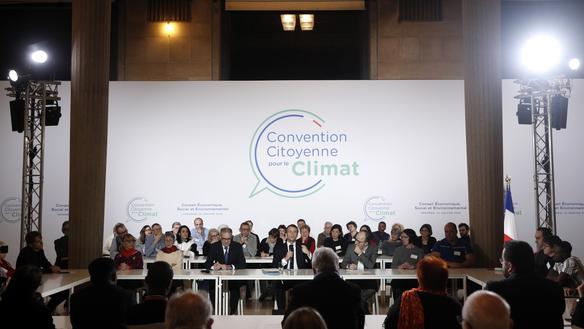
Feertchak: The Citizen Convention for the Climate does not meet with unanimity

With the Citizen Convention on the Climate publishing its report, Alexis Feertchak writes in the Le Figaro about early reactions.

The Citizen Convention for the Climate does not meet with unanimity
June 20th, 2020

The 150 allotted citizens are voting this weekend for as many environmental proposals. But since its introduction, reactions to this body have been mixed.

“Involve citizens in the governance of transportation at the local level as well as at the national level.” The “technical” tone of this proposal makes it sound more like a recommendation in report of the state bureaucracy than a conclusion of a citizen assembly chosen by lot. It is one of the points that are regularly made on the social networks: if we involve citizens directly in democratic deliberation, we should have been able to get more original results than that one.

Rather than being original, the 150 proposals or so, showing a leftist slant economically, seem quite familiar. Responding to the proposal of reducing the work week to 28 hours (a proposal that was eventually not presented), increasing the minimum wage, taxing dividends, etc., Philippe Bas, senator for [the center-right party] Les Républicains and head of the laws committee, twitted: “The results of the so-called citizen convention are a disappointment: a rehashing of the hymn book of the environmental lobby, (…) economic ignorance, total lack of legitimacy. Sortition exposed as a democratic deception!”
Continue reading

Massol: Participative democracy: a job for professionals

Nicolas Massol writes in Liberation.

Participative democracy: a job for professionals

The growth of citizen participation initiatives, such as the Climate Convention, has been made possible thanks to a lot of organizational work by specialized businesses.

Participative democracy is not a business for amateurs. To be convinced of that, it is enough to have a look at the sophisticated organization of the Climate Convention. All this beautiful engineering was designed and put together by professionals of citizen participation. For them this unprecedented experience is going to usher in a profession of a future. It is a future which has been in the making for 20 years in which, from participative budgeting to a Grand national debate, initiatives for directly involving citizens in political decision-making have been growing, with the support of the authorities. “Municipalities account for 80% of the initiatives”, estimates Alice Mazeaud, co-author of “The market of participative democracy” (2018). The Convention, on the other hand, was financed directly by the Prime Minister’s office, to the tune of over 4 million Euros. Not enough to speak of a real “participation business”, but still enough to create a small ecosystem.

And so, the organization of the Convention was handed to a consortium of businesses: The Harris Interactive polling institute carried out the allotment, Eurogroup Consulting set up the database available to the citizens, and for moderating the discussions, Res Publica and Missions publiques – two consulting firms for participative democracy – were hired. “My profession is to make sure the collective discussion advances”, says Gilles-Laurent Rayssac, the president of the first of those. A technical role, according to Judith Ferrando, the co-director of the second one: “Our moderation techniques promote the success of deliberation, but we stay in the wings, a little like in the theater.”
Continue reading