Interview with the Classical Republican

I was interviewed some time ago about sortition for the Classical Republican. It was a wide-ranging conversation that included discussion of this blog. The interview is now on Youtube, and can be viewed here. Note that the Classical Republican has an entire Youtube playlist devoted to sortition which features, in addition to my interview, an extended conversation with longtime sortition advocate Oliver Dowlen and other interesting videos. The playlist can be found here.

A democratic rock bottom

Guillaume Drago, a law professor at Université Panthéon-Assas Paris II writes [original in French] the following in the Catholic monthly journal La Nef.

A democratic rock bottom

It is the time, it seems, of “participative democracy”, which has been described as “the collection of methods aiming to involve the citizens in the process of political decision making” [L. Blondiaux, on the site vie-publique.fr], and which could be defined as the direct participation of citizens in the creation of rules, and in particular legislation. It surely involves that when it concerns the “Citizen Conventions” for the climate and for the end-of-life question.

The composition of these “conventions” is the product of allotment which is supposed to be representative of the French population. The institution which organizes these conventions is the Economic, Social and Environmental Council (CESE, pronounced “se-zeh”), with a “governance committee” which, it is easily understood, is there to steer the discussions in the desired directions and an “oversight body”, for the end-of-life convention [The role of the oversight body is defined on the site of the “convention”: “The oversight body is tasked with ensuring respect for the essential principles of the Citizen Convention: sincerity, equality, transparency, respect for the speech of the citizens. The body also verify that the conditions guarantee the independence of the Citizen Convention”.] The assessment of a legal scholar of the use of “citizen conventions” cannot avoid being severely negative, for several reasons.

The first is that these bodies are neither constitutionally nor legally recognized. No provision of our constitution discusses such a device for preparing or for participating in deciding laws or regulations. The law is silent on this type of device and it is unclear why the members of parliament would wish to give up some of their legislative power in favor of the citizens whereas those citizens have duly elected the members of parliament in order to represent them… For those two “conventions”, a simple letter of the prime minister to the president of the CESE is all that justifies their existence. They are then associated with what one of the sites of the “conventions” calls the “third Assembly of the Republic, and a legitimate player acting as an independent constitutional assembly, whose task is to be a juncture of citizen participation”. Good heavens! Such responsibility!
Continue reading

Bertrand Russell on Athenian democracy

In his 1945 book History of Western Philosophy Betrand Russell writes the following (p. 74):

Athenian democracy, though it had the grave limitation of not including slaves or women, was in some respects more democratic than any modern system. Judges and most executive officers were chosen by lot, and served for short periods; they were thus average citizens like our jurymen, with the prejudices and lack of professionalism characteristic of average citizens.

It is remarkable that the reason given for the Athenian system being more democratic than modern systems is not the standard superficial argument about the Assembly voting directly on laws. Russell’s appeal to the fact that Athenian judges and officers had, as a result of being chosen by lot, the same outlook as the average citizen is an adumbration of Manin’s pure theory of elections (“the principle of distinction”).

Doing Democracy Differently

Doing Democracy Differently

Teaching About Deliberative Democracy

in the Secondary Classroom

On April 3rd at 6 PM EST, we are hosting a short online Zoom call for anyone interested in learning more about this upcoming course. 

Register for the Zoom Call Here

Course Date: May 20-21 

Course Location: Manhattan (Barnard’s Milstein Center for Learning)

*Tuition-Free Teachers Fellowship Available & 10-CTLE Training Course in NYC*

**Limited travel funds available**

Maurice Pope’s The Keys to Democracy is now available

Hugh Pope writes:

I’m writing to share details about the publication of the book that has been my special project over the past 18 months: The Keys to Democracy: Sortition as a New Model for Citizen Power, by my late father, the classicist Maurice Pope.

The back story: my dad wrote the book in the 1980s, but, perhaps because it was ahead of its time, his usual publishers wouldn’t take it. We had thought the work was lost well before he passed away in 2019. But two years ago, while sorting through his library, my mother found the typescript.

As my brother Quentin and I edited the text, we consulted several experts and were urged on by messages back telling us that the book was “masterful”, “bold”, “visionary” and more (you can see all their endorsements here). Dr. Hélène Landemore of Yale University and Cambridge classicist Dr. Paul Cartledge generously wrote a preface and an introduction. With many such helping hands, we found a publisher at UK philosophy specialists Imprint Academic. The book went on sale on 7 March.

Back in the 1980s, few others proposed that randomly selected citizens could, after proper information and deliberation, reach better decisions than elected politicians. This open field is perhaps one reason for the book’s unique and accessible combination of the history, mathematics, philosophy and future of sortition. My dad’s ideal – in which random selection could be the decision-making heart of all branches of government – also makes him more radical than most other thinkers writing today.
Continue reading

Sintomer: The Government of Chance

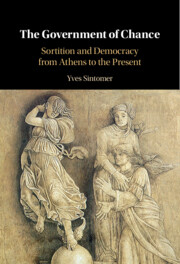
French political scientist Yves Sintomer has published a new book dealing with sortition called The Government of Chance: Sortition and Democracy from Athens to the Present.

The publisher, Cambridge University Press, provides a(n apparently auto-translated) book description:

Electoral democracies are struggling. Sintomer, in this instructive book, argues for democratic innovations. One such innovation is using random selection to create citizen bodies with advisory or decisional political power. ‘Sortition’ has a long political history. Coupled with elections, it has represented an important yet often neglected dimension of Republican and democratic government, and has been reintroduced in the Global North, China and Mexico. The Government of Chance explores why sortation is returning, how it is coupled with deliberation, and why randomly selected ‘minipublics’ and citizens’ assemblies are flourishing. Relying on a growing international and interdisciplinary literature, Sintomer provides the first systematic and theoretical reconstruction of the government of chance from Athens to the present. At what conditions can it be rational? What lessons can be drawn from history? The Government of Chance therefore clarifies the democratic imaginaries at stake: deliberative, antipolitical, and radical, making a plaidoyer for the latter.

Continue reading

Reflections on the representativeness of citizens assemblies and similar innovations

A blog post by Tiago C. Peixoto and Paolo Spada.

Introduction

For proponents of deliberative democracy, the last couple of years could not have been better. Propelled by the recent diffusion of citizens’ assemblies, deliberative democracy has definitely gained popularity beyond small circles of scholars and advocates. From CNN to the New York Times, the Hindustan Times (India), Folha de São Paulo (Brazil), and Expresso (Portugal), it is now almost difficult to keep up with all the interest in democratic models that promote the random selection of participants who engage in informed deliberation. A new “deliberative wave” is definitely here.

But with popularity comes scrutiny. And whether the deliberative wave will power new energy or crash onto the beach, is an open question. As is the case with any democratic innovation (institutions designed to improve or deepen our existing democratic systems), critically examining assumptions is what allows for management of expectations and, most importantly, gradual improvements.
Continue reading

Bailly: The democratic quality of European Citizens’ panels

“The democratic quality of European Citizens’ panels” is an interesting study of the citizen panels convened within the framework of the Conference on the Future of Europe which took place in 2021. The study by Jessy Bailly involved interviews with dozens of participants in the panels.

The study highlights some of the problems of the lack of an acceptable design, resulting in biased outcomes. Examples of problematic aspects of the design are the use of volunteers, the way the experts are appointed, the overrepresentation of a stratum of their choice (youth in this case), and the lack of transparency of the sortition method.

Some excerpts:

When I surveyed the citizens, many praised the “diversity of people” within the panels. Others emphasised the lack of representativeness of the citizens’ panels, with at least 5 of the 31 citizens interviewed insisting on it. One of them was a German citizen in her 30s: “You should pay attention to a greater diversity of people and not only people who are pro-Europe. There should be a greater selection of different people, different social classes and also religions.” It is worth noting that the “social class” criterion had to be respected (through the prism of occupation). However, no ethnic or religious criteria were considered.

Continue reading

Ovadya: Controlling AI via allotted bodies

Hélène Landemore has recently proposed using AI to manage the deliberation of allotted bodies. Aviv Ovadya proposes the opposite:

Technologist and researcher Aviv Ovadya isn’t sure that generative AI can be governed, but he thinks the most plausible means of keeping it in check might just be entrusting those who will be impacted by AI to collectively decide on the ways to curb it.

That means you; it means me. It’s the power of large networks of individuals to problem-solve faster and more equitably than a small group of individuals might do alone (including, say, in Washington). This is not naively relying on the wisdom of the crowds — which has been shown to be problematic — but the use of so-called deliberative democracy, an approach that involves selecting people through sortition to be representative (such that everyone in the population being impacted has an equal chance of being chosen), and providing them with an environment that enables them to deliberate effectively and make wise decisions. This means compensation for their time, access to experts and stakeholders, and neutral facilitation.

Either way, Ovadya is busily trying to persuade all the major AI players that collective intelligence is the way to quickly create boundaries around AI while also giving them needed credibility. Take OpenAI, says Ovadya. “It’s getting some flack right now from everyone,” including over its perceived liberal bias. “It would be helpful [for the company] to have a really concrete answer” about how it establishes its future policies.

Oligarchical intents

A piece by Eva Talmadge in The Guardian presents its audience with idea of sortition. To what extent such an article covers new ground for the reader would be interesting to try and find out. The article itself links to a 2018 Guardian article proposing a Brexit citizen assembly.

The article quotes some of the usual sortition suspects – Claudia Chwalisz, Peter MacLeod, and Peter Stone, and presents the standard deliberative rhetoric around citizen assemblies about how people are more informed and reasonable when they deliberate and about the potential of citizen assemblies “to help fractured societies not only work on complicated problems, but learn how to live with one another”.

Sandwiched in, however, Chwalisz does contribute a quite subversive idea:

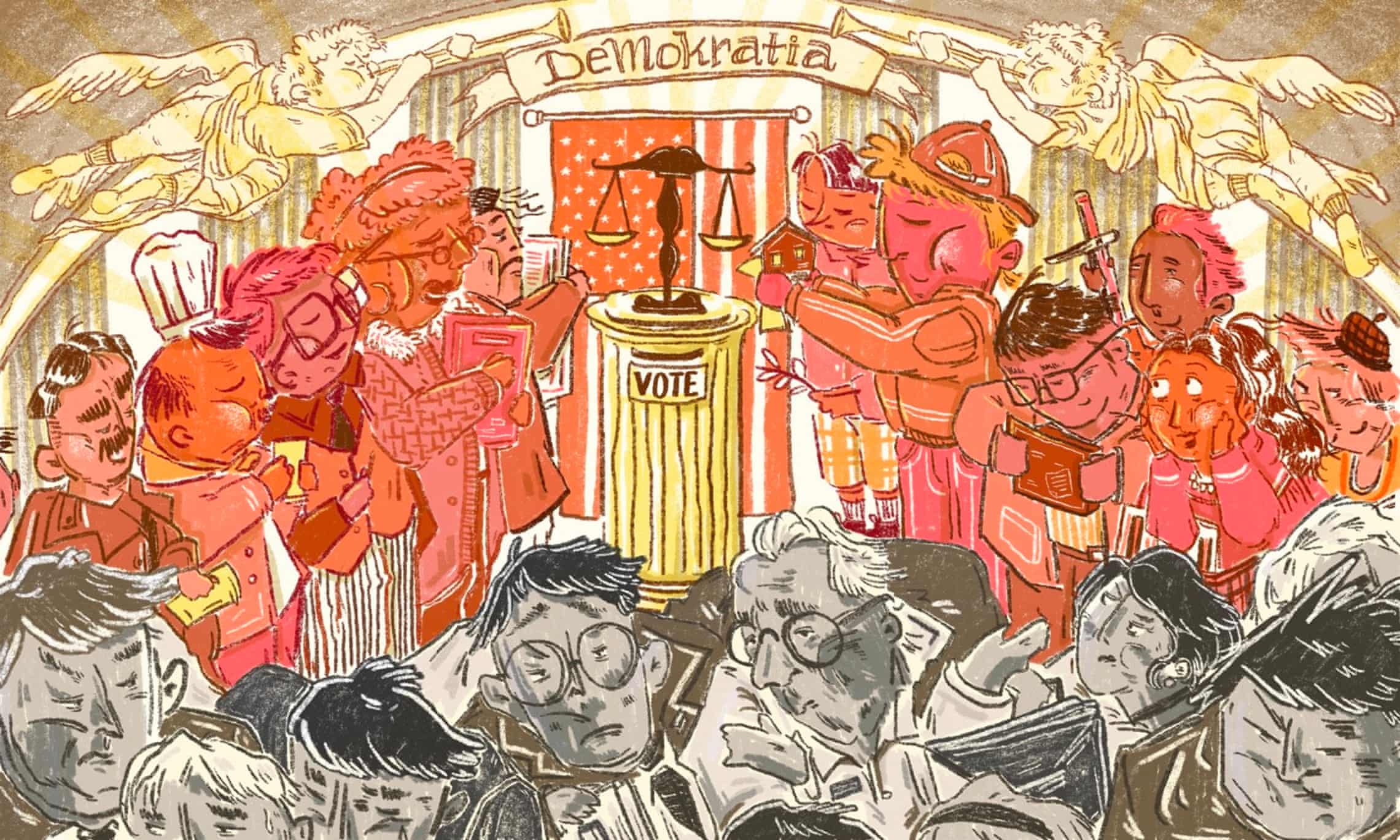
As the ancient Greeks and others recognized, elections are a way of constituting an oligarchy. When the French and American revolutions led to the establishment of the institutions that today we call democratic, the word ‘democracy’ was never used – the intent was for them to be oligarchic, concentrating power in the hands of the few.

Continue reading