Reading coverage of the UK’s Extinction Rebellion movement this week – which is beginning a campaign of civil disobedience in an attempt to pressure the British government into far more radical action to combat greenhouse gas emissions – I was intrigued to come across this:
The group also calls for the creation of a national Citizens’ Assembly to oversee “the changes necessary for creating a democracy fit for purpose”.
I can tell this will be a fun one for Equality by Lotters to contemplate.
For my own part, I got belted on the arms and peppered sprayed by Danish police in Copenhagen in 2009 in an attempt to chronicle what it felt like to take part in a civil disobedience action linked to global climate change negotiations. I did it deliberately to better understand the experience of civil disobedience – an approach inspired by the late, legendary US writer George Plimpton.
He called it participatory journalism. I experienced it as pretty stressful. Continue reading →
To spread our “mini,” or “demi,” message, I urge notable advocates of citizen juries to appear on one or more of America’s numerous talk-radio shows. (These are probably rarer in other countries.)
I Googled for “talk radio guest application” and dozens of places or ways to apply came up; if you Google for that phrase, you will get them too. (I wasn’t able to capture the results-page’s URL and post it here for you to click.)
A four-hour show that usually gives guests a two-hour segment (40 minutes per hour—the rest is news and ads) is “Coast to Coast AM.” It has a large audience—about three million. It often has guests from the UK and Australia. It specializes in heterodox topics (including a fair amount of “woo”). Its downside is its late-night hours: 1 to 5 AM in the East; 10PM to 2AM on the Pacific coast. Here’s its website: https://www.coasttocoastam.com. Here’s its request for guests, on its “Contact” thread:
Be Our Guest
Have you ever wondered how to become a guest on Coast to Coast AM? It’s easy. Just send an e-mail to the Producer stating your name, phone number, the area of your expertise or the nature of your experience. If it sounds like something worth talking about on Coast to Coast AM, the producer will call you. It’s that easy. Write to: CoastProducer@aol.com
The most desirable guests on any show, I suspect, would have one or more of these qualifications, among others: An academic post; a publishing record; a speaking-to-audiences record; a good speaking voice and a smooth presentation; a “common touch,” a lengthy period in the field, … I think it would be best if two or even three guests appeared, for the sake of variety and balance, so maybe you should have a name or two to suggest as your sparring partner. Continue reading →
Imagine scrapping elections and instead selecting politicians at random. What would you do if your name was drawn out and you suddenly found yourself in charge? How do you think the country should be run?
Award-winning performer Selina Thompson is sending out a far-reaching call to action for young people from all backgrounds to put their names forward for a new project this Summer.
The provocative new work, Sortition, will bring together a randomly selected team of young people under 30 from Scotland, England, Wales and Northern Ireland who don’t vote, feel like voting doesn’t work and that politics as usual doesn’t represent them. Sortition is co-commissioned by 14-18 NOW, the UK’s arts programme for the First World War centenary, supported by Jerwood Charitable Foundation, and will go on to be premiered this September at Arnolfini in Bristol.
I’ve never met Paul Wyatt – who describes himself as a self-producing filmmaker and media consultant. I’ve admired his work from a distance though, both as an inspiration for my own efforts to transform myself into a multi-media journalist and also for the subject matter he’s currently focused on.
I’m highlighting his work to Equality by Lot readers as you may be able to help him – right now – to raise some money to promote the cause of random selection and deliberation as it relates to economic policy. The challenge he’s facing is directly relevant to EbL readers. You are people, I assume, who are intent on spreading awareness and best practice of sortition in its different forms.
If Paul gets the money, and completes his film, we’ll all have a tool to help us argue the case for citizens to get a stronger voice in directing economic policy.
That’s why I’m spending some of my time writing this blog post.
The RSA programme gave randomly selected British citizens a non-binding say on national economic policy, and influence over the future of the UK economy.
So far, so so, you demanding EbL readers would say. You’d be right, of course, the Council conclusions didn’t oblige any policy maker to do anything with those findings, regardless of how good they might have been. Not at all best practice in sortition land but not catastrophically bad either.
The RSA initiative has had some heavyweight endorsement from the likes of Andrew Haldane, Chief Economist at the Bank of England. Who knows how far its recommendations will make it through the mechanisms of government and public policy? Perhaps its best legacy will be to move the debate and practices forward for others to then pick them up in turn.
Paul secured an RSA commission to document this event – something he did with skill and style in the short film shown below. You can access the kickstarter campaign via this link, and share it far and wide to your networks.
It’s interesting to see that councillors in charge of local government in the English market town of Frome are mulling over sortition. They face a byelection one year before the end of the council’s current, four-year term. Peter Macfadyen* and his fellow members of Independents for Frome (IfF) will be defending their record as part of the campaign.

No surprises there, it’s what any political party has to do mid term, even if IfF members see themselves as a “non-party party“. It does raise the intriguing point of manufactured conflict, though. Elections, as readers of Equality by lot know only too well, create divisions among competing candidates and their would-be voters.
Opposing candidates must somehow differentiate themselves from their opponents. That generally means over-blowing your own qualities while demeaning the opposition’s. Exchanges do little to illuminate or advance public understanding or people’s engagement in political issues.
Yes, yes, you know all that too.
The Frome election won’t change the balance of power on the council as IfF control all the other 16 seats. It will also cost money to stage and for candidates to contest. Continue reading →
I was lucky enough to get the following letter on sortition published in New Scientist, (not quite as I penned it). I’m hoping there will be an exchange of letters, so if anyone wants to comment, there is an opportunity.
Letters should be sent to:
letters@newscientist.com
or:
Letters to the Editor, New Scientist,
110 High Holborn, London WC1V6EU
They like them to be short (250-300 words maximum). Be sure to include your full postal address and telephone number, and a reference (issue, page number, title) to articles. In this case you should include “Campbell Wallace (Letters, 20 May, p53)…” if you comment on my letter; or, if you comment on another letter, the name of the writer and the date of publishing.
Dave Levitan (22 April, p 24), and Alice Klein (p 25) rightly deplore politicians such as Donald Trump and Malcolm Turnbull, who disregard scientific evidence in favour of policies chosen for short-term electoral advantage or to further special interests. But the problem is a consequence of the electoral system itself, which repeatedly brings to power people unfit to use it.
Since the 18th century we have assumed that elections are both necessary and sufficient for democracy, and that without them tyranny results. Yet the Greeks of Aristotle’s day knew that elections could lead to oligarchy, not democracy, and that a democratic alternative existed. Athenian democracy selected decision-makers by lot to get a statistically representative sample of the whole community: this is called “sortition“. It is perfectly feasible to design a system with the means to ensure that those chosen are well-informed on each issue that comes before them. Sortition would end the reign of big money, greatly reduce corruption, and would make intelligent decisions, taking into account the interests of all.
It’s high time we abandoned the myth that elections equal democracy.
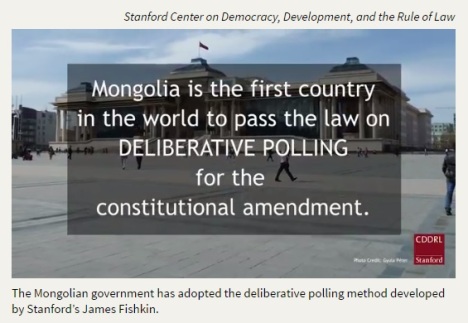
Dear all: I am just off the plane from Mongolia where a national Deliberative Poll considered several proposed elements of a constitutional amendment, as now required by law. National random sample of 669 deliberated a whole weekend and produced results, now with the parliament. Here is a pre-event press report and video:
This development raises interesting possibilities for how citizen deliberation can be institutionalized. Hope you will find it of interest. More information will appear on the http://cdd.stanford.edu web site when available. Best regards to the NCDD list. Jim Fishkin
Of particular interest, the above-linked press release announces:
The Mongolian government recently passed a law requiring that an immersive research method that analyzes public opinion developed by Stanford’s James Fishkin be conducted before its constitution could be amended. According to Fishkin, who devised the process called deliberative polling almost 30 years ago, it marks the first time that a country has incorporated the process into its law. … The measure was supported and passed into law on Feb. 9.
“Le Forme della politica” (Forms of Politics, abbr. FDP) is a an Italian non-partisan association whose objective is to analyze the forms, i.e. the rules of the game and the conceptual premises of the political decisions, in order to make proposals and take action for their improvement. The FDP is based on the teachings of the philosopher Giuseppe Polistena, who is also a co-founder of the association. He intends to correct “Aristotle’s mistake” (his statement that “the man is a political animal”), because politics is the pursuit of the common good and this is not a natural attribute of men and women, but requires a difficult effort in order to be achieved.
The FDP was founded in 2012 and up until 2016 focused on the Italian political sphere. The main themes were: the criteria necessary to guarantee the democratic functioning of political parties, the differences between institutional and political leadership, the limits to parliamentary mandates, and the study of foreign experiences regarding direct democracy and participation.
In 2016 we read and discussed David Van Reybroucks’s outstanding book “Against elections” that showed the intrinsic weaknesses of the electoral-representative democracy and proposed a bi-representative democracy in which sortition plays a relevant role. This was the inspiration for creating the international branch of our association, called “Improving Democracy” (ID), and to launch the “International Sortition Project” (ISP), in which we propose that a small proportion (e.g., 10%) of the members of the elective assemblies at various levels (parliament, regional council, town council, etc.) should be reserved for citizens, who will be able to put themselves forward as candidates for such roles without being part of an organized political force. Continue reading →
Spring is coming and the Sortition Foundation has an action-packed March chock-full of events, not least of which is our second Annual General Meeting happening on Wednesday March 15 at 8:30pm at Mildreds Restaurant in Kings Cross. If you plan on coming along please send us an email to let us know.
Otherwise if you are in (or near) Brighton, London, Bristol, Liverpool, Edinburgh or Cambridge then here is an event or two for your calendar:
If Brexit proved anything, it proved that what Christopher Achen and Larry Bartels say in Democracy for Realists: Why Elections Do Not Produce Responsive Government is true. People do not vote after careful consideration of facts and options, they vote to affirm their membership of various social groups and express agreement with the opinions of those groups, which may have little or nothing to do with the issue at hand being voted upon.
As David Van Reybrouck expressed so eloquently in his article, Why elections are bad for democracy (an extract from his book Against Elections) there is something very wrong with voting and elections and there is a much better way to do democracy: select a representative random sample of ordinary people, provide them with balanced information, and let them deliberate together to find out not what people do think, but what they would think, if given the time and information together with a good deliberative process.
From 11am to 4pm on September 24th, in Cambridge at the Six Bells Pub, a group of volunteers will meet to kick-off the process of bringing Van Reybrouck’s brainchild – a G1000 – to the UK for the first time. The dream is to bring a randomly selected group of 1000 residents together for one day in early 2017, to deliberate and decide together what is best for Cambridge.
But we need your help to make it a reality. We need people to donate their time and their energy to help organise such an event. We will need fundraisers, social media ambassadors, technicians, volunteers, cooks and a whole host of other help. Can you be one of these people? If so please join us, get in touch or come along to the G1000 Kick-off in Cambridge on September 24th.