To an ancient Greek democrat (of any stripe), all our modern democratic systems would count as “oligarchy”. By that I mean the rule of and by – if not necessarily or expressly for – the few, as opposed to the power or control of the people, or the many (demo-kratia).
That is the case even if – and indeed because – the few happen to be elected to serve by (all) the people. For in ancient Greece elections were considered to be in themselves oligarchic. They systematically favoured the few and, more particularly, the few extremely rich citizens – or “oligarchs”
[…T]here are a number of ancient democratic notions and techniques that do seem highly attractive: the use of sortition, for instance – a random method of polling by lottery that aimed to produce a representative sample of elected officials. Or the practice of ostracism – which allowed the population to nominate a candidate who had to go into exile for 10 years, thus ending their political career.
And comparison, or rather contrast, of our democracies with those of ancient Greece does serve to highlight what’s been called creeping crypto-oligarchy in our own very different (representative, not direct) democratic systems. Continue reading →
Paul Frijters is a Professor of Economics at the University of Queensland and an Adjunct Professor at the Australian National University’s Research School of Social Sciences.
Frijters has written a post titled “Would sortition help against corruption?” in which he lays out his thinking about “what is likely to happen to the problem of special interests in Australia in two different scenarios: if we’d select our MPs randomly, or if we’d decide on mayor policies via citizen juries.”
Frijters’s concluding paragraphs:
I used to be quite charmed of the idea of citizen juries for policies and even for deciding on who would be in parliament. It sounded so democratic, such an elegant solution to the problem of special interest groups worming their way into our democratic institutions. It seemed like a magic solution for hard problems.
On reflection though, I find myself on the side of Edmund Burke and Socrates, who both denounced the idea as silly and unworkable. I agree with them: it is hard to see what use small random groups of citizens would be for policy-making in modern Western institutions.
An interesting discussion follows the post, with several discussants who seem to be aware of the idea and who seem to have given it some thought.
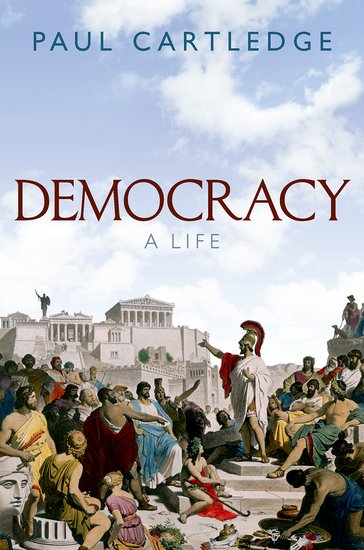
I seem to be reviewing a lot of books lately, including this review of Paul Cartledge’s Democracy: A Life in the Los Angeles Review of Books (cited in a previous post by Peter Stone). While the book covers what will be familiar ground for many here, the author also charts how the idea of ‘people power’ has been treated over the centuries that have elapsed since Athenian democracy. As such, I feel that he (intentionally or unintentionally) made an important contribution to challenging the negative perception that we have of citizen participation by explaining how this view developed over time. Another one to order for the library!
Cartledge goes to some effort to show how later [post-Athens] historians and statesmen were anxious to portray Greek democracy as a horrible mistake, the unworkable aspiration of starry-eyed dreamers that was preprogrammed to end in chaos. Under the onslaught of these propagandists, the vast majority of whom never experienced Athenian democracy — and indeed were often born several hundred years after it ceased to exist — the idea of political equality came to be regarded as a myth, the notion of the collective people holding power a danger to be shunned, suppressed, and preferably forgotten.
The truth was that democracy was a dangerous idea — to the kings, emperors, and high clergy who controlled information in the centuries after it ceased to be a living form of government. As the author puts it, while these autocrats held sway throughout the Middle Ages, the very idea of democracy was “on life-support.” And while things may have improved since, modern democracy is, in Cartledge’s view, not in much better shape — off the machine perhaps, but still staggering around the hospital ward, clutching at bits of furniture, and trying to remember what had happened to bring it there in the first place.
Two new articles argue that allotted bodes are a better democratic tool than referenda. Both criticize the referenda system for asking the public to make uninformed decisions and both invoke the Athenian precedent. There are also some differences for the sharp-eyed reader to pick out.
Let Juries Legislate: Why Citizen Juries Are Better Than the Ballot Initiative for Citizen Lawmaking
Twenty-four US states have the ballot initiative. Unfortunately, the process is heavily skewed in favor of rich interests and unsuitable for making informed decisions. A much better method of citizen lawmaking is needed.
[…]
Classical Athens, often called the birthplace of democracy, sheds light on how citizen lawmaking can be done in an informed, fair and highly democratic way. In Athens, much of the decision-making was done by various juries chosen from the citizens by lottery. This kept a wide range of decisions in the hands of the citizens, prevented elite rule and provided a more informed version of citizen rule than popular vote.
On June 23, Britain will go to the polls to decide whether or not the country should remain a member of the European Union. David Cameron’s in–out referendum on EU membership is, ostensibly, about finding out what the people want. But there is a better, and more democratic, way.
[…]
Referendums are swayed by irrelevant issues, are “very blunt instruments” and the outcome would be “a lottery”, [Peter Mandelson] said. In a sense, Lord Mandelson is right – the experience of countries like Ireland, where referendums are commonplace, suggests that they are often used to give the government of the day a kicking, rather than deal with the issue at hand. And yet a different kind of lottery could be more representative of public opinion than a referendum vote. Continue reading →
Just read a short piece by Paul Cartledge in which he talks about the history of sortition, a topic treated more extensively in his book Democracy: A Life (Oxford University Press). He even manages to plug my own book, The Luck of the Draw: The Role of Lotteries in Decision Making (also Oxford University Press) along the way. Check it out:
It is quite easy to compile a checklist, perhaps even a decalogue, of differences between their democracy (or rather democracies, as there was no one identikit ancient model) and ours (ditto). And in no respect did they and we differ more than on the issue of sortition, that is, the application of the lottery to the conduct of politics (another Greek invention, both the word and the thing, with – again – the accent to be placed on difference as well as similarity between theirs and ours). We today take the exercise of voting in either general or local elections to be the very quintessence of what it is to do ‘democracy.’ The ancient Greeks took the exact opposite view: elections were elitist and for the nobs, appropriate more for oligarchy (the rule of the few rich) than for democracy (the rule of the masses, most of whom were poor), whereas sortition, the lot, was the peculiarly democratic way of selecting most office-holders and all juror-judges to serve in the People’s jury-courts. Continue reading →
Rousseau’s Mistake: Representation and the Myth of Direct Democracy
Abstract: For Rousseau, democracy was direct or it wasn’t. As he famously put it, “the moment a people allows itself to be represented, it is no longer free: it no longer exists. The day you elect representatives is the day you lose your freedom” (Social Contract, III, 15). In other words, representative democracy is no democracy at all. Rousseau isn’t alone in this belief, and today the disappointed of representative government have turned to celebrating anew the virtues of direct democracy as more true to the ideal of popular sovereignty, self-rule, and genuine political equality. This paper defends the thesis that Rousseau was, in fact, mistaken and that there is no salvation to be found in the ideal of direct democracy. If democracy as a political regime is always, in fact, representative, then the interesting question is not: direct or representative democracy? But instead: What kind of representation should we aim for? The paper argues that beyond the familiar electoral model there are at least two other models of representation that present attractive features: the first is based on sortition and the other on self-selection.
Greetings, everyone. Please excuse my long absence, due to – of all things – running in an election. I recently had the pleasure of reviewing ‘Democracy’s Beginning: The Athenian Story’ by Thomas N. Mitchell former Provost of Trinity College, Dublin for the Irish Times:
Alien and fascinating
It is common knowledge that democracy was invented in ancient Athens, but Mitchell explodes the myths of what that democracy was like. In Athens, all citizens had an equal say in public affairs (known as isegoria), staffed enormous citizen juries, were chosen for office by lottery, and were paid to participate in politics. In describing this way of life, Mitchell paints a picture of a society both alien and fascinating, underscoring the vibrancy of this long-lost civilization with a collection of maps and photos in the centre of the book.
His close scholarship shines in documenting the transition of Athens from financially and morally bankrupt oligarchy to emancipated democracy 2,500 years ago. It was not an easy or linear process, and the book tracks the many clashes of ideas and personalities with a commendable attention to detail that beautifully captures the essence of ancient Greek culture and politics.
From Solon’s economic balancing act, through the political reorganisation of Cleisthenes, the assassination of Ephialtes and, finally, Pericles, one of the most respected but sober leaders of the early democracy, Democracy’s Beginning explores this innovative and fearless experiment in “people power”.
Full review here. I would highly recommend the book to anyone interested in Athenian democracy. It is extremely comprehensive and highly readable.
I recently appeared on the Irish Radio show “Talking History.” I was part of a discussion of democracy with Paul Cartledge, the esteemed classicist; Roslyn Fuller, whose work has been discussed on this blog; and Iain Walker, from New Democracy in Australia. Much discussion of Athens and sortition. The show can be heard here:
Sortition, or the selection of political officers by lot, has its antecedent in the direct democratic tradition of ancient Athens. Its transfer into a modern context of representative democracy poses rightful scepticism not only about the practical difficulties, but more so about the theoretical inconsistencies that arise. Modern systems of political representation are based on the aristocratic idea of ‘government by the best’, who are to be selected through a competitive call for candidates (Manin 1997). Sortition, on the other hand, replaces this aristocratic criterion of competition and evaluative election with the democratic mechanics of direct and equal distribution of political office by chance. Hence, the very expression ‘democratic (s)election’ includes a paradoxical contradiction in terms, between the democratic concept of equal access to public office and the aristocratic idea of government by the (s)elected best.
My aim in this chapter is to shed some light into this contradiction by critically discussing the benefits and pitfalls of using sortition today, comparing it throughout the chapter with voting and the general effects of electoral representation. More specifically, my arguments are divided in four sections. I begin by addressing the reasons that drive klerotarians away from electoral representation (1). Next, I consider alternative modes of political ‘outsourcing’, such as the inclusion of civil society actors or the use of quotas (2). I continue by discussing the democratic legitimacy of sortition by dividing the subject in two questions: (a) political equality and (b) political participation (3). Last, I focus on the type of political representation that the lot produces, viewed from the perspectives of descriptiveness, authorization and accountability (4). In conclusion, I suggest that lotteries may offer valuable improvement to current practices of democratic selection, but only if special measures are taken to compensate for the limitations they entail.



 Adam Cronkright
 Ali
Ali Ahmed R. Teleb
 avanderven
 avergne
 Alex Kovner
 azakaras
 Brett Hennig
 campbellwallace
 Simon Threlkeld
 Nick Coccoma
 codyhipskind
 Common Lot Sortitionist
 Conall Boyle
 constitutionalism
 davidschecter
 Ethan McCutchen
 graytmatter
 gtridimas
 Henry Tuttle
 H.J. Hofkirchner
 HpR
HpR James Kierstead
 John Burnheim
 jgarry20151
 Jochen Krattenmacher
 johnedwardtaylor
 johnhuang865
 Jonathan Crock
 keithsutherland
 Jacob Richter
 kkoreilly
 lukewhito
 SimonPek
 Nathan El
 Nicholas Gruen
 Owen Shaffer
 Patrick Chalmers
 Paul Gölz
 peterstone
 Pierre-Etienne Vandamme
 pronfeld
 Emil
Emil rcaze
rcaze richwbrown
 Roger Knights
 roslynfuller
 Pierre-Etienne Vandamme
 shaharavin
 tbouricius
 Ted Wachtel
 Joshua Laferriere
 theodorestathis
 towardsautonomyblog
 Wayne Liebman
 Yoram Gat
 Oliver Milne
