Sortition theory and practice: the G1000 comes to the UK

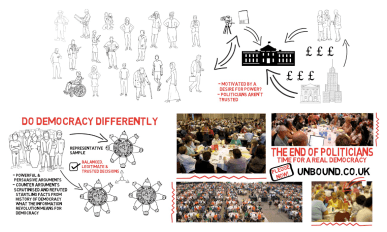
The End of Politicians screeenshotThe “short, powerfully argued and carefully researched” book The End of Politicians, by Sortition Foundation co-founder Brett Hennig, is now 75% funded and well on the way to being published by the crowdfunding publisher, Unbound. You can help get this book to 100% and get published by pledging and pre-ordering it here: https://unbound.co.uk/books/the-end-of-politicians

And the ideas in the book are on the way to becoming a reality – on the 10th and 11th of June Harm van Dijk and Jerphaas Donner, the founders of the G1000 in the Netherlands, are coming to the UK to help launch the G1000 in the UK. The aim of the G1000 is to bring a representative, random selection of people from a community together to deliberate about what they think is most important for their community.

Continue reading

Achen and Bartels: Democracy for Realists: Why Elections Do Not Produce Responsive Government

Via Garreth McDaid.

Political scientists Christopher Achen and Larry Bartels have a new book, Democracy for Realists: Why Elections Do Not Produce Responsive Government.

I have not read the book. Chapter 1 is available online, and it certainly makes for some interesting reading. Some comments following reading that first chapter:

(1) It seems that despite their critique of electoralism the authors are not ready to abandon it. At some point they seem to indicate that they cannot imagine something better when they opine that “[n]o existing government comes close to meeting all of Dahl’s criteria [for democracy]; in our view, no possible government could.” The book’s objective seems purely analytical: to produce “a democratic theory worthy of serious social influence [which] must engage with the findings of modern social science.”

(2) The book appears to adopt the conventional electoralist terminology which makes no clear distinction between electoralism and democracy. The authors should have known better.

(3) “Democracy for realists” seems to largely retrace the elitist democratic theories which rose to prominence in political science in the third quarter of the 20th century. Indeed Joseph Schumpeter and Walter Lippmann – leading propounders of those ideas – make a prominent appearance in the first chapter. Those theories fell out of fashion when, after the civil rights struggles, dominant ideology changed and became incompatible with their conclusions. It may be that the main innovation of the book is not in “engaging with the findings of modern social science”, but in being willing to (re)acknowledge the (now-)inconvenient truths that were buried over the last 40 years or so. In that, the book seems to be very much a product of current politics.

Excerpt:

In the conventional view, democracy begins with the voters. Ordinary people have preferences about what their government should do. They choose leaders who will do those things, or they enact their preferences directly in referendums. In either case, what the majority wants becomes government policy — a highly attractive prospect in light of most human experience with governments. Democracy makes the people the rulers, and legitimacy derives from their consent. In Abraham Lincoln’s stirring words from the Gettysburg Address, democratic government is “of the people, by the people, and for the people.” That way of thinking about democracy has passed into everyday wisdom, not just in the United States but in a great many other countries around the globe. It constitutes a kind of “folk theory” of democracy, a set of accessible, appealing ideas assuring people that they live under an ethically defensible form of government that has their interests at heart.
Continue reading

Paul Cartledge: The case for sortition is persuasive

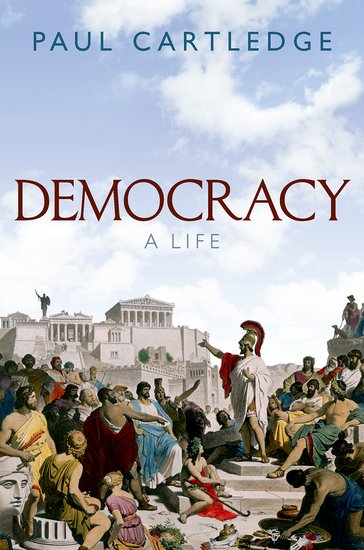
Just read a short piece by Paul Cartledge in which he talks about the history of sortition, a topic treated more extensively in his book Democracy: A Life (Oxford University Press). He even manages to plug my own book, The Luck of the Draw: The Role of Lotteries in Decision Making (also Oxford University Press) along the way. Check it out:

It is quite easy to compile a checklist, perhaps even a decalogue, of differences between their democracy (or rather democracies, as there was no one identikit ancient model) and ours (ditto). And in no respect did they and we differ more than on the issue of sortition, that is, the application of the lottery to the conduct of politics (another Greek invention, both the word and the thing, with – again – the accent to be placed on difference as well as similarity between theirs and ours). We today take the exercise of voting in either general or local elections to be the very quintessence of what it is to do ‘democracy.’ The ancient Greeks took the exact opposite view: elections were elitist and for the nobs, appropriate more for oligarchy (the rule of the few rich) than for democracy (the rule of the masses, most of whom were poor), whereas sortition, the lot, was the peculiarly democratic way of selecting most office-holders and all juror-judges to serve in the People’s jury-courts.
Continue reading

Sortition – Part 2: the book, the AGM, and a strategy

The End of Politicians screeenshotHere’s the latest on the new book on sortition, and two events in London next week: the Citizens’ Parliament strategy meeting, and the Sortition Foundation’s first Annual General Meeting.

Read on for more details on all of the above.

Continue reading

Sortition: the idea, the meeting, and a strategy

[Latest news from the Sortition Foundation blog]

There’s exciting news from the Sortition Foundation:

  • The idea: A new “compelling, inspiring” book on sortition, The End of Politicians, by director and co-founder of the Sortition Foundation, Brett Hennig, is being crowd-funded now by book publisher Unbound: https://unbound.co.uk/books/the-end-of-politicians

The-End-of-Politicians-screeenshot

  • The meeting: The first Sortition Foundation Annual General Meeting will be held at 6pm on Wednesday April 6th in central London. Venue to be confirmed depending on numbers, so please RSVP if you intend to come along.
  • The Strategy: A strategy meeting on how to progress the Citizens’ Parliament campaign (http://www.citizensparliament.uk/) will also be held on Wednesday April 6th from 1-4pm in central London. Exact venue will also depend on numbers, so please RSVP if you want to come along.

Read on for more details on all of the above.

Continue reading

Why I am not a kleroterian

That is because I don’t think equality of power is the supreme objective or that sortition alone is sufficient to achieve it, or many other important objectives.

If we go back to my 1985 book, most of it was devoted to exploring many problems which have only tenuous links with sortition. All that other stuff was ignored, fair enough, and a group formed with “a passionate belief in sortition” as its bond. I, in the other hand have always emphasised that having good people in positions of power is not enough to ensure good outcomes. Everything depends on the procedures and processes by which those outcomes are produced. In particular, where collective decisions are arrived at by following certain procedures, the logic and dynamics of those procedures are just as important to the outcome as the input fed into them.

Moreover, I want to insist that while we can best understand the logic of such procedures, by studying simple models, the dynamics are always a matter of what works under what conditions and on what scale. For instance decision procedures depend on information flows, which depend on technologies of recording, storing, retrieving and circulating relevant information rapidly enough and in such quantities as the time available demands. What “ought to work” often doesn’t, as we all know.
Continue reading

Book Review: Democracy’s Beginning

Greetings, everyone. Please excuse my long absence, due to – of all things – running in an election. I recently had the pleasure of reviewing ‘Democracy’s Beginning: The Athenian Story’ by Thomas N. Mitchell former Provost of Trinity College, Dublin for the Irish Times:

Alien and fascinating

It is common knowledge that democracy was invented in ancient Athens, but Mitchell explodes the myths of what that democracy was like. In Athens, all citizens had an equal say in public affairs (known as isegoria), staffed enormous citizen juries, were chosen for office by lottery, and were paid to participate in politics. In describing this way of life, Mitchell paints a picture of a society both alien and fascinating, underscoring the vibrancy of this long-lost civilization with a collection of maps and photos in the centre of the book.

His close scholarship shines in documenting the transition of Athens from financially and morally bankrupt oligarchy to emancipated democracy 2,500 years ago. It was not an easy or linear process, and the book tracks the many clashes of ideas and personalities with a commendable attention to detail that beautifully captures the essence of ancient Greek culture and politics.

From Solon’s economic balancing act, through the political reorganisation of Cleisthenes, the assassination of Ephialtes and, finally, Pericles, one of the most respected but sober leaders of the early democracy, Democracy’s Beginning explores this innovative and fearless experiment in “people power”.

Full review here. I would highly recommend the book to anyone interested in Athenian democracy. It is extremely comprehensive and highly readable.

A review of Landemore’s Democratic Reason

A review of Landemore’s Democratic Reason by Alfred Moore published in Contemporary Political Theory:

Landemore argues that rule by the many is better than rule by the few or the one because it can harness ‘democratic reason’. Democratic Reason refers to the collective political intelligence of the many, which in turn is a function of individual epistemic competence and the cognitive diversity of the group. [S]he claims that a group containing diverse perspectives, interpretations, heuristics and predictive models, will be better at making decisions than a less diverse group of people, even if they are individually smarter. As the key feature of democracy is that it is an inclusive decision procedure, and inclusion tends to increase cognitive diversity, democracies are likely to outperform rival regime types.

The Demarchy Manifesto

71157100257740l

Many kleroterians are bound to be disappointed in my new book The Demarchy Manifesto, due to be release from Imprint Academic on March 1, because it makes no proposals for replacing voting in favour of sortition in existing institutions, but only in the new voluntary institutions I propose. I believe it is necessary to start this way, since it is extremely difficult to persuade people to give up their vote, but they are prepared to consider sortition where it gives them access to a chance of participating that they do not at present have. This is just an instance of a general pattern in the way that the presentation of options makes a great difference to the evaluations people make of alternatives. You might like to look at this article in the US edition of The Conversation for February 6.

The book suggests that we can snatch the initiative in discussing and formulating public policy from the political parties and produce proposals that they have to accept on pain of voter backlash. I think that there is just a chance that my proposals would consolidate the middle ground whereas the existing procedures encourage the extremes. More fundamentally I aim to move attention from “who gets what” to the sort of public goods that we all can take pride in.

An excerpt from the Introduction to the book:

What I call ‘demarchy’ is primarily a process of transferring the initiative in formulating policy options from political parties to councils representative of the people most directly affected by those policies. The task of those councils would be to distil from public discussion the most acceptable policy in a particular matter. It would be up to voters to insist that the politicians heed them. There is no question of constitutional change, no new parties or new laws, no call for a mass conversion of opinion, but a suggestion about how to initiate a change in accepted practice, starting with actions that may seem of little significance in the big picture, but are still justified by their specific purposes. My focus is on how policy is produced and adopted. I am not concerned with questions about the philosophical basis of state power, or human rights, or crime and punishment. The precise forms these things take in practice are a matter of conventions, which I do not propose to challenge. There is already much debate about these matters. I am concerned about what I see as a more important, but neglected, question.

I begin by concentrating on how to establish some new practices and initiatives in policy formation, empowering those most affected to take the initiative in formulating what they want. It is no advantage to have a choice of products if none of those on offer meets your requirements. The best situation is to be able to say exactly what you want and commission specialists to supply it. Or is that analogy anachronistic and inappropriate in the era of mass production and distribution? I try to analyse our unique problems. My ultimate aim is to transform our political culture. I intend to show how different practices of policy formation are appropriate to different problems at every level from the local to the global and how they might come to be accepted.
Continue reading

The Paradox of Democratic Selection: Is Sortition Better than Voting?

A draft book chapter by Anthoula Malkopoulou:

Sortition, or the selection of political officers by lot, has its antecedent in the direct democratic tradition of ancient Athens. Its transfer into a modern context of representative democracy poses rightful scepticism not only about the practical difficulties, but more so about the theoretical inconsistencies that arise. Modern systems of political representation are based on the aristocratic idea of ‘government by the best’, who are to be selected through a competitive call for candidates (Manin 1997). Sortition, on the other hand, replaces this aristocratic criterion of competition and evaluative election with the democratic mechanics of direct and equal distribution of political office by chance. Hence, the very expression ‘democratic (s)election’ includes a paradoxical contradiction in terms, between the democratic concept of equal access to public office and the aristocratic idea of government by the (s)elected best.

My aim in this chapter is to shed some light into this contradiction by critically discussing the benefits and pitfalls of using sortition today, comparing it throughout the chapter with voting and the general effects of electoral representation. More specifically, my arguments are divided in four sections. I begin by addressing the reasons that drive klerotarians away from electoral representation (1). Next, I consider alternative modes of political ‘outsourcing’, such as the inclusion of civil society actors or the use of quotas (2). I continue by discussing the democratic legitimacy of sortition by dividing the subject in two questions: (a) political equality and (b) political participation (3). Last, I focus on the type of political representation that the lot produces, viewed from the perspectives of descriptiveness, authorization and accountability (4). In conclusion, I suggest that lotteries may offer valuable improvement to current practices of democratic selection, but only if special measures are taken to compensate for the limitations they entail.

Full text (uncorrected draft: not for citation).