Posted on February 8, 2016 by John Burnheim

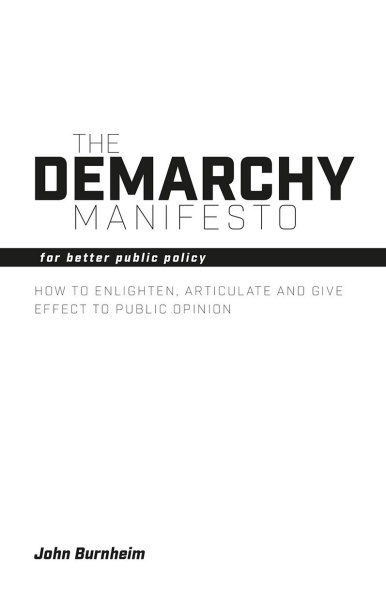
Many kleroterians are bound to be disappointed in my new book The Demarchy Manifesto, due to be release from Imprint Academic on March 1, because it makes no proposals for replacing voting in favour of sortition in existing institutions, but only in the new voluntary institutions I propose. I believe it is necessary to start this way, since it is extremely difficult to persuade people to give up their vote, but they are prepared to consider sortition where it gives them access to a chance of participating that they do not at present have. This is just an instance of a general pattern in the way that the presentation of options makes a great difference to the evaluations people make of alternatives. You might like to look at this article in the US edition of The Conversation for February 6.
The book suggests that we can snatch the initiative in discussing and formulating public policy from the political parties and produce proposals that they have to accept on pain of voter backlash. I think that there is just a chance that my proposals would consolidate the middle ground whereas the existing procedures encourage the extremes. More fundamentally I aim to move attention from “who gets what” to the sort of public goods that we all can take pride in.
An excerpt from the Introduction to the book:
What I call ‘demarchy’ is primarily a process of transferring the initiative in formulating policy options from political parties to councils representative of the people most directly affected by those policies. The task of those councils would be to distil from public discussion the most acceptable policy in a particular matter. It would be up to voters to insist that the politicians heed them. There is no question of constitutional change, no new parties or new laws, no call for a mass conversion of opinion, but a suggestion about how to initiate a change in accepted practice, starting with actions that may seem of little significance in the big picture, but are still justified by their specific purposes. My focus is on how policy is produced and adopted. I am not concerned with questions about the philosophical basis of state power, or human rights, or crime and punishment. The precise forms these things take in practice are a matter of conventions, which I do not propose to challenge. There is already much debate about these matters. I am concerned about what I see as a more important, but neglected, question.
I begin by concentrating on how to establish some new practices and initiatives in policy formation, empowering those most affected to take the initiative in formulating what they want. It is no advantage to have a choice of products if none of those on offer meets your requirements. The best situation is to be able to say exactly what you want and commission specialists to supply it. Or is that analogy anachronistic and inappropriate in the era of mass production and distribution? I try to analyse our unique problems. My ultimate aim is to transform our political culture. I intend to show how different practices of policy formation are appropriate to different problems at every level from the local to the global and how they might come to be accepted.
Continue reading →
Filed under: Academia, Books, Proposals, Sortition | 49 Comments »
Posted on January 6, 2016 by keithsutherland
A draft book chapter by Anthoula Malkopoulou:
Sortition, or the selection of political officers by lot, has its antecedent in the direct democratic tradition of ancient Athens. Its transfer into a modern context of representative democracy poses rightful scepticism not only about the practical difficulties, but more so about the theoretical inconsistencies that arise. Modern systems of political representation are based on the aristocratic idea of ‘government by the best’, who are to be selected through a competitive call for candidates (Manin 1997). Sortition, on the other hand, replaces this aristocratic criterion of competition and evaluative election with the democratic mechanics of direct and equal distribution of political office by chance. Hence, the very expression ‘democratic (s)election’ includes a paradoxical contradiction in terms, between the democratic concept of equal access to public office and the aristocratic idea of government by the (s)elected best.
My aim in this chapter is to shed some light into this contradiction by critically discussing the benefits and pitfalls of using sortition today, comparing it throughout the chapter with voting and the general effects of electoral representation. More specifically, my arguments are divided in four sections. I begin by addressing the reasons that drive klerotarians away from electoral representation (1). Next, I consider alternative modes of political ‘outsourcing’, such as the inclusion of civil society actors or the use of quotas (2). I continue by discussing the democratic legitimacy of sortition by dividing the subject in two questions: (a) political equality and (b) political participation (3). Last, I focus on the type of political representation that the lot produces, viewed from the perspectives of descriptiveness, authorization and accountability (4). In conclusion, I suggest that lotteries may offer valuable improvement to current practices of democratic selection, but only if special measures are taken to compensate for the limitations they entail.
Full text (uncorrected draft: not for citation).
Filed under: Academia, Athens, Ballot measures, Books, Elections, Participation, Sortition, Theory | 26 Comments »
Posted on October 2, 2015 by Yoram Gat
The St. Louis Post Dispatch reports:
Global movement towards representative legislatures
St. Louis, Missouri, 18 October: A world-wide movement towards establishing legislative bodies that are fully representative finds expression in the staged reading of “Our Common Lot” by David Grant. The short play is written for an international conference, “Democracy for the 21st Century,” to be held in December at the Library of Alexandria, Egypt.
In the play, Marisa, Alma, Sami, and Ali live in a city embroiled in conflict and violence — the Regime, the Opposition, the Opposition to the Opposition. When the fighting stops, they ask themselves: What is the best way to move forward? “Our Common Lot” argues for choosing legislators in the way that the first democracy did – by random lot, known as ‘sortition.’
In the original Athenian democracy, sortition was regarded as a principal characteristic of democracy. Most recently the city of Melbourne, Australia has used a random sample of citizens to determine its ten-year financial plan. Two-thirds of the recent Irish Constitutional Convention was composed of sortitionally-chosen citizens.
The reading of “Our Common Lot” is its world premiere. The ensemble includes Adam Flores, Carl Overly, Jr., Erin Roberts, and Jacqueline Thompson.
Continue reading →
Filed under: Action, Books, Fiction, Press, Sortition | 1 Comment »
Posted on September 28, 2015 by Ahmed R. Teleb

Hélène Landemore’s book Democratic Reason won the 2015 Spitz Prize for work in democratic theory.
That makes the second Spitz (for outstanding work in democratic theory) to a Sortinista in three years, following John McCormick’s Machiavellian Democracy in 2013.
Filed under: Academia, Books, Sortition | Comments Off on News: Democratic Reason wins 2015 Spitz Prize for work in democratic theory
Posted on September 19, 2015 by Yoram Gat
This topic came up recently. Here is the most thorough discussion of this matter in the primary sources that I am aware of. Aristotle is describing here (Politics, 1317a-1318a) what he considers as the conventional wisdom of his time:
And for this inquiry we must take into view all the features that are popular and that are thought to go with democracies; for it comes about from combinations of these that the kinds of democracy are formed, and that there are different democracies and more than one sort. In fact there are two causes for there being several kinds of democracy, first the one stated before, the fact that the populations are different (for we find one multitude engaged in agriculture and another consisting of handicraftsmen and day-laborers, and when the first of these is added to the second and again the third to both of them it not only makes a difference in that the quality of the democracy becomes better or worse but also by its becoming different in kind); and the second cause is the one about which we now speak. For the institutions that go with democracies and seem to be appropriate to this form of constitution make the democracies different by their combinations; for one form of democracy will be accompanied by fewer, another by more, and another by all of them. And it is serviceable to ascertain each of them both for the purpose of instituting whichever of these kinds of democracy one happens to wish and for the purpose of amending existing ones. For people setting up constitutions seek to collect together all the features appropriate to their fundamental principle, but in so doing they make a mistake, as has been said before in the passage dealing with the causes of the destruction and the preservation of constitutions. And now let us state the postulates, the ethical characters and the aims of the various forms of democracy.
Continue reading →
Filed under: Athens, Books, Elections, History, Participation, Sortition | 57 Comments »
Posted on August 26, 2015 by campbellwallace

My book “DOWN WITH ELECTIONS!” will be available as an e-book on Amazon and Smashwords from 1st September for the princely sum of 99c US or equivalent. It’s a revised and corrected version of the articles published earlier on this forum.
The links are:
Smashwords (epub, most ebook readers), Amazon (mobi – Kindle).
Readers of this forum can have it free from my Dropbox account. It would be nice if you post a comment on Amazon or Smashwords. (Thanks)
Dropbox links:
epub, mobi, HTML, PDF, ODT, DOC.
Filed under: Books, Sortition | 2 Comments »
Posted on May 18, 2015 by Common Lot Sortitionist

A new book by Shaazke Beyerle, Curtailing Corruption: People Power for Accountability and Justice, describes grassroots efforts around the world to fight corruption.
In one of the cases described a randomly chosen group of regular citizens in Korea served as a ‘citizen jury’ that confirmed results of an investigation into political corruption. The outcome of this ‘people power’ campaign was that over 50% (58 out of 112) of the politicians identified as corrupt dropped out of the race, and of the blacklisted candidates who did run, 68% (59 out of 86) were defeated.
Filed under: Applications, Books, Juries, Sortition | Tagged: Korea | Leave a comment »
Posted on May 13, 2015 by Yoram Gat
Manuel Arriaga‘s Foreign Policy magazine article is a well-aimed, much needed corrective to the techno-progressivist formula of popular political theory:
Democracy Does Not Live by Tech Alone
Democracy is in crisis — and more apps won’t save it. Instead, bring decision-making back to the people.
Enthusiasm for reforming our democracies has been gaining momentum. From the pages of FP to the colorful criticisms of comedian Russell Brand, it is evident that a long-overdue public conversation on this topic is finally getting started.
There is no lack of proposals. For example, in their recent FP piece, John Boik and colleagues focus on decentralized, emergent, tech-driven solutions such as participatory budgeting, local currency systems, and open government. They are confident that such innovations have a good chance of “spreading virally” and bringing about major change. Internet-based solutions, in particular, have captured our collective imagination. From Pia Mancini’s blockbuster TED presentation to New Scientist‘s recent coverage of “digital democracy,” we’re eager to believe that smartphone apps and novel online platforms hold the key to reinventing our way of governance. This seems only natural: after all, the same technologies have already radically reconfigured large swaths of our daily lives.
To put it bluntly, I believe that focusing on innovations of this sort is a dangerous distraction. Continue reading →
Filed under: Athens, Books, History, Participation, Sortition | Tagged: Manuel Arriaga, technology | 1 Comment »
Posted on January 10, 2015 by Yoram Gat
Claudia Chwalisz writes in 3am magazine:

Representative democracy today seems to be at an impasse. Low voter turnout, falling party membership, plummeting trust in politicians, the fierce rise of populist parties. These trends, together with political fragmentation, disengagement among young generations, and backlash against the political elite who have failed to govern responsibly, highlight democracy’s dilemma. Though much has been written about this democratic crisis, less has been proposed in terms of solutions. Belgian historian David Van Reybrouck’s recent book, Contre les élections [Against Elections], attempts to fill this gap of ideas. Although it has not yet been translated into English, as is obvious from what I discuss below, his analyses are critically important in the current climate.
Chwalisz’s long article mostly revolves around Van Reybrouk’s book, but also mentions Gilens and Page. She seems to some extent skeptical of Van Reybrouck’s progressivist outlook and ends thusly:
[T]he dilemma of how to get elected elites to relinquish their grip on the seats of power remains unresolved. Perhaps the starting point is to question ourselves: are we, in fact, electoral fundamentalists?
Filed under: Athens, Books, History, Juries, Press, Proposals, Sortition | 4 Comments »
Posted on November 1, 2014 by avanderven
On Sunday, September 29th 2013 in a Dutch TV series named Buitenhof the word Lottocracy (Dutch: lottocracy), although casually, for the first time was used in public in Holland. There was an interview with David Van Reybrouck about his new book ‘Against elections’. Great, that the idea of Lottocracy was mentioned for the first time in the Dutch media. The broadcast can be viewed by clicking below:
http://www.uitzendinggemist.nl/afleveringen/1368517
However, van Reybrouck did not mention in the program nor in his book, that the idea of lottocracy has already been discussed extensively in the book ‘The World Solution for World Problems’, especially in the chapter ‘A Concept for Government’. The book was already published in 1988. The book is available as an electronic book at:
http://www.picarta.nl/
The book can also be read directly on Internet at the address:
http://www.socsci.kun.nl/~advdv/leonbook/leonbook.html
Continue reading →
Filed under: Books, Elections, Sortition | Leave a comment »