Queuing vs. Lotteries

I was watching a talk by Michael Sandel yesterday dealing with his book What Money Can’t Buy: The Moral Limits of Markets (2012). He discusses the fact that people have to queue to attend congressional hearings, federal court hearings, etc. Apparently, you can hire someone to wait in line (all night, if need be) to save your place for you. There are even services that you can contact that specialize in this.

There is often discussion about whether lotteries and queues are interchangeable, equivalent, etc. It strikes me that this is a clear case where a lottery would be superior to a queue. (Not sure if they discuss lotteries at all in here, as I haven’t had the time to finish the video yet.)

Sandel’s talk can be found here:

Epistemic Democracy and Sortition

In order to spark a discussion of the significance or relevance of “epistemic democracy” to the use of randomly selected assemblies, juries, or other minipublics, I paste my (very positive) review of Democratic Reason. A short paper by David Estlund called “Introduction to Epistemic Approaches to Democracy” names at least four flavors of epistemic democracy. I believe Landemore’s is it’s “purest” form and therefore a good one to discuss.

How relevant or significant is the epistemic approach? How relevant or significant is the work on diversity and group decision making? How much does all this depend on empirical work not yet done by political scientists?

What empirical studies are out there that Kleroterians would recommend to other sortinistas and to the general public?

Review of Democratic Reason

This book follows the recent trend in democratic theory termed “epistemic democracy” in a novel way. Rather than relying on liberal philosophy or an analogy with science, it begins with results in mathematics, decision theory, psychology and cognitive science. It also mentions an evolutionary basis for the superiority of group decision making.
Continue reading

Skin-in-the-game Argument: Citizen Warriors and Origins of Democracy

In First Democracy: The Challenge of an Ancient Idea, Paul Woodruff argues that democracy became and remained the Athenian form of government for mainly two reasons:

1) It ended class warfare and created a harmonious community.

but perhaps more importantly,

2) It provided free citizen warriors (in the form of naval rowers) who identified with the state and were therefore willing to make sacrifices for it.

Woodruff says that if so many rowers were not needed for Athenian navies’ ships, elites may not have allowed the people (the many) to wield as much power as they did.

Being not at all a historian, I ask those who know more about ancient history to agree or disagree with the above assessment.

Did military need provide the conditions for democracy in Athens?

Does the state (or elites) today need something in exchange for genuine democracy?

What would today’s state (or elites) want from the people in return? Citizen consumers?

[I hope there is something less cynical than my last suggestion.]

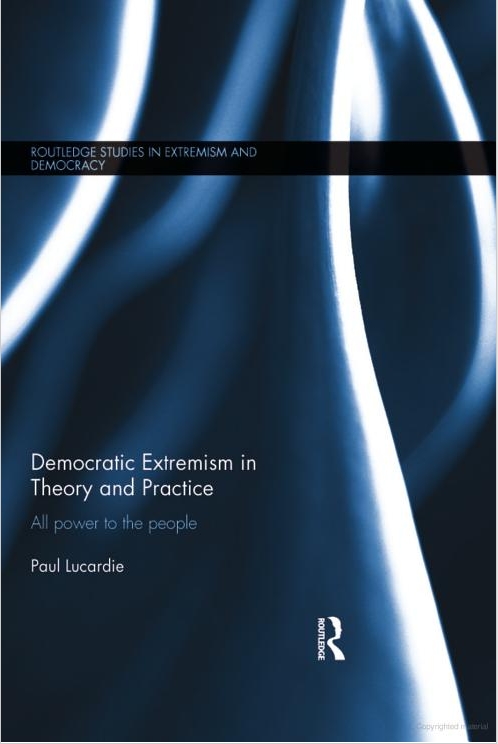
Paul Lucardie: Democratic Extremism

Paul Lucardie sent the following excerpts from his new book ‘Democratic Extremism in Theory and Practice. All power to the people’ (London: Routledge, 2014).

democratic-extremism

Author’s comment: Democratic extremism may appear to be an oxymoron, as ‘democracy’ is usually associated with moderation, pluralism and tolerance. Yet one could also regard democratic extremism as the opposite of autocratic and aristocratic extremism: whereas the latter imply that all decisions are taken by a dictator, a class of landowners or perhaps (in a more modern variety) the Central Committee of a ruling Communist Party, the former means that all decisions are taken by the people and that a political elite does not play any significant role. Examples of extreme democracy are rare, as far as I could find out. More common are cases of what I would call radical democracy: not all decisions but most important decisions are taken by the people, some are left to a political elite. Even more common, however, are mixed regimes where most decisions are taken by an elected aristocracy (professional politicians) and some by the people. In fact most so-called representative democracies are, in my opinion, mixed regimes, if not elective aristocracies.
Continue reading

2013 review – sortition-related events

Ahmed Teleb suggested the following as the most noteworthy sortition-related events of 2013:

  • the publication of Hélène Landemore’s book, Democratic Reason: Politics, Collective Intelligence, and the Rule of the Many, which has a section called “Elections versus Random Selection”:

    Random lotteries would indeed produce what is known as ‘descriptive representation’ of the people […] ensuring statistical similarity of thoughts and preferences of the rulers and the ruled.” (p. 108),

    and

  • Continue reading

Discussions of sortition in German?

Does anyone know of organizations, publications or websites that discuss sortitional selection of legislatures in German?

Teleb: If Crowds Are Wise, Why Isn’t Congress?

Ahmed Teleb makes the wisdom-by-diversity argument against elections and more specifically against first-past-the-post systems:

We’ve all heard of the “wisdom of crowds” especially after James Surowiecki’s 2004 best-selling book by that name and Scott Page’s 2007 “The Difference.” […]

So why does the US Congress, a crowd of 535, seem so remarkably un-wise?
Continue reading

Un-vote for a new America

A 1976 book named Un-vote for a new America by Ted Becker, Paul Szep and Dwight Ritter* offers, among other ideas for political reform, the idea of using sortition for selecting half the members of the U.S. Congress:

[I]f the reader makes even the most superficial survey of the world’s “democracies” particularly zeoring in on the national legislatures, it will be obvious that they are all dominated by elites, business or political. All of them claim to represent the people; obviously they don’t. They merely represent the elites’ view of what is in the “public interest” and we are told, correspondingly, that what they decide to be the public interest is, ipso facto, the public interest.
Continue reading

David Van Reybrouck: Against elections

Ad van der Ven wrote to draw attention to David Van Reybrouck’s argument in favor of sortition. Van Reybrouck is a prize winning Flemish Belgian author writing historical fiction, literary non-fiction, novels, poetry, plays and academic texts.

His latest book is Tegen verkiezingen (Against elections) (machine translation with my touch-ups):

Our representative democracy is increasingly in the doldrums. Its legitimacy is affected: fewer and fewer people vote, voters are less predictable in their choice, and the membership of political parties is decreasing dramatically. It is the efficiency of less democracy: since long term government is problematic, politicians increasingly align their policies to the next election. It all leads to what is called by David Van Reybrouck democratic fatigue. But how do tackle it? Papering over the cracks – that is what is happening now mainly. There are some renovation trends here and there. Reybrouck fears that this kind of marginal solutions is no longer sufficient and that the existing system will result in more and more crises.
Continue reading

A theory of sortition, part 2 of 2

Part 1 is here.

Extension of self-representation

Like many other authors discussing sortition (Dahl, Leib, Zakaras, Fishkin, and others), Stone and Dowlen choose, then, to drastically downgrade sortition from a tool of radical democratic reform (as presented by C&P, or earlier by C.L.R. James) to an add-on to the electoral system. Such a retreat is certainly not warranted by the theoretical considerations discussed in the first part of the article. The claim that sortition can be expected to produce good government can be put on a much more solid theoretical foundation than the faulty intuitive argument provides. An alternative argument works by employing the properties of sampling in order to extend self-representation of the decision-making group into representation of the entire population. It goes as follows:

  1. A small group of people, under reasonably favorable conditions, is able to represent its own interests. This claim is not directly associated with sortition, but is rather a claim about the political dynamics of small groups of people in general. The claim is that when a small group of people, meeting on an a-priori egalitarian basis, has the opportunity to make collective decisions that would promote the interests of the members as they perceive them, then it will tend to do so. This is a situation which most people would be familiar with – group decision making in the family, within a group of friends or with colleagues. “A small group” is taken to be a group in which all-to-all communication is possible. The upper size limit of such a group would depend on the circumstances, but even under the most favorable circumstances a few hundred people seems like the most that would fit the description.
  2. Policy that promotes the interests of a small group of people which are selected as a sample of a larger group will tend to promote the interests of the larger group as well. Since the interests of a group selected as a sample of a larger group are typical of those of the entire group, policy that promotes the interests of the sample would tend to promote the interests of the group. In particular, if a certain policy promotes the interests of a majority of the members of the sample then that policy is likely to promote the interests of a majority in the population. There would be some obvious exceptions to this extension from sample to population. Policy that applies directly to the members of the sample in their role as members – their salaries for example – affects interests for which the sample members are very atypical. In a government by sortition such exceptions would have to be treated separately.

Continue reading