Understanding the present by listening to the past: Walter Lippmann’s “The Public Philosophy”

I thought readers of this blog might be interested in a post I’ve just put on my own blog on Walter Lippmann’s The Public Philosophy. It does not directly reference sortition, but I think it’s an excellent illustration of the value that sortition can bring — and it provides a corroborative context for the ideas I sketched out here.

oooOOOooo

One way to get beneath the surface of what’s going on is to read people who were writing about issues as they emerged rather than in more modern times when they’d become the norm and become infused in our commonsense.

I was browsing in one of the few remaining second-hand bookshops around (as is my wont) when I came upon Walter Lippmann’s 1955 book, The public philosophy. Walter Lippmann was one of the great journalists and thinkers of the 20th century. He wrote a series of books that were landmarks in their day, despite uniformly bland titles. Public opinion. The good life. And this one — The public philosophy

Reading part 1. I was shocked to discover a critique of democracy that I had not really crystallised for myself. It comprehends two tendencies both of which are at their most disastrous in the avoidance of war on the one hand and the fighting of wars on the other.

In the first place there’s what I’ll call temporal mismatch. It can take an electorate years to catch up with emerging developments and so public opinion can be a disastrous guide to the exigencies of a particular situation. A further aspect of public opinion is its capacity for wild swings in sentiment which I’ll call temperamental amplification.

Lippmann explains how democracies wildly overshoot. They’re not good at avoiding war by preparing properly for it. It is easy to understand why that is. Wars are very expensive. So preparing for them is expensive too. That means that politicians get the choice between warning the electorate and preparing for war and winning elections. If they call for more military spending their democratic opponent will say that it can be handled without serious financial pain — either because the threat is overblown or because it can be managed via borrowing or some other evasively defined expedient.

Then as war looms larger, far greater sacrifice than would otherwise have been necessary is called for, alongside industrial scale demonisation of the enemy. We’re somewhat familiar with this narrative from WWII, but Lippmann extends it back to the insouciance of war before WWI, the imposition of the Carthaginian Peace of 1919 which in humiliating Germany made Round Two of the Great War all the more likely. (Lippmann became fast friends with Keynes when they were both in Versailles. Coming to terms with the cataclysm of that war and its peace burned itself deeply into both men’s thought.)

Of course, this is directly relevant to today’s circumstances where the economic hangover from both COVID and Europe’s first major war in eighty years is intensifying the scarcity of energy and food, and in so doing undermining living standards. A further demand is to get Ukraine the arms it needs to fight off the Russians — but that’s expensive too.

But how much are our political leaders leveling with their populations? They’re not of course. Because to do so they’d have to say something like “Here’s the plan. We need to reduce living standards compared to what they would otherwise be by 2-3%. Then their opponents will denounce this as the counsel of despair and incompetence and come out and say they can do all they need to do without such hardship.

An extract from Lippmann is over the fold.

Continue reading

Beaudet: Let us push the frontiers of democracy

Thierry Beaudet is the President of the French Economic, Social and Environmental Council (CESE), the body which organized the French allotted bodies which discussed environmental policy and end-of-life policy. He has now published a book in which he advocates the use of sortition as a tool of democracy. The book is described by the publisher as follows:

The trappings of our democracy are falling apart: elections are no longer adequate for the task, and there is general distrust toward every authority and every power. Facing this crisis, new political practices assert themselves, practices which engage and refer to the citizen body. Citizen participation, still in its beginning in our country, must develop, through sortition, the exercising of collective deliberation, the systematic collaborative construction of public policy. Thierry Beaudet, the President of the Economic, Social and Environmental Council, proposes that we learn how to remake democracy and to discuss together substantive issues rather than keep rehashing divisions in a vacuum.

Bertrand Russell on Athenian democracy

In his 1945 book History of Western Philosophy Betrand Russell writes the following (p. 74):

Athenian democracy, though it had the grave limitation of not including slaves or women, was in some respects more democratic than any modern system. Judges and most executive officers were chosen by lot, and served for short periods; they were thus average citizens like our jurymen, with the prejudices and lack of professionalism characteristic of average citizens.

It is remarkable that the reason given for the Athenian system being more democratic than modern systems is not the standard superficial argument about the Assembly voting directly on laws. Russell’s appeal to the fact that Athenian judges and officers had, as a result of being chosen by lot, the same outlook as the average citizen is an adumbration of Manin’s pure theory of elections (“the principle of distinction”).

Maurice Pope’s The Keys to Democracy is now available

Hugh Pope writes:

I’m writing to share details about the publication of the book that has been my special project over the past 18 months: The Keys to Democracy: Sortition as a New Model for Citizen Power, by my late father, the classicist Maurice Pope.

The back story: my dad wrote the book in the 1980s, but, perhaps because it was ahead of its time, his usual publishers wouldn’t take it. We had thought the work was lost well before he passed away in 2019. But two years ago, while sorting through his library, my mother found the typescript.

As my brother Quentin and I edited the text, we consulted several experts and were urged on by messages back telling us that the book was “masterful”, “bold”, “visionary” and more (you can see all their endorsements here). Dr. Hélène Landemore of Yale University and Cambridge classicist Dr. Paul Cartledge generously wrote a preface and an introduction. With many such helping hands, we found a publisher at UK philosophy specialists Imprint Academic. The book went on sale on 7 March.

Back in the 1980s, few others proposed that randomly selected citizens could, after proper information and deliberation, reach better decisions than elected politicians. This open field is perhaps one reason for the book’s unique and accessible combination of the history, mathematics, philosophy and future of sortition. My dad’s ideal – in which random selection could be the decision-making heart of all branches of government – also makes him more radical than most other thinkers writing today.
Continue reading

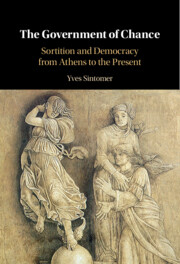
Sintomer: The Government of Chance

French political scientist Yves Sintomer has published a new book dealing with sortition called The Government of Chance: Sortition and Democracy from Athens to the Present.

The publisher, Cambridge University Press, provides a(n apparently auto-translated) book description:

Electoral democracies are struggling. Sintomer, in this instructive book, argues for democratic innovations. One such innovation is using random selection to create citizen bodies with advisory or decisional political power. ‘Sortition’ has a long political history. Coupled with elections, it has represented an important yet often neglected dimension of Republican and democratic government, and has been reintroduced in the Global North, China and Mexico. The Government of Chance explores why sortation is returning, how it is coupled with deliberation, and why randomly selected ‘minipublics’ and citizens’ assemblies are flourishing. Relying on a growing international and interdisciplinary literature, Sintomer provides the first systematic and theoretical reconstruction of the government of chance from Athens to the present. At what conditions can it be rational? What lessons can be drawn from history? The Government of Chance therefore clarifies the democratic imaginaries at stake: deliberative, antipolitical, and radical, making a plaidoyer for the latter.

Continue reading

Martin Wolf on Democratic Capitalism (and me as it turns out!)

Martin Wolf is talking up a storm on the crisis of democratic capitalism, and he’s supporting sortition as you can hear from around 11 minutes in where I’ve set it up to begin.

In case you’re interested, here’s the presentation he gave before the panel session recorded above.

Snell: Countries obsessed with sortation likely to be inward looking and self-obsessed

As they describe themselves, James Snell is a senior advisor at the New Lines Institute, currently writing a book on the war in Afghanistan. The New Lines Institute for Strategy and Policy is a nonprofit and non-partisan think tank in Washington D.C. working to enhance U.S. foreign policy based on a deep understanding of the geopolitics of the different regions of the world and their value systems.

Snell has a piece in Politico where he expresses his concern about the dangers of what he consistently calls “sortation”. Snell’s concern has seemingly been triggered by the upcoming posthumous publication of Maurice Pope’s book “The Keys to Democracy”.

[T]he ancient Athenians — so admired by the founders of the United States — were ruled by a boule, or a council, where the positions were filled by lot. The same went for Athens’ courts, and Roman juries after the founding of their republic.

There’s something romantic about this notion of a non-representative democracy, of government formed by citizens rather than their elected delegates — so romantic, in fact, that it’s making a comeback.
Continue reading

Sortition in 2022

Equality-by-Lot’s traditional yearly review post.

The most significant piece of sortition-related news for 2021 had been, in my view, the finding that over a quarter of public in four Western European countries – the UK, France, Italy and Germany – supports using allotted bodies to systematically complement the work of parliament. This year, the most significant piece of sortition-related news was the findings of a wider-coverage poll, this time conducted in 15 Western European countries. According to this poll, in all those countries there is fairly strong popular support (~4 in a scale of 0 to 10 on average) for having “a group of randomly-selected citizens make decisions instead of politicians”.

But while popular support for sortition is strong, and while (well justified) concern in elite circles about the declining popularity of the elections-based system persists, it seems to me that 2022 has continued a down-trend in interest in sortition in elite circles, a down-trend that indicates a recovery from the heights of establishment hysteria about the “Crisis of Democracy” following Brexit, the election of Donald Trump and the Gilets Jaunes protest in France. Academics have continued publishing papers and opinions on the pros and cons of sortition (unfortunately often rehashing very well hashed material) but applications of sortition have been fading in prominence since the zenith of the French Citizen Convention for the Climate, and discussion of the idea in mass media has receded as well.

That said, there were certainly many notable pieces of news and opinion written about sortition over the last year. Pieces advocating for sortition and discussions of the subject that were mentioned this year on Equality-by-Lot included items from South Africa, the UK: 1, 2, the US: 1, 2 3, 4, 5, 6, Australia, Malaysia, Texas, US, France, Ireland, Utah, US, California, US, Pakistan, Pennsylvania, US, and Massachusetts, US.

Also this year, an allotted council on climate change in Herefordshire, UK generated a discussion about its cost as well as other aspects. A fairly prominent Australia politician,
Vicotr Kline, wrote a strident article advocating replacing elections with sortition, and an independent candidate for governor of Minnesota, US ran on a sortition-based platform. In the city of Petaluma, California, an allotted Citizens’ Assembly was convened to determine how to use a piece of public property, an assembly to discuss food policy was set up in Switzerland, and in the province of Trento, Italy, a bill was discussed for constituting a citizen assembly for reviewing municipal regulations.

Finally, this year saw the passing of citizen assembly pioneer, Ned Crosby.

Hansen: ancient and modern democracy

In a recent article Dr. Polyvia Parara made reference to a 2005 book by Mogens Herman Hansen, The Tradition of Ancient Greek Democracy and its Importance for Modern Democracy. It turns out this book is available online.

As always, Hansen is a very useful source of information about democracy in the ancient Greek world. In this book, Hansen focuses less on ancient Greece and more on the connections between ancient Greek democracy and “modern democracy”. Hansen rightly points out that, contrary to what some would have us believe (he cites and quotes Hannah Arendt), there is very little evidence for either institutional or ideological continuity between the two periods.

Hansen focuses first on the ideology.

The classical example that inspired the American and French revolutionaries as well as the English radicals was Rome rather than Greece. Thus, the Founding Fathers who met in Philadelphia in 1787, did not set up a Council of the Areopagos, but a Senate, that, eventually, met on the Capitol. And the French constitution of 1799, designed by Sieyès, had no board of strategoi but a triumvirate of consuls.

Continue reading

Parara: Democracy and the modifiers of modernity

Dr. Polyvia Parara teaches Classics and Modern Greek Studies at the University of Maryland College Park. In a recent article in the English edition of the Greek newspaper Kathimerini, Parara argues that modern Western-system states, conventionally known as “democracies”, are in fact a distortion of the original meaning of democracy, since they do not implement “Isopoliteia” – political equality.

Compared to the original meaning of democracy, it is deduced that modern western societies constitute liberal parliamentary republics protecting individual freedoms and granting rights. They are governed by elected representatives, professional politicians that draw legitimacy by the popular vote. Yet, the citizenry remains limited in the private sphere, not constituting a governing body.

Parara references work of interest by two authors. Continue reading