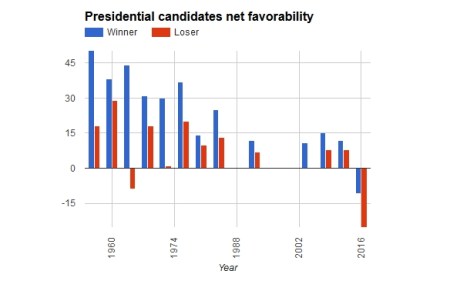
6 decades of decreasing favorability

Gallup has been tracking U.S. presidential candidate favorability ratings for 60 years. It turns out that this year’s candidates have the lowest net favorability (i.e., % favorable minus % unfavorable) ratings observed over those six decades, with, for the first time, both candidates having negative net ratings. Even more interesting, there is a steady trend of decline in favorability over the years.

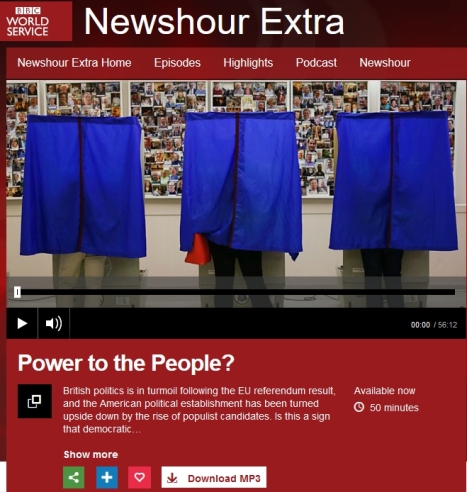
Van Reybrouck: Why elections are bad for democracy

In the wake of the Brexit referendum David Van Reybrouck takes his “tired democracy” message to the readers of the Guardian:

Brexit is a turning point in the history of western democracy. Never before has such a drastic decision been taken through so primitive a procedure – a one-round referendum based on a simple majority. Never before has the fate of a country – of an entire continent, in fact – been changed by the single swing of such a blunt axe, wielded by disenchanted and poorly informed citizens.

Van Reybrouk now recounts the statistics showing low and falling citizen trust in elected institutions and offers a diagnosis of the problem. Avoiding the mention of any substantive complaints about the policies implemented by those institutions, for Van Reybrouk it is purely a matter of procedure. There is considerable vagueness whether the procedural problem was always there or is a new phenomenon. The risk, if things are not repaired, is that voters will continue to make transparently foolish choices.

In a referendum, we ask people directly what they think when they have not been obliged to think – although they have certainly been bombarded by every conceivable form of manipulation in the months leading up to the vote. But the problem is not confined to referendums: in an election, you may cast your vote, but you are also casting it away for the next few years. […]

Referendums and elections are both arcane instruments of public deliberation. If we refuse to update our democratic technology, we may find the system is beyond repair; 2016 already risks becoming the worst year for democracy since 1933. We may find, even after the folly of Brexit, that Donald Trump wins the American presidency later this year. But this may have less to do with Trump himself, or the oddities of the American political system, than with a dangerous road that all western democracies have taken: reducing democracy to voting.
Continue reading

Roslyn Fuller educates Andrew Sullivan

It used to be a mainstream, respectable occupation to theorize about the horrors of popular rule. Socrates and other Athenian aristocrats have been upfront about the fact that the average person should not be trusted with power. This clear-headedness and frankness has been maintained over many centuries. The water began to muddy as the aristocrats were being challenged by the up-and-coming bourgeoisie. Now there had to be some rational criteria explaining why it was not the aristocrats who should be holding power. Talk about natural aristocracy became fashionable, but outright rejection of democracy was still part of the mainstream discourse.

Then, in the 19th century, the term “democracy” was rehabilitated and the ideological water became so thick it was impossible to know where one was heading. In the middle of the 20th century Schumpeter and the elite theorists tried to clear the water by explicitly redefining the term not to refer to popular power after all but simply to a competition between elites for popular vote.

This moment of clarity passed when the 1970’s saw the ideological victory of the Civil Rights movement. At that point popular rule became the only defensible meaning of “democracy”, and since then theorists are in the unpleasant situation of having to reconcile an oligarchical practice with a democratic ideology.

This brief history is presented as an introduction to a recent exchange between Andrew Sullivan, a British author, editor, blogger, conservative political commentator, former editor of The New Republic, and the author or editor of six books, and prof. Roslyn Fuller, an Irish academic, legal expert, columnist, electoral candidate, author of the book Beasts and Gods, and an Equality-by-Lot contributor.
Continue reading

Sortition merchandise

voting-tess

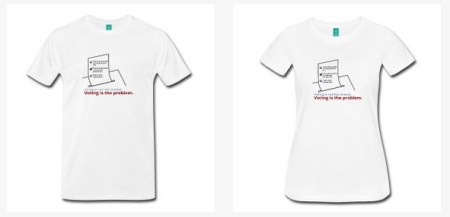
One way to advocate for sortition is to wear its messages or display them on your bag, phone case, etc. It turns out that there are various websites that make it quite easy nowadays to create merchandise with your favorite designs and distribute it worldwide.

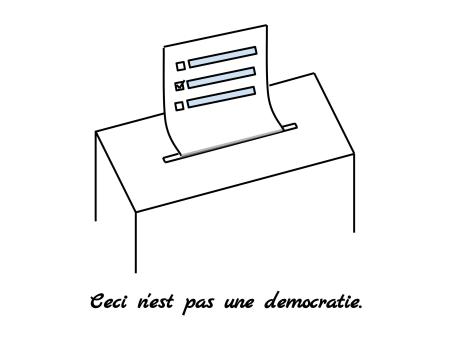
I just created T-shirts with the “voting is the problem” cartoon that I made some time ago. Feel free to buy those shirts for yourself or for your friends and family and wear them proudly to disseminate the sortition message. Please let me know if you would prefer different merchandise with the same design.

Admittedly, this is a very amateurish design, but if Equality-by-Lot readers see fit maybe we can raise some money to fund the creation of professional designs. Also, if readers have designs they made that they would like to contribute, please let me know.

BTW, I make absolutely no money from the sale of those shirts. Things could be set up, however, so that some money from the proceeds of the sales go to the designer and such money can then be used to fund various activities associated with promoting sortition, such as the creation of more and better designs.

Somin: Sortition won’t solve political ignorance

jpeg-of-cover-final-version-e1464367107681

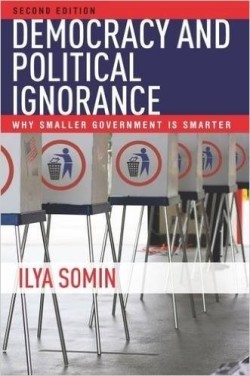
Ilya Somin, Professor of Law at George Mason University, is the author of the book Democracy and Political Ignorance: Why Smaller Government is Smarter. Somin opens an opinion piece in the Washington Post thus:

Widespread political ignorance is a serious problem for modern democracy. In recent years, many scholars have argued that we can overcome it by relying on “sortition”: delegating various political decisions to jury-like bodies selected at random from the general population. In this post, I explain why such proposals are unlikely to succeed.

Before going into the substance of Somin’s arguments about sortition, it is important to realize that ignorance is actually only the second most important problem with the current system, the first being the difficulty of mass scale agenda setting. More details here. The emphasis on ignorance rather than agenda setting is typical of the “rational choice” line of political argument which ignores the complexity of organization largely for ideological reasons. That said, the ability of decision makers to become informed about their subject matters is important and worth discussing. Some of the considerations that are discussed below apply also to the matter of agenda setting.

Continue reading

Threlkeld: Electoral system should be decided by jury, not politicians or referendum

Simon Threlkeld has a new article in the Canadian National Observer advocating against having electoral reform decided by referendum. An excerpt:

Electoral system should be decided by jury, not politicians or referendum

Politicians should not decide the rules under which they are elected, because fair and democratic decision-making requires that those who decide do not have a conflict of interest. All of Canada’s political parties should accept this.

The Conservatives say that whatever electoral system parliament decides on, it needs to be ratified in a national referendum. Rather transparently, what concerns them is not giving the public a say, but rather preserving the status quo which in the 2011 election gave them a majority of the seats with just under 40 per cent of the popular vote.

Rule by the people needs to be well-informed, because only informed views provide a good basis for a decision.

A referendum is highly unsuitable for ensuring an informed decision about Canada’s electoral system. The public would only learn about the option(s) on the ballot voluntarily in their spare time, and most people are not especially interested in learning about electoral systems. In B.C.’s 2005 referendum on a proposed new electoral system, shortly before voting day 66 per cent of those surveyed by Ipsos-Reid said they knew “nothing” or “very little” about the proposal on the ballot. In another survey, over half of those who voted “no” said they did so because they did not feel “knowledgeable.”

Cartledge: Crypto-oligarchy

Paul Cartledge is continuing his assault on the modern conventions about democracy:

To an ancient Greek democrat (of any stripe), all our modern democratic systems would count as “oligarchy”. By that I mean the rule of and by – if not necessarily or expressly for – the few, as opposed to the power or control of the people, or the many (demo-kratia).

That is the case even if – and indeed because – the few happen to be elected to serve by (all) the people. For in ancient Greece elections were considered to be in themselves oligarchic. They systematically favoured the few and, more particularly, the few extremely rich citizens – or “oligarchs”

[…T]here are a number of ancient democratic notions and techniques that do seem highly attractive: the use of sortition, for instance – a random method of polling by lottery that aimed to produce a representative sample of elected officials. Or the practice of ostracism – which allowed the population to nominate a candidate who had to go into exile for 10 years, thus ending their political career.

And comparison, or rather contrast, of our democracies with those of ancient Greece does serve to highlight what’s been called creeping crypto-oligarchy in our own very different (representative, not direct) democratic systems.
Continue reading

The slave’s suggestion box

slaves-suggestion-box

Democracy Talk, Episode 2

In this episode Patrick Chalmers and Yoram Gat talk about Patrick’s inside view of establishment journalism. Patrick presents his analysis of the roots of the problems with journalism and their connection to the problems of our systems of government.

Patrick’s book – Fraudcast News – How Bad Journalism Supports Our Bogus Democracies – can be found online here: http://fraudcastnews.net.

Sortition is good for investor confidence

The Australian Broadcasting Corporation reports:

SA Nuclear dump debate to go before citizens’ juries

South Australia will randomly select 400 people to sit on citizens’ juries to consider the state’s approach to its nuclear future.

The juries are part of a public relations exercise Premier Jay Weatherill said would cost less than $1 million this financial year and there would be additional spending after that.

The announcement came a day after the Nuclear Fuel Cycle Royal Commission report said plans for a high-to-intermediate-level waste dump should be actively pursued, if the public wants it.

Mr Weatherill said it was important to have “the fullest and most mature debate that we can possibly organise”.
Continue reading