The representativity of a random sample: the need for mandatory participation

The unexpected Conservative majority in the 2015 UK general election has led to considerable agonising in the polling industry. Why were the polls — which consistently predicted a hung parliament, or even a Labour victory — so wrong? A polling industry enquiry has come to some interim conclusions, here paraphrased by the BBC political editor, Laura Kuennsberg:

Pollsters didn’t ask enough of the right people how they planned to vote. Proportionately they asked too many likely Labour voters, and not enough likely Conservatives.

Nobody is suggesting that this bias was intentional — it was the accidental by-product of the polling methodology which, rather than drawing a random sample and then knocking on doors (the gold standard, but very expensive), relied heavily on telephone and online surveys. The problem with phone surveys, according to Martin Boon from ICM, is that out of 30,000 random numbers only around generally 2,000 agree to participate. This sample is anything but representative:

Adam Drummond, from Opinium, suggested that the people who agreed to be interviewed were so politically enthusiastic that the would even vote in elections for the European Parliament. . . This seems like a Groucho Marx problem — people answering the phone and agreeing to answer questions about their political opinions automatically means that they are too politically engaged to be representative.

Online polling is even worse:

Online polls are answered by a database of volunteers who have signed up to be on a panel and who the company knows a lot about. When the company is commissioned to do a poll it can be sure that the people it is asking have the same features as the whole population in — for example, the proportion of men and women, or the age profile or income distribution.

However what stratified sampling does not do is to control for the level of political engagement, so

The online polls came out with much the same inaccuracies as the phone ones. Does people’s willingness to be on a panel automatically make them unrepresentative?

Continue reading

The difficulty of insuring accurate randomness

This article points to the problem of how to produce true representation in juries.

Dearbhail McDonald: The verdict is in – our jury selection process is a farce

Juries are meant to be representative of society as a whole. However, they are anything but, writes Dearbhail McDonald

Trial by jury is one of the last remaining sacred cows in the criminal justice system.

Born by accident to replace trial by ordeal and duelling, amongst other dispute resolution techniques, the random selection of 12 peers is still prized as the only anchor by which a government can be held to the principles of its constitution.

Lord Devlin, the celebrated British judge whose father was from Co Tyrone, famously described jury trial as the lamp that shows that freedom lives.

Here’s the salient point:

For the most part, trial by a jury of one’s peers is as unquestioned as it is innate.

But our current system of selecting juries makes a mockery of jury trial as a bulwark against State power and other anomalies.

To fulfil their constitutional mandate, juries (which only featured women from as late as 1976) are meant to be representative and jurors drawn from a complete cross-section of the community.

They are anything but.

In practice, the burden of jury duty is disproportionately borne by Dubliners; the young, the old and retired, the unemployed, civil servants or those who can manage to undertake the difficult task. The recent empanelling of a 15-strong jury … brought home to me the challenges of achieving the “constitutional completeness” of the representative jury.

Continue reading

The Paradox of Democratic Selection: Is Sortition Better than Voting?

A draft book chapter by Anthoula Malkopoulou:

Sortition, or the selection of political officers by lot, has its antecedent in the direct democratic tradition of ancient Athens. Its transfer into a modern context of representative democracy poses rightful scepticism not only about the practical difficulties, but more so about the theoretical inconsistencies that arise. Modern systems of political representation are based on the aristocratic idea of ‘government by the best’, who are to be selected through a competitive call for candidates (Manin 1997). Sortition, on the other hand, replaces this aristocratic criterion of competition and evaluative election with the democratic mechanics of direct and equal distribution of political office by chance. Hence, the very expression ‘democratic (s)election’ includes a paradoxical contradiction in terms, between the democratic concept of equal access to public office and the aristocratic idea of government by the (s)elected best.

My aim in this chapter is to shed some light into this contradiction by critically discussing the benefits and pitfalls of using sortition today, comparing it throughout the chapter with voting and the general effects of electoral representation. More specifically, my arguments are divided in four sections. I begin by addressing the reasons that drive klerotarians away from electoral representation (1). Next, I consider alternative modes of political ‘outsourcing’, such as the inclusion of civil society actors or the use of quotas (2). I continue by discussing the democratic legitimacy of sortition by dividing the subject in two questions: (a) political equality and (b) political participation (3). Last, I focus on the type of political representation that the lot produces, viewed from the perspectives of descriptiveness, authorization and accountability (4). In conclusion, I suggest that lotteries may offer valuable improvement to current practices of democratic selection, but only if special measures are taken to compensate for the limitations they entail.

Full text (uncorrected draft: not for citation).

Dr. Ron Prestage thanks Congress

Forbes reports:

On Friday, Congress repealed the country-of-origin-labeling rule (COOL) on beef and pork after the World Trade Organization (WTO) imposed $1 billion in retaliatory import tariffs against United States if the rule was not overturned.

90% of those surveyed in 2013 favored country-of-origin-labeling for fresh meat sold in stores.

Dr. Ron Prestage, president of the National Pork Producer’s Council, released a statement expressing gratitude to Congress for repealing COOL. “I know tariffs on U.S. pork would have been devastating to me and other pork producers,” he said.

2015 review – sortition-related events

This is a review of notable sortition-related events of the year 2015.

Brett Hennig wrote to mention citizens’ assembly pilots and the Irish constitutional assembly which led to the marriage equality vote.

In my mind the two most notable sortition-related events of 2015 were:

  • In Mexico, the Morena party allotted of some of its congressional candidates among the party rank-and-file. This was covered on Equality-by-Lot here (English version), here and here.
  • Leading Belgian politicians from various parties proposed changing the selection method of the Belgian upper house to sortition. This is the most high-profile proposal of its kind of the modern age.

Continuing the trend of previous years, those developments happened in the non-English speaking world. However, they are a reflection of a wide-spread disillusionment with elections – a sentiment that is as common in the English-speaking world as it is outside of it.

In the US this sentiment found an electoral outlet in the surprise strength of the campaigns of two presidential candidates which are perceived as being outside of the electoral establishment – Donald Trump and Bernie Sanders. This fact was observed in a relatively well-noticed academic paper in Science journal by Fisman and Markovits about the way class affects policy choices. The authors drew from their work some conclusions that come close to an indictment of the electoral method.

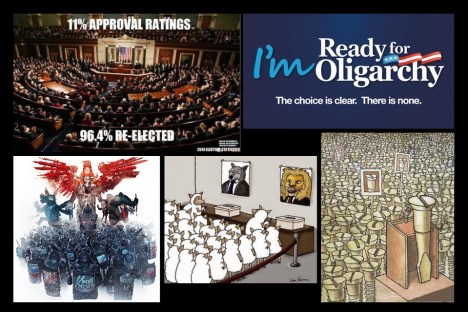
2015 review – images

Images that appeared on Equality-by-Lot in the passing year.

Equality-by-lot 2015 image review

The choice is clear

oligarchy

Prinz and Garry: Democracy is due for an overhaul – could lawmaking-by-jury be the answer?

In an article in The Conversation, Janosch Prinz and John Garry, both from Queen’s University Belfast, advocate for legislation by ad-hoc allotted bodies.

They start off by recounting a standard list of instances of electoral disfunction:

Many will agree that, in practice, democracy leaves a lot to be desired. The system often falls short of its ideals: whether it’s the US congress causing a total government shutdown; Australian prime ministers being ousted by internal party politics; or the UK’s disproportionate electoral system allocating only one seat to a party which received close to 4m votes.

This misses the point. None of these examples is an indication of a problem inherent in elections. The problem with electoralist systems is not that they don’t function but that they function in favor of electoral elites and their allies rather than for the average person.
Continue reading

The Dunning–Kruger effect and its implications for voting

The Dunning–Kruger effect

is a cognitive bias wherein relatively unskilled individuals suffer from illusory superiority, mistakenly assessing their ability to be much higher than is accurate.

The effect is named after David Dunning and Justin Kruger of the department of psychology at Cornell University who published a paper in 1999 which described a series of experiments which they conducted which demonstrated the effect.

In an interview, Dunning described his understanding of the effect as follows:

Dunning: [I]f you’re incompetent, you can’t know you’re incompetent.

[Interviewer:] Why not?

Dunning: If you knew it, you’d say, “Wait a minute. The decision I just made does not make much sense. I had better go and get some independent advice.” But when you’re incompetent, the skills you need to produce a right answer are exactly the skills you need to recognize what a right answer is. In logical reasoning, in parenting, in management, problem solving, the skills you use to produce the right answer are exactly the same skills you use to evaluate the answer. And so we went on to see if this could possibly be true in many other areas. And to our astonishment, it was very, very true.

Continue reading

Koop: Allotted assemblies allow the elected to renege on campaign promises

Kevin Mooney wrote to point out an article in the Ottawa Citizen. In the article Royce Koop, an associate professor in the Department of Political Studies at the University of Manitoba, argues against repeating the electoral reform process carried out in British Columbia and Ontario provinces.

Koop makes two arguments. The first is the somewhat tautological point that “tak[ing power] from elected representatives and giv[ing it] to the people […] threatens representative democracy by taking decision-making power from MPs and handing it to citizens, [while] representative democracy is best served by allowing MPs to represent the interests of their constituents through their votes, rather than by seizing MPs’ power and handing it to citizens”.

The more interesting argument (which to a large extent is in fact contradictory to the first one) is a much more practical one:

[T]he use of citizens assemblies and referendums would have the effect of allowing politicians to escape from being accountable to the public for their actions.
Continue reading