The U.S. Constitutional Convention Considered a Lottery to Select The Electoral College

convention-debatesWith Donald Trump winning a majority in the Electoral College and Hillary Clinton receiving the plurality of the popular vote, the role of the Electoral College is once again in the news.

For those interested in the history of the use and consideration of lotteries in political decisions making, here is an interesting little tid bit. During the debate at the Constitutional Convention about how the President should be selected, there was a lot of discussion of the pros and cons of various schemes for selecting the Chief Executive. Possibilities included allowing a national popular vote, having Congress elect (as in a parliamentary system), having the state legislatures elect, or having one-time electors (an Electoral College), choose the president of the United States.

According to James Madison’s notes, James Wilson, one of the most important and influential delegates to the Constitutional Convention, proposed that the electors for the Electoral College be chosen by lot from among the members of Congress.

Tuesday, July 24, 1787 notes by James Madison

Mr. WILSON then moved, that the Executive be chosen every — years by — Electors, to be taken by lot from the National Legislature, who shall proceed immediately to the choice of the Executive, and not separate until it be made.

Mr. CARROLL seconds the motion.

Mr. GERRY. This is committing too much to chance. If the lot should fall on a set of unworthy men, an unworthy Executive must be saddled on the country. He thought it had been demonstrated that no possible mode of electing by the Legislature could be a good one.

Mr. KING. The lot might fall on a majority from the same State, which would insure the election of a man from that State. We ought to be governed by reason, not by chance. As nobody seemed to be satisfied, he wished the matter to be postponed.

Mr. WILSON did not move this as the best mode. His opinion remained unshaken, that we ought to resort to the people for the election. He seconded the postponement.

Mr. GOUVERNEUR MORRIS observed, that the chances were almost infinite against a majority of Electors from the same State.

On a question whether the last motion was in order, it was determined in the affirmative, — ayes, 7; noes, 4.

On the question of postponement, it was agreed to, nem. con.

Antoine Bevort: Chouard and democracy: an intellectual and political fraud

The following is my translation of a recent article Antoine Bevort in the online French publication Mediapart. Like Tommy Lasserre’s Sortition in politics – the false good idea, which appeared in Mediapart two years ago, the article is a critique of Chouard and his proposals. Bevort makes some similar points, but, unlike Lasserre, doesn’t focus solely on sortition, and when he does discuss sortition he often deals with implementation details rather than with the principle itself to which he is not wholly hostile. Bevort also relies much less than Lasserre on canned Leftist rhetoric. As a result of those differences more of his punches land on target.

Chouard and democracy: an intellectual and political fraud
29 June 2016 Antoine Bevort

Étienne Chouard presents himself as the scholar of “real” democracy. His proposal of allotting of a constitutional assembly is however a fraud. It incorporates general principles which can be embraced, at least in part, but rests on largely specious argumentation, eventually leading to a strange and dogmatic conception of democracy.

Chouard considers himself the guru of “real” democracy. He feels he has found the “cause of causes” of the political crisis (“the political disempowerment of the citizens”) and proposes as a solution the allotment of a constitutional assembly. In his analyses, Chouard invokes general principles which can be embraced at least in part, but advances mainly through theoretical and historical shortcuts, simplifications or even misinterpretations, and through blunt claims and assertions. His dogmatic propositions are based on largely specious argumentation and lead eventually to a strange philosophy of democracy.

In order to deconstruct this rhetoric of mystification, we use a conference video available online[i], a text on the Gentils Virus website whose contents are very similar to those of the conference, as well as on the wiki of this organization, and particularly on the constitution drafted by Chouard. We first discuss his analysis of the existing political system, his claims that “we are not living in a democracy yet” and that “an electoral system is not a democracy”. Then we examine his conception of the “true democracy”, and his proposal of drawing by lot a constitutional assembly. We conclude with the mode of action which Chouard, the Gentils Virus (GV) and Les Citoyens Constituants (LCC), two organizations which promote his ideas, are pursuing.
Continue reading

Foa and Mounk: The democratic disconnect

A paper in the Journal of Democracy by Roberto Stefan Foa and Yascha Mounk explores trends in the tremendously valuable World Values Survey database.

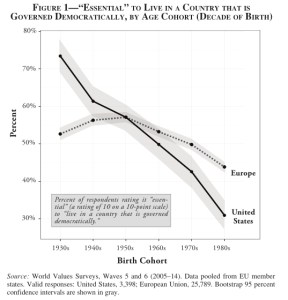
Drawing on data from Waves 3 through 6 of the World Values Surveys (1995–2014), we look at four important types of measures that are clear indicators of regime legitimacy as opposed to government legitimacy: citizens’ express support for the system as a whole; the degree to which they support key institutions of liberal democracy, such as civil rights; their willingness to advance their political causes within the existing political system; and their openness to authoritarian alternatives such as military rule.

What we find is deeply concerning. Citizens in a number of supposedly consolidated democracies in North America and Western Europe have not only grown more critical of their political leaders. Rather, they have also become more cynical about the value of democracy as a political system, less hopeful that anything they do might influence public policy, and more willing to express support for authoritarian alternatives. The crisis of democratic legitimacy extends across a much wider set of indicators than previously appreciated.

Continue reading

Vincent Azoulay: An electoral campaign in reverse

An article by Vincent Azoulay, professor of ancient history in the University of Paris-Est/Marne-la-Vallée, in france culture (original in French, my translation [corrections welcome]):

An electoral campaign in reverse: the ostracism

Let us start from a finding that is at first surprising. We possess no detailed record of an electoral campaign in Athens – despite it being history’s first democracy! There are multiple reasons for this: first, elections may not have necessarily been important events, being considered an aristocratic selection mechanism, being the opposite of the more egalitarian mechanism of sortition. Most importantly, when elections were held – when selecting generals, for example – they were most often if not unanimous then at least less-contentious: because it was never for selecting a single individual, a bitterly competitive affair, but a board of ten magistrates, which made the competition not as harsh.
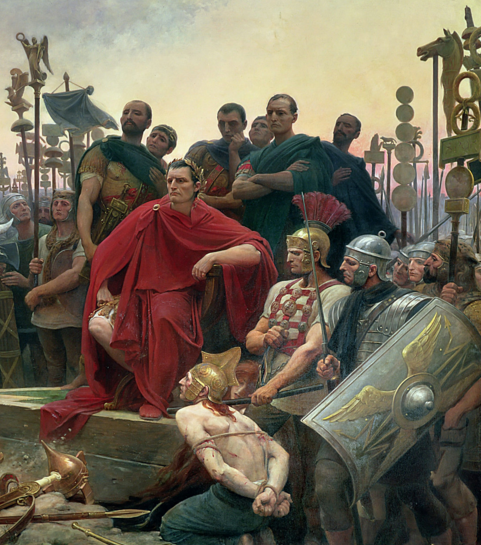
To find the real electoral campaigns in Athens, with their maneuvers and intrigue, we have to turn to a celebrated institution, the ostracism, which may be considered as an election in reverse, as it was for politicians who would definitely not be elected!
Continue reading

Against elections, the video

A surprisingly militant video from David Van Reybrouck.

The Democratic Significance of the Classical Athenian Courts

This draft, not-for-citation paper by Daniela Cammack (forthcoming in Declinism, Central European University Press), argues that the 4th Century was actually the high point of Athenian democracy and culture:

The incomparable Mogens Hansen has done more than anyone to refocus attention on fourth century Athens (particularly 355-22), arguing convincingly not only that the democracy in the age of Demosthenes differed significantly from that of Pericles but also that the vastly richer philosophical, oratorical and epigraphical sources of the fourth century should make it the centre of gravity of histories of the period.

Unfortunately Hansen views the change from assembly- to sortition-based legislative decision making as ‘a move from the “radical” democracy of the fifth century to a more “moderate” (later “modified”) system in the fourth’. According to Cammack this is anachronistic:

This is exactly what a subject of a modern constitutional democracy would expect. The judiciary, in such systems, is indeed meant to limit what “the people” (or their representatives) can do to themselves. But it is not clear that the relationship between Athenian judges and assemblygoers should be understood in these terms. In particular, we cannot assume that late fifth-century Athenians regarded their courts as a less democratic forum than the assembly, since in both cases, among other things, decisions were made by ordinary citizens voting en masse. Indeed, I will argue that judicial panels may have been regarded as a significantly more reliable vehicle of the rule of the dêmos, conceived as the collective common people as distinct from those who took leading political roles. From this perspective, far from moderating democracy, the reforms of the late fifth century seem designed to render it more extreme.

Sortition advocacy in North Carolina

Owen Shaffer, a retired college professor living in Asheville, NC has an opinion piece in the local Citizen Times. Unlike many sortition advocates, Shaffer is not talking half-measures. He is ready to dispose of elections altogether and replace them with sortition:

Is there a better way to select representative bodies to govern us? Is it possible to remove “politics”, “lobbyist”, and “campaign contribution” from our vocabulary, and still have a democracy? Can we remove the oligarchic underpinnings to our democracy? One only needs to look at history to find the answer. “It is thought to be democratic for the offices to be assigned by lot, for them to be elected would be oligarchic” – Aristotle (Politics, Book 4, Section 1294b)

What changes might happen if the random selection of members of a governing body occurs? It would be more likely that they deliberate issues and not sink into decisions based on political affiliation, posturing, and “sound bite” opportunities. They would be unafraid to make hard choices since they would owe no one any favors nor have an opportunity for re-election. In short, they would be more willing to make the right decisions.

6 decades of decreasing favorability

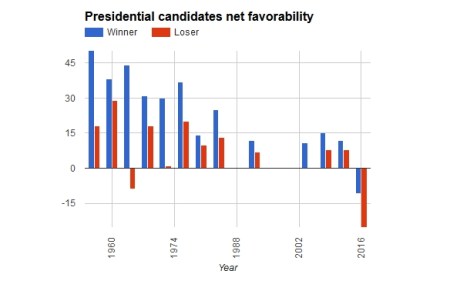
Gallup has been tracking U.S. presidential candidate favorability ratings for 60 years. It turns out that this year’s candidates have the lowest net favorability (i.e., % favorable minus % unfavorable) ratings observed over those six decades, with, for the first time, both candidates having negative net ratings. Even more interesting, there is a steady trend of decline in favorability over the years.

Roslyn Fuller educates Andrew Sullivan

It used to be a mainstream, respectable occupation to theorize about the horrors of popular rule. Socrates and other Athenian aristocrats have been upfront about the fact that the average person should not be trusted with power. This clear-headedness and frankness has been maintained over many centuries. The water began to muddy as the aristocrats were being challenged by the up-and-coming bourgeoisie. Now there had to be some rational criteria explaining why it was not the aristocrats who should be holding power. Talk about natural aristocracy became fashionable, but outright rejection of democracy was still part of the mainstream discourse.

Then, in the 19th century, the term “democracy” was rehabilitated and the ideological water became so thick it was impossible to know where one was heading. In the middle of the 20th century Schumpeter and the elite theorists tried to clear the water by explicitly redefining the term not to refer to popular power after all but simply to a competition between elites for popular vote.

This moment of clarity passed when the 1970’s saw the ideological victory of the Civil Rights movement. At that point popular rule became the only defensible meaning of “democracy”, and since then theorists are in the unpleasant situation of having to reconcile an oligarchical practice with a democratic ideology.

This brief history is presented as an introduction to a recent exchange between Andrew Sullivan, a British author, editor, blogger, conservative political commentator, former editor of The New Republic, and the author or editor of six books, and prof. Roslyn Fuller, an Irish academic, legal expert, columnist, electoral candidate, author of the book Beasts and Gods, and an Equality-by-Lot contributor.
Continue reading

Griffiths: Seven potential problems with sortition

Edmund Griffiths has a post about concerns he has regarding sortition. The post is quite interesting in its originality and in avoiding most of the standard anti-sortition talking points.

Griffiths is generally sympathetic to sortition and starts out with a long list of “well known” advantages of the system. The first few of these are:

it is likelier than any other system to produce representative bodies that are sociologically representative of the people;

• it removes the need for any specific positive discrimination;

• it forces political parties, campaign groups, etc., to address themselves to the public as a whole if they want to have any consistent influence on policy;

• it transforms political representation into a genuine public service, carried out by people who would often not have chosen it: a matter of duty, not ambition[.]

In terms of potential problems, Griffiths is much concerned about the validity of the sampling procedure and raises the questions of both deliberate tampering and non-intentional error as well as the question of whether the public will have faith in the procedure.

Griffiths lists four additional potential problems:
Continue reading