Equal Participation in the Post-Democratic Age

Forthcoming book chapter by Dirk Jörke and Anthoula Malkopoulou

Equal participation is a sine qua non of democracy. Yet, today equal voting rights are insufficient for embodying this principle. On one hand, the use of voting rights is not equal among the population. On the other, elections have increasingly become a post-democratic facade, because decision-making has shifted to unelected bodies or non-transparent network meetings. Are more direct democratic procedures the solution to this predicament? This chapter argues that they are not. For once, deliberative citizen assemblies bring inequalities in from the backdoor, as they permit knowledge, skills and other resources more available to advantaged citizens to weigh in positively. Likewise, introducing random selection as a way of distributing public office may allow advantaged citizens to dominate, if the pool of candidates is voluntary and thus self-selected. We argue that reforms should generally focus not on introducing more direct participation, but on reducing the inequalities of participation in representative systems.

The other alternative being large non-deliberative juries with mandatory participation.

Full text

Le Parisien Magazine: For or against allotting senators?

Nicolas Priou, January 18th, 2017

Appoint some of the senators by chance. That is one of the proposals of Arnaud Montebourg, for “rebuilding the lost confidence” between the citizens and the institutions. More precisely, the candidate for the primary of the left (on the 22nd and the 29th of January) would like to allot 100 senators in an assembly reduced to 200 members. This means one citizen for each department, drawn from the electoral registry, as is already the case for judicial juries.

A system created in ancient Greece

The goal? “Assure the involvement of citizens in the political system” and making the Senate “a chamber with oversight powers over the public purse, public commitments, political promises to the public, and European decisions”. The idea is as old as the Athenian democracy – or rather klerocracy, as the Greeks called the political system where the representatives of the people and the rulers are selected by lot. But this method is rarely applied other than for selecting juries. More recently, it was Iceland that went farther. In response to the financial crisis of 2008, an assembly of 1,000 allotted citizens was formed to create the basis for a new constitution. Which was eventually rejected. In France, in addition to Arnaud Montebourg, various think tanks, philosophers, and researchers have been promoting the idea of sortition of senators for several years, proposing different numbers of people designated by lot. But are the French people ready?
Continue reading

Let’s reimagine democracy: replace elections with lotteries

An article by Joe Humphreys, in the The Irish Times, November 19th, 2016:

What’s happening to our democracies? Donald Trump’s presidential-election victory in the United States, after a bitter campaign characterised by deceitful and incendiary rhetoric, is not an isolated episode. It’s the natural outcome of what David Van Reybrouck calls democratic-fatigue syndrome.

One of the most worrying facets of electoral democracy is what political scientists call rational ignorance. Citizens have negligible chances of influencing which candidates get elected and of influencing those candidates once elected. “Citizens thus have no incentive to become well-informed regarding political affairs,” says Dr Peter Stone of Trinity College Dublin.

The answer, says Stone, is to find new ways of invigorating democracy, suggesting a much greater role for “citizen juries” randomly selected to serve public roles. This notion of governing by lottery rather than election is at the heart of Van Reybrouck’s book, which has sought to popularise a concept that stretches back to ancient Greece, the birthplace of democracy. In Athens, in the fifth and fourth centuries BC, the most important governmental offices were appointed by sortition, or the drawing of lots.

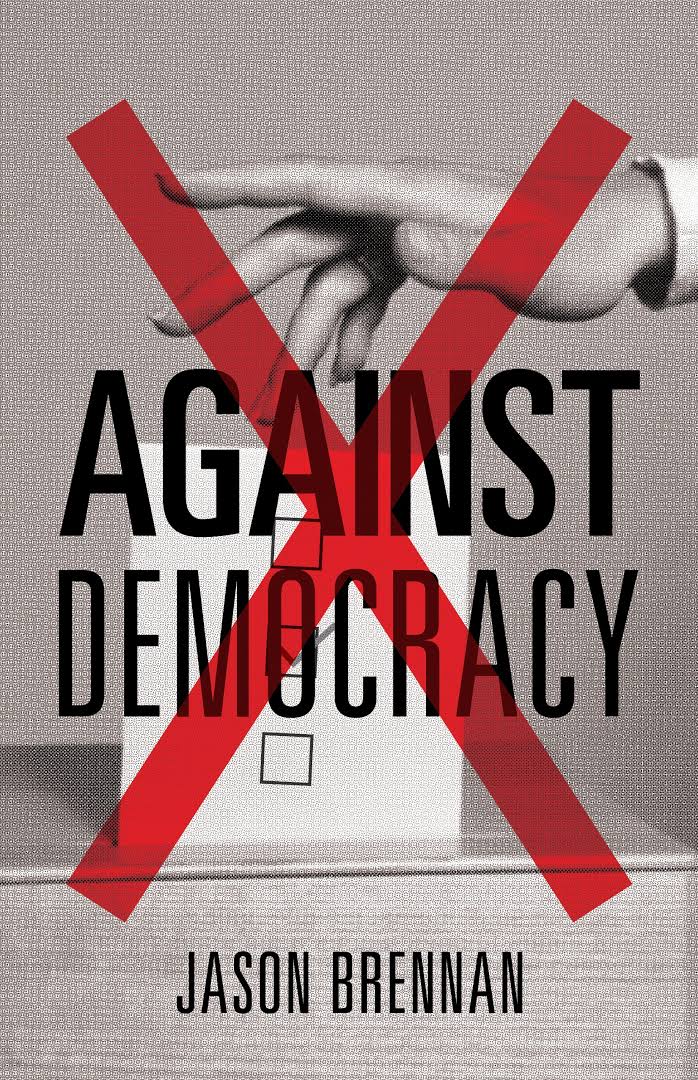
Double Review: ‘Against Democracy’ and ‘Against Elections’

I recently reviewed two books ‘Against Democracy’ by Jason Brennan and ‘Against Elections’ by David van Reybrouck for the Los Angeles Review of Books. I wouldn’t say that I loved either book, but I did give Terry a shout-out in the review :-)

“Against Democracy” and “Against Elections”: Where Do We Go From Here?

AS THE UNITED STATES APPROACHES a most divisive presidential election, it is hardly surprising to see an upsurge in literature proposing to diagnose and cure the ailments of modern politics.

Against Democracy and Against Elections both fall into this category. Despite their provocative titles, they each present detailed plans regarding what they are for rather than focusing solely on what they are against. This willingness to explore alternative politics is a clear strength of both books and what sets them apart in a market clogged with tomes that tend to be heavier on rants than original thinking.

Antoine Bevort: Chouard and democracy: an intellectual and political fraud

The following is my translation of a recent article Antoine Bevort in the online French publication Mediapart. Like Tommy Lasserre’s Sortition in politics – the false good idea, which appeared in Mediapart two years ago, the article is a critique of Chouard and his proposals. Bevort makes some similar points, but, unlike Lasserre, doesn’t focus solely on sortition, and when he does discuss sortition he often deals with implementation details rather than with the principle itself to which he is not wholly hostile. Bevort also relies much less than Lasserre on canned Leftist rhetoric. As a result of those differences more of his punches land on target.

Chouard and democracy: an intellectual and political fraud
29 June 2016 Antoine Bevort

Étienne Chouard presents himself as the scholar of “real” democracy. His proposal of allotting of a constitutional assembly is however a fraud. It incorporates general principles which can be embraced, at least in part, but rests on largely specious argumentation, eventually leading to a strange and dogmatic conception of democracy.

Chouard considers himself the guru of “real” democracy. He feels he has found the “cause of causes” of the political crisis (“the political disempowerment of the citizens”) and proposes as a solution the allotment of a constitutional assembly. In his analyses, Chouard invokes general principles which can be embraced at least in part, but advances mainly through theoretical and historical shortcuts, simplifications or even misinterpretations, and through blunt claims and assertions. His dogmatic propositions are based on largely specious argumentation and lead eventually to a strange philosophy of democracy.

In order to deconstruct this rhetoric of mystification, we use a conference video available online[i], a text on the Gentils Virus website whose contents are very similar to those of the conference, as well as on the wiki of this organization, and particularly on the constitution drafted by Chouard. We first discuss his analysis of the existing political system, his claims that “we are not living in a democracy yet” and that “an electoral system is not a democracy”. Then we examine his conception of the “true democracy”, and his proposal of drawing by lot a constitutional assembly. We conclude with the mode of action which Chouard, the Gentils Virus (GV) and Les Citoyens Constituants (LCC), two organizations which promote his ideas, are pursuing.
Continue reading

Graham Smith: The problem with politicians and democracy…

I would complete the headline of Alex Sakalis’s interview with Graham Smith on openDemocracy with “… is that they are mutually exclusive” (at least if by “politicians” it is meant “elected politicians”). Smith, however, strikes a more tentative note:

Citizens’ priorities are not necessarily the same as those of their political representatives. […] What is clear is that citizens are willing and able to deliberate on complex and contested political issues. The question is whether they will be listened to by local and national political leaders. The evidence is not promising.
Continue reading

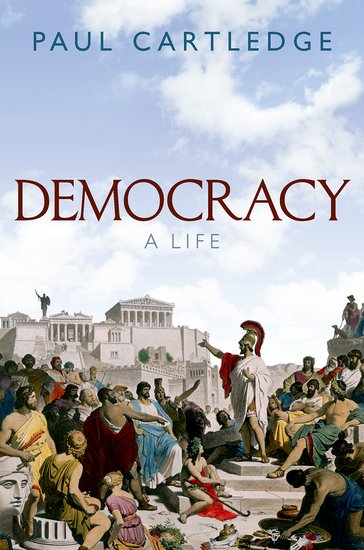
Book Review: Democracy: A Life

I seem to be reviewing a lot of books lately, including this review of Paul Cartledge’s Democracy: A Life in the Los Angeles Review of Books (cited in a previous post by Peter Stone). While the book covers what will be familiar ground for many here, the author also charts how the idea of ‘people power’ has been treated over the centuries that have elapsed since Athenian democracy. As such, I feel that he (intentionally or unintentionally) made an important contribution to challenging the negative perception that we have of citizen participation by explaining how this view developed over time. Another one to order for the library!

Cartledge goes to some effort to show how later [post-Athens] historians and statesmen were anxious to portray Greek democracy as a horrible mistake, the unworkable aspiration of starry-eyed dreamers that was preprogrammed to end in chaos. Under the onslaught of these propagandists, the vast majority of whom never experienced Athenian democracy — and indeed were often born several hundred years after it ceased to exist — the idea of political equality came to be regarded as a myth, the notion of the collective people holding power a danger to be shunned, suppressed, and preferably forgotten.

The truth was that democracy was a dangerous idea — to the kings, emperors, and high clergy who controlled information in the centuries after it ceased to be a living form of government. As the author puts it, while these autocrats held sway throughout the Middle Ages, the very idea of democracy was “on life-support.” And while things may have improved since, modern democracy is, in Cartledge’s view, not in much better shape — off the machine perhaps, but still staggering around the hospital ward, clutching at bits of furniture, and trying to remember what had happened to bring it there in the first place.

Gutting: Should Everyone Vote?

An op-ed piece in The New York Times by Gary Gutting, a professor of philosophy at the University of Notre Dame:

At election time we inevitably hear earnest pleas for everyone to vote. Voter participation is a data point often cited in political studies, along with an assumption that the higher the percentage, the better: 100 percent participation is the goal. But we rarely question this belief, or objectively consider whether everyone who can vote ought to vote.

The author then outlines the problems of mass democracy, including ‘trumpery’, plutocracy and rational ignorance, and attempts to justify voting as an act of participatory solidarity. But he goes on to consider sortition as an alternative:

At least one political philosopher has put forward the radical idea that we could ensure informed voters by employing an “enfranchisement lottery.” Such a lottery would restrict voting to a randomly chosen group of citizens who are provided unbiased in-depth information relevant to an election. We can think of this approach as a matter of modeling our voting on our jury system. We would never accept deciding important and highly publicized trials by a vote of the general public. We think only people fully informed of the facts and relevant arguments put forward in a trial should make such important judgments. Shouldn’t we be at least as careful in deciding who should be president?

Notice that answering yes does not imply the elitist view that only a small minority of citizens are capable of making informed votes. The idea is not that voters are too stupid or biased to access the needed information; it’s just that they don’t have the time and resources to do so. Ideally, we would provide everyone with the relevant knowledge, but that would be impractical, time-consuming and expensive.

Continue reading

Achen and Bartels: Democracy for Realists: Why Elections Do Not Produce Responsive Government

Via Garreth McDaid.

Political scientists Christopher Achen and Larry Bartels have a new book, Democracy for Realists: Why Elections Do Not Produce Responsive Government.

I have not read the book. Chapter 1 is available online, and it certainly makes for some interesting reading. Some comments following reading that first chapter:

(1) It seems that despite their critique of electoralism the authors are not ready to abandon it. At some point they seem to indicate that they cannot imagine something better when they opine that “[n]o existing government comes close to meeting all of Dahl’s criteria [for democracy]; in our view, no possible government could.” The book’s objective seems purely analytical: to produce “a democratic theory worthy of serious social influence [which] must engage with the findings of modern social science.”

(2) The book appears to adopt the conventional electoralist terminology which makes no clear distinction between electoralism and democracy. The authors should have known better.

(3) “Democracy for realists” seems to largely retrace the elitist democratic theories which rose to prominence in political science in the third quarter of the 20th century. Indeed Joseph Schumpeter and Walter Lippmann – leading propounders of those ideas – make a prominent appearance in the first chapter. Those theories fell out of fashion when, after the civil rights struggles, dominant ideology changed and became incompatible with their conclusions. It may be that the main innovation of the book is not in “engaging with the findings of modern social science”, but in being willing to (re)acknowledge the (now-)inconvenient truths that were buried over the last 40 years or so. In that, the book seems to be very much a product of current politics.

Excerpt:

In the conventional view, democracy begins with the voters. Ordinary people have preferences about what their government should do. They choose leaders who will do those things, or they enact their preferences directly in referendums. In either case, what the majority wants becomes government policy — a highly attractive prospect in light of most human experience with governments. Democracy makes the people the rulers, and legitimacy derives from their consent. In Abraham Lincoln’s stirring words from the Gettysburg Address, democratic government is “of the people, by the people, and for the people.” That way of thinking about democracy has passed into everyday wisdom, not just in the United States but in a great many other countries around the globe. It constitutes a kind of “folk theory” of democracy, a set of accessible, appealing ideas assuring people that they live under an ethically defensible form of government that has their interests at heart.
Continue reading

Paul Cartledge: The case for sortition is persuasive

Just read a short piece by Paul Cartledge in which he talks about the history of sortition, a topic treated more extensively in his book Democracy: A Life (Oxford University Press). He even manages to plug my own book, The Luck of the Draw: The Role of Lotteries in Decision Making (also Oxford University Press) along the way. Check it out:

It is quite easy to compile a checklist, perhaps even a decalogue, of differences between their democracy (or rather democracies, as there was no one identikit ancient model) and ours (ditto). And in no respect did they and we differ more than on the issue of sortition, that is, the application of the lottery to the conduct of politics (another Greek invention, both the word and the thing, with – again – the accent to be placed on difference as well as similarity between theirs and ours). We today take the exercise of voting in either general or local elections to be the very quintessence of what it is to do ‘democracy.’ The ancient Greeks took the exact opposite view: elections were elitist and for the nobs, appropriate more for oligarchy (the rule of the few rich) than for democracy (the rule of the masses, most of whom were poor), whereas sortition, the lot, was the peculiarly democratic way of selecting most office-holders and all juror-judges to serve in the People’s jury-courts.
Continue reading