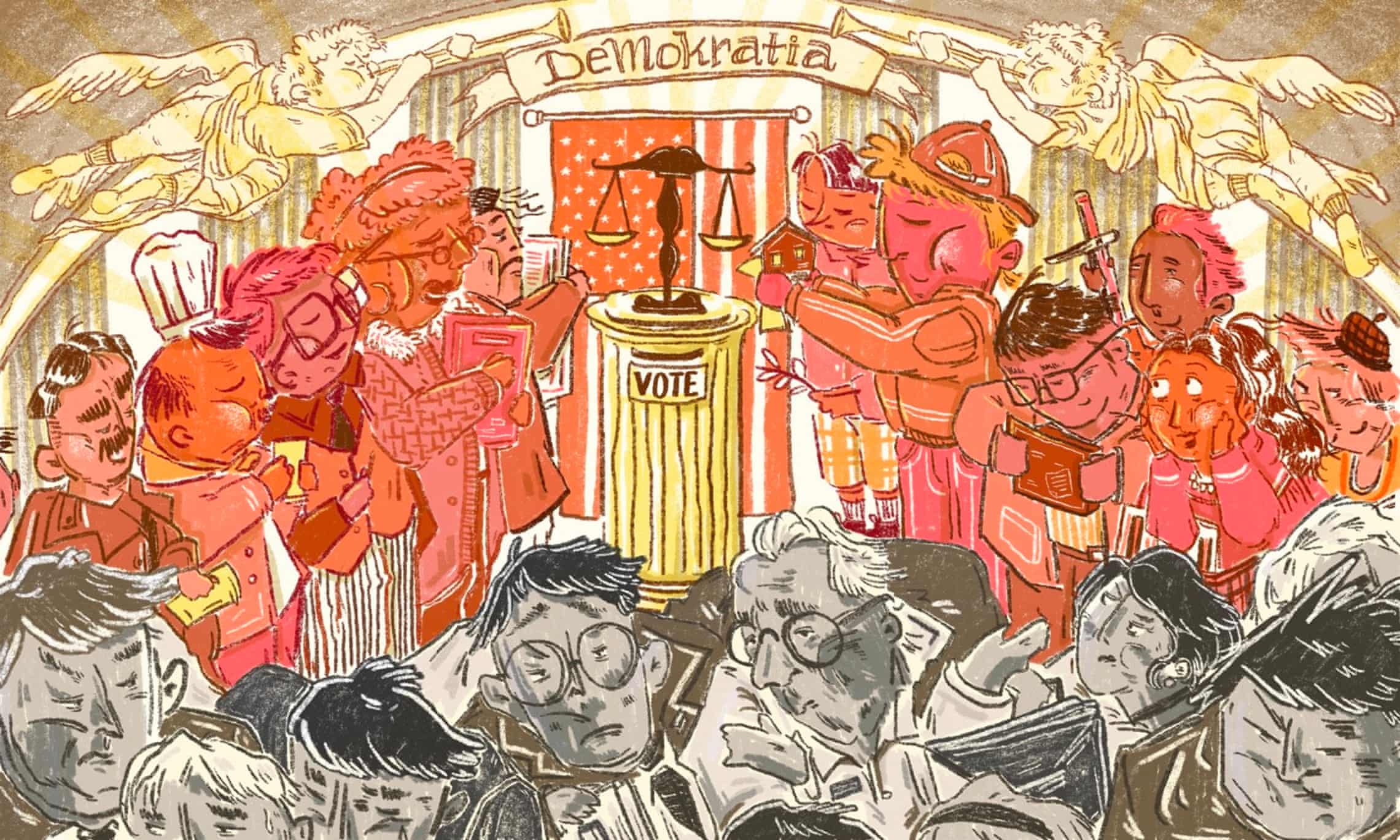
The Times alarmed about the radical proposals of the Sortition Foundation

The Times writes:

Group that wants to abolish MPs wins government cash

Even Extinction Rebellion believes the Sortition Foundation’s ideas are too radical

The taxpayer has been funding a group that campaigns for the end of parliamentary democracy and which even Extinction Rebellion considers to be too radical.

The Sortition Foundation has provided recruitment services for parliament and other governmental bodies, helping them to organise “citizens’ assemblies” that are used to inform decision makers on issues such as climate change.

Participants are paid to take part and chosen through a process of “stratified random selection” so that assemblies, made up of between 20 to 200 people, are representative of communities in the UK and can be used to guide government policy.

The not-for-profit company was awarded £26,000 by the Department for Environment, was among the beneficiaries of a £120,000 contract from the House of Commons and received £10,000.

A democratic rock bottom

Guillaume Drago, a law professor at Université Panthéon-Assas Paris II writes [original in French] the following in the Catholic monthly journal La Nef.

A democratic rock bottom

It is the time, it seems, of “participative democracy”, which has been described as “the collection of methods aiming to involve the citizens in the process of political decision making” [L. Blondiaux, on the site vie-publique.fr], and which could be defined as the direct participation of citizens in the creation of rules, and in particular legislation. It surely involves that when it concerns the “Citizen Conventions” for the climate and for the end-of-life question.

The composition of these “conventions” is the product of allotment which is supposed to be representative of the French population. The institution which organizes these conventions is the Economic, Social and Environmental Council (CESE, pronounced “se-zeh”), with a “governance committee” which, it is easily understood, is there to steer the discussions in the desired directions and an “oversight body”, for the end-of-life convention [The role of the oversight body is defined on the site of the “convention”: “The oversight body is tasked with ensuring respect for the essential principles of the Citizen Convention: sincerity, equality, transparency, respect for the speech of the citizens. The body also verify that the conditions guarantee the independence of the Citizen Convention”.] The assessment of a legal scholar of the use of “citizen conventions” cannot avoid being severely negative, for several reasons.

The first is that these bodies are neither constitutionally nor legally recognized. No provision of our constitution discusses such a device for preparing or for participating in deciding laws or regulations. The law is silent on this type of device and it is unclear why the members of parliament would wish to give up some of their legislative power in favor of the citizens whereas those citizens have duly elected the members of parliament in order to represent them… For those two “conventions”, a simple letter of the prime minister to the president of the CESE is all that justifies their existence. They are then associated with what one of the sites of the “conventions” calls the “third Assembly of the Republic, and a legitimate player acting as an independent constitutional assembly, whose task is to be a juncture of citizen participation”. Good heavens! Such responsibility!
Continue reading

Hugh Pope on the Belgian Citizens’ Dialogue

Hugh Pope has a piece in the The New European about the permanent allotted body in the German speaking community in Belgium.

If we are trying to fix our “broken politics”, is the solution really just another set of politicians? If the electoral system is at fault, might the process of government work better if it were run by a group of randomly selected citizens?

Liesa Scholzen is a politician whose constituents are the 70,000 German speakers on Belgium’s eastern border. People with an interest in new political systems are paying close attention to Scholzen’s hilltop parliament in Eupen, Ostbelgien. That’s because in 2021, as part of its Citizens’ Dialogue initiative, Ostbelgien inaugurated the world’s first official, permanent legislative body chosen not by votes, but by lottery.

“The Citizens’ Dialogue” […] is led by a standing council of citizens, drawn by lot. The 24-member council serves for 18 months, and they choose the topics which are then debated by separate Citizens’ Assemblies. These assemblies have 25-50 members, also chosen by lot, who make their recommendations following two to three days of deliberation. Members meet in the evening or at weekends, and receive expenses plus €50 to €95 (£44-£84) per session. All participants are chosen from the German-speaking community.

An interesting paragraph discusses the matter of the rate of acceptance:

[O]nly 5% to 10% of invitations to attend Citizens’ Assemblies are initially accepted. This is because people have no knowledge of them, no time to spare or just think the invitation letters are a hoax. Organisers usually ensure that those who do volunteer are representative through “stratification”, a second layer of random selection that balances gender, language, age, education and other criteria. But [activist Juliane] Baruck from Es geht LOS [a German organization promoting sortition] goes out knocking on the doors of those who don’t respond. “We trust the lottery to get a truly representative sample, so we keep trying,” she said. “I don’t try to convince those chosen. I ask them: ‘What do you need to join in?’ Already, we’ve got the positive response rate up to 22%.”

Continue reading

Bailly: The democratic quality of European Citizens’ panels

“The democratic quality of European Citizens’ panels” is an interesting study of the citizen panels convened within the framework of the Conference on the Future of Europe which took place in 2021. The study by Jessy Bailly involved interviews with dozens of participants in the panels.

The study highlights some of the problems of the lack of an acceptable design, resulting in biased outcomes. Examples of problematic aspects of the design are the use of volunteers, the way the experts are appointed, the overrepresentation of a stratum of their choice (youth in this case), and the lack of transparency of the sortition method.

Some excerpts:

When I surveyed the citizens, many praised the “diversity of people” within the panels. Others emphasised the lack of representativeness of the citizens’ panels, with at least 5 of the 31 citizens interviewed insisting on it. One of them was a German citizen in her 30s: “You should pay attention to a greater diversity of people and not only people who are pro-Europe. There should be a greater selection of different people, different social classes and also religions.” It is worth noting that the “social class” criterion had to be respected (through the prism of occupation). However, no ethnic or religious criteria were considered.

Continue reading

Ovadya: Controlling AI via allotted bodies

Hélène Landemore has recently proposed using AI to manage the deliberation of allotted bodies. Aviv Ovadya proposes the opposite:

Technologist and researcher Aviv Ovadya isn’t sure that generative AI can be governed, but he thinks the most plausible means of keeping it in check might just be entrusting those who will be impacted by AI to collectively decide on the ways to curb it.

That means you; it means me. It’s the power of large networks of individuals to problem-solve faster and more equitably than a small group of individuals might do alone (including, say, in Washington). This is not naively relying on the wisdom of the crowds — which has been shown to be problematic — but the use of so-called deliberative democracy, an approach that involves selecting people through sortition to be representative (such that everyone in the population being impacted has an equal chance of being chosen), and providing them with an environment that enables them to deliberate effectively and make wise decisions. This means compensation for their time, access to experts and stakeholders, and neutral facilitation.

Either way, Ovadya is busily trying to persuade all the major AI players that collective intelligence is the way to quickly create boundaries around AI while also giving them needed credibility. Take OpenAI, says Ovadya. “It’s getting some flack right now from everyone,” including over its perceived liberal bias. “It would be helpful [for the company] to have a really concrete answer” about how it establishes its future policies.

Oligarchical intents

A piece by Eva Talmadge in The Guardian presents its audience with idea of sortition. To what extent such an article covers new ground for the reader would be interesting to try and find out. The article itself links to a 2018 Guardian article proposing a Brexit citizen assembly.

The article quotes some of the usual sortition suspects – Claudia Chwalisz, Peter MacLeod, and Peter Stone, and presents the standard deliberative rhetoric around citizen assemblies about how people are more informed and reasonable when they deliberate and about the potential of citizen assemblies “to help fractured societies not only work on complicated problems, but learn how to live with one another”.

Sandwiched in, however, Chwalisz does contribute a quite subversive idea:

As the ancient Greeks and others recognized, elections are a way of constituting an oligarchy. When the French and American revolutions led to the establishment of the institutions that today we call democratic, the word ‘democracy’ was never used – the intent was for them to be oligarchic, concentrating power in the hands of the few.

Continue reading

Martin Wolf on Democratic Capitalism (and me as it turns out!)

Martin Wolf is talking up a storm on the crisis of democratic capitalism, and he’s supporting sortition as you can hear from around 11 minutes in where I’ve set it up to begin.

In case you’re interested, here’s the presentation he gave before the panel session recorded above.

Is allotted citizen representation a matter of importance for civilization?

The following is an article published by a newly created civil group in Belgium – Collectif Cap Démocratie (Democracy Direction Collective). Original in French.

Human organizations are never static. They always evolve in one way or another and our Western democracies are no exception to this rule. Thus they are being increasingly contested. How would we like to see them evolve? In the Swiss direction, or in Putin’s direction?

It is for us, the citizens, to choose and decide.

The best way to protect our democracy is to fundamentally improve it. This is the goal of our recently created Collectif Cap Démocratie. What we want is a democracy which is stronger, which is more aligned with its fundamental values and principles.

What is our complaint towards our leaders?

We are poorly represented

We, the citizens of Wallonia, feel we are no longer represented, or are poorly represented, by elected officials locked-in by a game between the parties, by electoralism and by a career which distances them from the general interest and the real concerns of the population.
Continue reading

Ephraim David on sortition

Prof. Ephraim David is a historian of Classical Greece at the Haifa University in Israel. In a 2021 paper, published in the journal Advances in Historical Studies, David discusses sortition in Ancient Athens in the context of recent interest in sortition as a mechanism which can complement or replace elections in modern political systems.

The abstract of the paper is as follows:

Though considered the most democratic method of allocating citizens to office in Classical Greece, sortition (selection by lot) has never been adopted on a large scale by modern democracies (except for juries) and has fallen into oblivion. Recently, however, some political theorists, motivated by deep disappointment with current electoral practices, have been advocating a return to sortition without being sufficiently aware of the complexities involved in their ancient Athenian model. This study tries to explain the roots and ideology of sortition, the ways in which it operated in Athens and the causes of its functional success there for almost two centuries. Proposals of returning to a similar system should pay due attention to the significant role played by elections alongside the lottery in Classical Athens and the precautions taken there to prevent possible harm. In my view, the optimal formula for reform would be a political compromise combining, in one way or another, elections with sortition among volunteering candidates from various quarters of the civic society, selected in due proportions so as to be statistically representative of the demos. Selection by lottery should apply only to groups of people (e.g., committees and councils)—never to individual magistrates.

As the abstract indicates, David is somewhat conservative, emphasizing various aspects of the Athenian system that, as he presents things, guaranteed that “[d]espite the widespread use of sortition, Athenian democracy was far from being a dogmatic ‘lottocracy'”: election of generals and reliance on other forms of expertise, age qualifications, the voluntaristic way in which the allotment pool was created, the dokimasia and retrospective accountability for political decisions.

Nevertheless, it is clear that, unlike most academics dealing with sortition, including those that are considered as being advocates for sortition, David recognizes that reform of the existing system is an urgent need, due to the severe dysfunction of the electoral system as a means for representing public values and interests:

The adoption of sortition among volunteers (in one way or another) for the legislative, in addition to elections, is liable to galvanize participatory democracy and significantly reduce (or, at least, balance) the extent of the ills involved in an exclusively elective system, particularly the manipulation of party elites, the extensive cheating of voters by deceptive electoral propaganda, the manipulation of populist politicians and the over-influence of wealthy oligarchs and tycoons in politics—the blatantly plutocratic aspect of most modern democracies. The optimal ways of reaching
those aims remain to be further explored not only for macro-politics but also with respect to other forms of administration.

Khoban: A Feminist Defense of Randomly Selected Political Representatives

In a recent paper in Critical Policy Studies, Swedish researcher Zohreh Khoban argues that feminism and sortition are naturally allied.

Politics of Emancipation: A Feminist Defense of Randomly Selected Political Representatives
Zohreh Khoban

Abstract

The presence of women in elected assemblies has been argued to transform the political agenda so that it better addresses the needs and interests of women. In this article, I reflect on women’s political representation by starting from democratic theories that point to the inadequacy of electoral democracy. I argue that, compared to including women in the political elite, dissolving the division of political labor between professional politicians and ‘ordinary’ citizens has a greater potential to challenge status quo gender relations. I suggest that political assemblies consisting of randomly selected citizens would better serve women’s self-determination and emancipation for three reasons: 1) allotted representatives would be more willing and able than elected representatives to critique social norms and practices, 2) the idea of allotted representatives better supports the idea that knowledge is situated, and 3) it better accommodates the notion that political merit is a gendered, racialized and class-based concept.