Let Legislative Juries Decide Laws

In a new article in Dissident Voice I explain how laws can be decided by legislative juries, and why this is far preferable to laws being decided by elected politicians and the ballot initiative. This is an update and further statement of the legislative juries proposal I first published in 1998. I set out four ways in which I am in favour of laws being proposed to legislative juries, my preferred approach to deciding the details and arrangements for jury lawmaking, and some of the role agenda juries can play.

It would be far better and far more democratic if laws are decided by legislative juries rather than by elected politicians.

Legislative juries would decide proposed laws by majority vote, using secret ballot, after a fair hearing on a level playing field with supporters and opponents of the proposed law having equal time to present their case to the jury.

It is essential that rule by the people be exercised in an informed manner, including with regard to deciding laws, because informed views are a far better basis for a decision than poorly informed and uninformed views.

Continue reading

Táíwò: Power over the police

In the context of the recent mass outrage over the murder of George Floyd by a policeman in Minneapolis, Olúfẹ́mi O. Táíwò of the Pan-African Community Action reiterates the proposal made by Max Rameau to enforce citizen control over police via allotted citizen boards.

The core problem with policing and incarceration is the same problem that plagues our whole political system: elite capture. The laws, the regulations, the bailouts, and the wonks who write and evaluate all of the above are all powerfully influenced—if not functionally controlled—by elite political and corporate interests. We cannot put our faith in elected representatives and merely vote our way out of this problem: elections are more dominated by dollars than ever, and grassroots energy around political figures is increasingly shaped by identity politics, which faces its own elite capture problem.

Instead, we need to give power back to the people—directly. Under one specific proposal, offered by the Washington, D.C.–area group Pan-African Community Action (of which I’m a member), communities would be divided into districts, each of which would be empowered to self-determine how to maintain public order. Each district would hold a plebiscite to decide what to do with its current police department, immediately giving the community the direct voting power to abolish, restructure, downsize, or otherwise reconstruct their departments.
Continue reading

The French citizen convention on the climate: the endgame


Florent Gougou and Simon Persico write in La Vie des idées about the approaching culmination of the French citizen convention on the climate and how its work should be translated into policy. They find the use of a referendum particularly appealing. Also included in the article is the useful chart above comparing along several dimensions the makeup of the French National Assembly to that of members of the convention (which were selected to reflect the makeup of the French population).

Deciding together: The citizen convention on the climate and the democratic challenge

Now that the citizen convention on the climate is drawing to a close, how should the proposals of the allotted citizen be made into policy within the framework of the a democratic process? What place and shape should a referendum take within the political decision-making?

In the weekend of June 19 to 21, the 150 citizens allotted to the citizen convention on the climate will meet for the last time in order to conclude their work. Two essential points will be on their schedule. The first is finalizing the list of proposals that they will hand to the executive, and more broadly to the French people. The second is choosing the legal mechanisms by which a decision would be made regarding those proposals: executive orders, legislation or through a referendum.
Continue reading

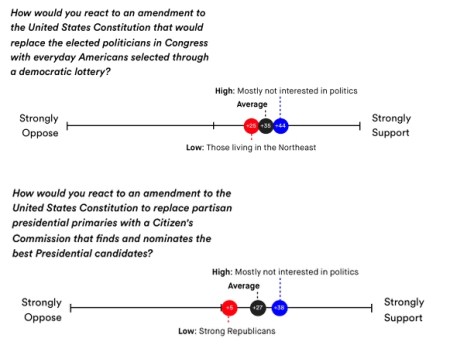
Americans support constitutional amendments replacing voting with lotteries

The chart below is excerpted from the results of an opinion survey conducted for “of by for” – an organization working “to get past parties and politicians and put everyday people front and center”. The organization has high profile sortition advocates such as Lawrence Lessig, James Fishkin and Jane Mansbridge as advisors.

Étienne Chouard: Public decision-making from the perspective of the common good, Part 4

Previously published parts of this essay are the Introduction, Part 1, Part 2 and Part 3.

It remains to examine the different applications of sortition in politics:

Part II. Comparison of different applications of sortition

Having seen how poorly the common good is served by elections and how well it is defended by sortition, we can ask (i) what are the principal applications of allotment for appointing representatives, and (ii) how could this procedure become part of a constitutional, institutional structure.

(i) Principal applications of sortition in politics

Elections among candidates are generally used to award privileges, whereas sortition is used to assign duties.

In addition, to fill a post or carry out a function we elect a single person for an extended duration, during which time there is little or no control over that person. With sortition, a group of people are allotted for a short period, during which time they are closely monitored.
Here are three notable models for the use of sortition in politics (keeping the most important one for the end):

1. Sortition for appointing oversight bodies

It is often asserted in the literature of political philosophy how important it is for citizens to closely control all forms of political power. Here is Montesquieu:

It is the universal experience that any man who carries power comes to abuse it. He abuses it up to the point where he finds his limits. Even virtue needs to have limits! In order to prevent abuse of power it is necessary to match power against power [The Spirit of the Laws, Book XI, Chapter IV].

Continue reading

Altman: Strengthening Democratic Quality: Reactive Deliberation in the Context of Direct Democracy

A 2014 paper by David Altman, professor of political science at the Pontificia Universidad Católica de Chile, proposes using citizen juries as part of the intiative/referendum process in a way that goes beyond Citizen Initiative Review.

Strengthening Democratic Quality: Reactive Deliberation in the Context of Direct Democracy

David Altman

Kellogg Institute for International Studies – Working Paper Series #400

Abstract: Acknowledging that mechanisms of direct democracy can fall prey to narrow and egoistic interests (regardless of how legitimate they may be) and that legislatures do not always have the incentives to articulate responses to those narrow interests, I propose a hypothetical reform: any time a popular vote (i.e., initiative, referendum, or authorities’ referendum) is held, representative and direct institutions should be supplied with a stratified random sample of eligible voters convened to advance citizens’ counterproposals. This original institution—which does not exist even in the places where direct democracy is most developed—would discuss, deliberate, and offer an alternative or an improvement to a policy question that is to be decided in the near future; it would refine and enlarge public views on a contentious topic, providing meaningful political choices, and thus strengthening democratic quality. In arguing for this, my research takes insights from two real-world situations—Uruguay’s two 2009 initiatives for constitutional reform—in which citizens’ counterproposals could have played a crucial role in informing public views on a contentious topic and offered an alternative to both sides of the debate.

Étienne Chouard: Public decision-making from the perspective of the common good: Breaking out of the electoral trap

What follows is the table of contents of a 2016 essay by Étienne Chouard, which Chouard describes as “my most recent methodical comparison between election and sortition”. I will publish my translation to English of the essay in several parts. The original French version is here.

Public decision-making from the perspective of the common good: Breaking out of the electoral trap
A comparison between election and allotment of representatives
Étienne Chouard, 2016
(Original in French, translation to English by Yoram Gat, 2020.)

Part I. A comparison of the general strengths and weaknesses of elections and allotment of representatives

  • (i) Elections infantilize, and in this way paralyze, the voters. They discourage thinking and defending the common good (whereas sortition does not)
    • 1. By definition, elections are aristocratic, whereas sortition is democratic
    • 2. By definition, elections are an abdication, a renunciation of the exercising of one’s sovereignty oneself, it is delegation, it is the renunciation of legislation, whereas sortition is the assertion of sovereignty
    • 3. Elections infantilize, strip of responsibility, dissuade from doing what is right, and distance the people from politics and the common good, whereas sortition encourages, and promotes responsibility for, doing the right thing
  • Continue reading

Sortition for selecting civilian police control boards

In an undated proposal by Max Rameau from the an organization called “Pan-African Community Action” the author writes:

A Model: The Civilian Police Control Board
The primary institution for the exercise of Community Control over Police is the Civilian Police Control Board (CPCB).

The CPCB must be comprised entirely of civilian adult human beings- not corporations or human representatives of corporations- residing in the police district. To be explicit, residing means living in, not owning property in, without regard to citizenship status or criminal history.

While some envision an elected board, we propose something entirely different: a board selected entirely at random among residents of the policing district.

There are two (2) main constraints to an elected board. First, elections in the US are thoroughly corrupted by influences of corporate finance on one side and two party electoral politics on the other. Even if multiple communities were to win control over their police, it is not difficult to imagine that after one or two election cycles, your local CPCB would be a corporate board brought to you by [ insert name of powerful corporation here ]. For this board to shift power, instead of becoming another institution to maintain power, it must break through the limitations of electoral corruption.

Second, even elections with minimal levels of corporate or party influence, still occur in a social context. In this social context, elected officials are disproportionately white, male and wealthy- the exact population with the highest level of support for the police. We must devise democratic systems that encourage active participation from those least likely to engage, not those most likely to benefit.

Sortition- government by random selection- is the best way to ensure that everyone has an equal opportunity to exercise power. The rich and poor, straight and gay, male and female, white and Black all have an equal shot at making decisions through random selection. If we believe that democracy is for everyone, then random selection of officials is the best way to ensure each person can exercise power.
Continue reading

Defending independence in the age of deep spin

If you know anything about the latest State of the Union Address, you know that after Donald Trump had handed Nancy Pelosi his speech as if she were his secretary when she held out her hand to him to shake hands, Pelosi tore up his speech. Didn’t look particularly well-judged politically to do that to me but there you go. What would I know?

Trump operatives have now released the video (above) of Pelosi tearing up his speech spliced interleaved with Trump’s comments praising heroes like aged soldiers. Facebook have agreed to take down the video as obviously misleading.

(Only kidding. Facebook wasn’t interested in getting in the way of its profits). On the other hand, Twitter has said that the Tweet violates policy that will be enforced when they’re ready to do so on March 2.

I can imagine it’s a scary call for Twitter to say so to the Gangster in chief. Rage will ensue and Donald Trump has a lot of power including the power of his mob. In those circumstances if I were Twitter, I’d be wanting to distance myself from this process, whilst having a decent approach.

I’d do it with a standing citizens’ assembly. If I were Twitter I’d recruit a demonstrably objective selection of ordinary American citizens using the same kinds of methods we use to recruit juries (in which I’d include random selection and representative random selection of various kinds.)
Continue reading

Van Reybrouck’s Against Elections translated to Japanese

Prof. Seiki Okazaki of Kyushu University, Japan, wrote to draw attention to the publication of a translation of David Van Reybrouck’s book Against Elections to Japanese. It seems the book has generated significant interest in Japan. Prof. Okazaki attributes the positive reception to some extent to the fact that sortition-based judicial institutions have been part of the Japanese system for a decade.

The Japanese translation of David Van Reybrouck’s Against Elections (Tegen Verkiezingen) appeared in April 2019 […] Three of the four national newspapers published a book review: the Yomiuri Shimbun on May 19, the Asahi Shimbun on June 1, and the Nikkei on August 10. Many regional newspapers printed a book review transmitted by Kyodo News. Other newspapers and magazines also reviewed the book favourably. Supported by these reviews, the book was reprinted as early as September 2019.

2019 marked the 10th anniversary of the the lay judge trial system and of the mandatory prosecution through citizen review of non-charge decisions. These are both reforms related to the criminal justice system in Japan enhancing the participation of citizens using sortition in a procedure that was until then exclusive territory of professionals. As the Supreme Court noted, the lay judge system has become well accepted and acquired legitimacy in Japanese society. Japanese citizens have become familiar with sortition in the judicial system and realize how this enhances quality and democracy in the courts. This is probably one of the reasons that Japanese citizens are interested in the central arguments developed in Against Elections and why sortition was not immediately rejected a proposal unfeasible for Japanese society.

However, the most important factor for the book’s success is the wide and deep distrust of party politics. Opinion polls show that about 40 percent of Japanese voters support no political party.

OKAZAKI Seiki, one of the translators of Against Elections, proposed to replace the elected House of Councillors with the sorted House of Citizens. He suggests that the sorted House can exercise veto power over the decisions of the elected House (Okazaki Seiki, “Election and Sortition,” Kenpo-kenkyu (Review of Constitutional Law), No. 5, November 2019, pp. 87-96. Written in Japanese).