2018 review – sortition-related events

This is the end-of-year summary of notable sortition related events for 2018.

Sortition received some increasing attention in the English-speaking world in 2018. The Hannah Arendt Center for Politics and Humanities at Bard College has announced the creation of the Bard Institute for the Revival of Democracy through Sortition. Richard Askwith and Tim Dunlop published books advocating for sortition. Selina Thompson put on a sortition-themed play and organized a sortition-themed workshop. Van Reybrouck’s Against Elections was (dismissively) reviewed in the New York Times. Sortition was featured in the Left-leaning magazine Jacobin as well as on BBC radio, and was mentioned in the Washington Post. Canadian scientist and environmentalist expressed interest in drawing politicians from a hat.

Brett Hennig’s TED talk about sortition was featured by TED on their main page, generating a spike of interest in the idea, including by Beppe Grillo, co-founder of the Italian electorally successful Five Star movement. Another spike of interest in sortition followed media reports about the arrest of a sortition advocate who allegedly planned to blow himself up in an attempt to draw attention to the idea.

Late in the year, sortition was on the agenda of two mass-action movements: UK’s Extinction Rebellion and France’s Gilets Jaunes.

Earlier in the year elites continued to express their dissatisfaction with the way elections are turning out. A proposal was made to use sortition to improve citizen behavior. Former UK prime minister Gordon Brown made a similar suggestion in the context of Brexit. The Ireland abortion referendum that approved the recommendations of an allotted chamber was held as an example to emulate.

Reports about sortition being used or advocated at local government appeared in the press. An initiative for appointing judges by lot is under way in Switzerland. Charlie Pache, a Swiss sortition activist, promotes single issue allotted citizen panels. Academic conferences about sortition were held in Belgium and in the US.

In France, the discussion has moved beyond the initial stage of unfamiliarity into some substantive discussion of the details of applications of sortition. A member of La France insoumise who was allotted to its electoral committee expressed disillusionment with the process. Other FI activists claim that “so far, the allotted have had no real power”. Michel Quatrevalet, a power industry professional in France, complains that the so-called participatory democracy process that was part of the process for the creation of a French multi-year energy plan was a sham.

Democracy For Young People: a provocative podcast

Democracy For Young People is, in my opinion a very compelling analysis of the ills of our democracy. It’s a very simple idea – which is that electoral democracy massively underrepresents three classes of people whose influence on democracy the great anti-democrats of the ancient world (i.e. all the thinkers whose work has come down to us in any substantial form) were most hostile to. The young, the poorly educated and the poor.

I thought the ‘solutions’ section would end up at selection by lot, but it moved right along from that to lowering the voting age (dramatically!). But then the conclusion on what to do was an afterthought, and not really the focus of the podcast. The analysis was compelling. It’s good points are that the ideas are very simple, clearly important. They’re also clearly right to some extent, though of course there could be very wide reasonable disagreement on that extent.

So I recommend it.

Gordon Brown embraces citizens’ assemblies

In a thoughtful contribution to considering the governance of Britain in the context of the still running Brexit fiasco, Gordon Brown offers this suggestion:

We must renounce the unsatisfactory, inward-looking, partisan and inevitably piecemeal decision-making process of the past 30 months.

In the old days, political parties saw their role as aggregating and then articulating grassroots views. But to the British people the parties seem – like social media – to be dominated by those with the loudest voice.

[…]

I envisage bringing together in each region a representative panel of a few hundred citizens, engaging them in a day’s dialogue to deliberate on arguments presented by informed opinion leaders and advocates from both sides — and testing whether pro and anti-Brexit voters can find any common ground.

The Justice Initiative: Appointing the Federal Judges by Sortition

Collection of signatures for the Justice Initiative has been going on over the last month. By autumn 2019, the initiative must be signed by 100,000 citizens for it to qualify for the Swiss ballot. Although social networks are playing an increasingly important role in politics, the collectors of signatures on the street need convincing arguments.

The website is in French, German, Italian and Roman. I translated the German text using automatic translation and made some minor corrections. For those who can read German, here is the original text:

Bundesrichterinnen und Bundesrichter sollen Entscheide frei von Interessenkonflikten und politischen Einflüssen fällen können. Das ist heute nicht möglich.

Um von der Bundesversammlung als Bundesrichterin oder Bundesrichter gewählt zu werden, muss eine Person heute de facto einer politischen Partei angehören und über gute Beziehungen zu Entscheidungsträgern verfügen.

Dieses Beziehungsgeflecht besteht auch nach der Wahl in das Bundesgericht und kann die Entscheide der Richterinnen und Richter beeinflussen. Zudem kann mit der Drohung der Abwahl, Druck auf Richterinnen und Richter ausgeübt werden.

Deshalb sollen Juristinnen und Juristen alleine aufgrund ihrer Fähigkeiten – auch ohne Beziehungsnetz in die Politik und Verwaltung hinein – Bundesrichterin und Bundesrichter werden können. Und als solche sollten sie auch bei unbequemen Entscheiden keine Nachteile zu befürchten haben und nicht abgewählt werden können.

Diese Ziele werden mit der eidgenössischen Volksinitiative «Bestimmung der Bundesrichterinnen und Bundesrichter im Losverfahren» erreicht.

Richterkandidatinnen und -kandidaten dürfen einzig aufgrund ihrer fachlichen und persönlichen Qualifikation am Losverfahren teilnehmen. Das Losverfahren garantiert eine faire Besetzung des Bundesgerichts, ohne Rücksicht auf allfällige Parteibücher. Die im Losverfahren bestimmten Bundesrichterinnen und Bundesrichter, bleiben bis zur Pensionierung im Amt.

Translation:

Federal judges should be able to make decisions free from conflicts of interest and political influences. That is not possible today. To be elected by the Federal Assembly as a federal judge or a federal judge, a person today must de facto belong to a political party and have good relations with decision-makers. This network of relationships also exists after the election to the Federal Supreme Court and can influence the decisions of the judges. In addition, with the threat of dismissal, pressure can be exercised on judges. That is why lawyers should be able to become federal judges on their own merits – without a network of relationships in politics and administration. And as such, they should not have to worry about consequences of uncomfortable decisions and about being voted out. These goals are achieved with the federal popular initiative “Appointing the Federal Judges by Sortition”. Judge candidates may participate in the process solely on the basis of their professional and personal qualifications. The sortition system guarantees a fair composition of the Federal Court, regardless of any party membership. The federal judges, who are determined by lot, remain in office until retirement.

This might be a very important step for the use of sortition in present society.  And not limited to the appointment of judges. Let’s hope they get the 100,000 signatures in time.

Fishkin: Random Assemblies for Lawmaking? Prospects and Limits

James Fishkin’s contribution to the September 2017 workshop “Legislature by Lot” was titled “Random Assemblies for Lawmaking? Prospects and Limits”:

Abstract
A randomly selected microcosm of the people can usefully play an official role in the lawmaking process. However, there are serious issues to be confronted if such a random sample were to take on the role of a full-scale, full-time second chamber. Some skeptical considerations are detailed. There are also advantages to short convenings of such a sample to take on some of the roles of a second chamber. This article provides a response to the skeptical considerations. Precedents from ancient Athens show how such short-term convenings of a deliberating microcosm can be positioned before, during, or after other elements of the lawmaking process. The article draws on experience from Deliberative Polling to show how this is both practical and productive for the lawmaking process.

Keywords
Athens, corruption, Deliberative Polling, elections, minipublics, nomothetai, representative democracy, sortition

In arguing for short term “Delibertive Polls”, Fishkin offers three problems with long-term allotted chambers: (1) lack of technical expertise, (2) potential for corruption, and (3) not maintaining what he calls “the conditions for deliberation”.
Continue reading

Southall: A proposal for using sortition in South Africa

A 2017 paper by Roger Southall in Politikon, the South African Journal of Political Studies, proposes applying sortition in South Africa.

The Case for Sortition: Tackling the Limitations of Democracy in South Africa

Roger Southall, University of Witwatersrand, Johannesburg, South Africa and the Department of Political Studies, University of Cape Town, Cape Town, South Africa

Abstract

This article considers how the erosion of democracy in South Africa since 1994 might be addressed through sortition, the random selection of citizens to perform public tasks. Drawing upon the recent essay outlining the case Against Elections by David Van Reybrouck [(2016). Against Elections: The Case for Democracy. London: Bodley Head], which paints liberal democracy as facilitating rule by elites, it argues for the appointment of sortition panels to consider reform of the electoral system. Sortition in South Africa could draw upon streams of participatory democracy experienced during the struggle against apartheid, and lead towards a more deliberative democracy.

Dan Hind: The Cooperative State

Dan Hind proposes using sortition to achieve a “cooperative state”.

Rather refreshingly Hind rejects the “modernization” argument:

I do not propose far-reaching constitutional change in Britain or the United States because the current arrangements are irrational or anachronistic. On the contrary, these arrangements are, for the most part, rational and frighteningly up-to-date.

Hind’s proposal is an elections-sortition hybrid:

The idea is not to do away with elections. Some offices require technical abilities or experience and election does not seem like a terrible way of filling them, even if at times it is hard to imagine a worse person for an elected office than the person holding it. But it does not follow that public office should be monopolised by those who, for whatever reason, manage to win an election. Indeed, if representation is to retain its authority, it will have to be supplemented by more properly democratic institutional forms.

Hind seems to fall into an obvious fallacy: the simple point that not every position should be filled by lot does very little to advance the argument that some positions should be filled by election.

That said, Hind does propose to invest allotted bodies with some real powers of oversight:
Continue reading

Demarchy—small, sample electorates electing officials

From Cornucopia of Ideas, Social Inventions Journal for 2001, by Roger Knights, “Demarchy—small, sample electorates electing officials,” pages 237–44

[SIJ editor’s comment:] Sumarized from a longer paper by Roger Knights entitled ’Nec Pluribus Impar’ which can be read in full on the web (at www.globalideasbank.org/demarchy.html)

(Alas, it’s no longer available online because the Global Ideas Bank was hacked and destroyed. My own copy was lost due to one of Microsoft’s black screens of death.—Roger Knights)

I contend that if the power of electing officials were transferred to small, sample electorates, government would be more accountable to common sense. 

What’s wrong with current democracy is that it is too influenced by interest groups and crusading moralists. And where those two forces are in abeyance, it lacks common sense.

The theory of democracy is that the government should be accountable to the common sense of the community. Now, common sense is a quality, not a quantity; it is present to the same degree in a small sample of the electorate as it is in the whole body. This system of demarchy that I propose would make democracy more real.
Continue reading

Tim Dunlop: It’s time to replace voting with sortition

In 2014 Tim Dunlop had just been introduced to the idea of sortition by David Van Reybrouck. He was “not completely convinced by his [Van Reybrouck’s] argument, but [was] sufficiently incensed by our current parliamentary democracy and its many failures to at least consider what he suggests.”

Four years later, Dunlop has written a book advocating sortition, and has an article in the Guardian that opens with an unambiguous statement:

If we want to fix the way our governments work, the first thing we should do is replace voting with sortition in at least some of our governing bodies.

Like many feel-good reformists, Dunlop puts much emphasis on the potential for fostering deliberation, trust and respect amongst the members of the allotted chamber and by extension, in the population at large. However, bucking the norm among such reformists (including Van Reybrouck), Dunlop’s message is very clearly democratic in the most fundamental sense (i.e., making power representative) and his rejection of elections and its elitist implications is uncompromising.

If we are really serious about bottom-up reform of our democratic institutions, then reforming the seat of government itself in this way, a way that installs ordinary people at the heart of power, is essential. Our neoliberal economy and the representative form of government that dominates our societies do everything they can to divide us from and pit us against each other. A People’s House transcends these divisions and brings us together. The basic concept of sortition is pretty straight-forward, and introducing it as a replacement for voting in, say, the Australian Senate, while leaving that body’s other powers intact, represents, at least administratively, fairly minimalist change. But on every other level, the potential effect is explosive. In one fell swoop, you diminish the power of the parties and that of many of the lobbyists who exist to influence their decisions. You transform the way in which the media covers politics. You hand control of at least part of the legislative process to a genuinely representative sample of the population as whole, rather than vesting it in a bunch of elites and their representatives. You empower people in a way that the current system could never hope to do, and you reconnect our chief democratic institution with the life in common.

Nothing is going to change until the main source of power in our society, our seat of government, is populated by people who are genuinely representative of the society at large. We have been taught forever that the way to do that is by voting, but that is simply wrong, and the quicker we unlearn it the better, no matter how counterintuitive it might seem at first. If you want a truly representative government of, by and for the people, then you need to choose it not by voting, but by sortition.

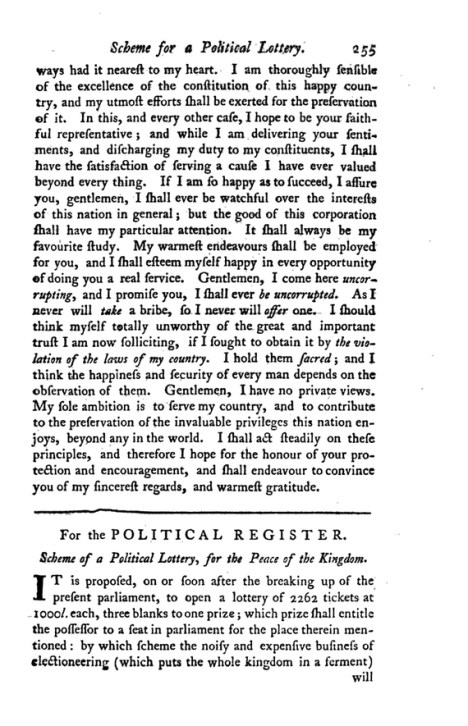
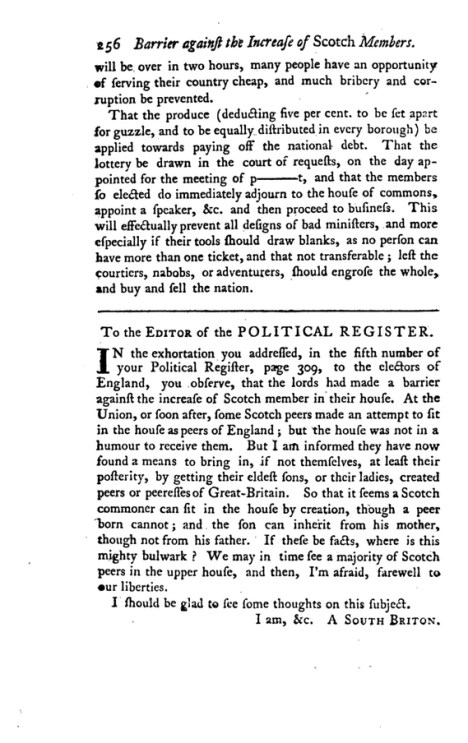
1768: Scheme of a Political Lottery, for the Peace of the Kingdom

The following letter to the Political Register and Impartial Review of New Books, printed in London in 1768, offers sortition of parliament as a way to remedy the corruption of elections. Thanks to Terry Bouricius for drawing attention to this historical piece.

Scheme of a Political Lottery, for the Peace of the Kingdom

It is proposed, on or soon after the breaking up of the present parliament, to open a lottery of 2262 tickets at 1000l. each, three blanks to one prize; which prize shall entitle the possessor to a seat in parliament for the place therein mentioned: by which scheme the noisy and expensive business of electioneering (which puts the whole kingdom in ferment) will be over in two hours, many people have an opportunity of serving their country cheap, and much bribary and corruption be prevented.

The the produce (deducting five per cent. to be set apart for guzzle, and to be equally distributed in every borough) be applied towards paying the national debt. That the lottery be drawn in the court of requests, on the day appointed for the meeting of p——t, and that the members so elected do immediately adjourn to the house of commons, appoint a speaker, &c. and then proceed to business. This will effectually prevent all designs of bad ministers, and more especially if their tools should draw blanks, as no person can have more than one ticket, and that not transferable; lest the courtiers, nabobs, or adventurers, should engrose the whole and buy and sell the nation.