Arash Abizadeh: Take electoral reform away from politicians and let citizens decide

David Schecter wrote to point out an article in the Canadian Globe and Mail by Arash Abizadeh, a professor of political science at McGill University:

Take electoral reform away from politicians and let citizens decide

Prime Minister Justin Trudeau campaigned on a promise to change the way we elect Parliament. Here’s the problem: letting politicians who won the last election decide future election rules is like letting the team who won the last playoff game decide rules for the next game. There’s an obvious conflict of interest. Electoral rules determine who forms government, and different rules favour different parties.

[…]

One solution is a referendum. But the Liberals have ruled this out. Maybe they’re right to do so. Referenda are expensive, few Canadians care much about electoral reform, and fewer still will cuddle up with a treatise on voting systems this Sunday evening. A referendum might be a big waste of money in which few vote and fewer still care to learn about the pros and cons of alternative electoral systems.

But without a referendum, how could electoral reform be legitimized? We need a manifestly fair procedure – a neutral body, unbeholden to politicians, that will reasonably evaluate the alternatives.

Fortunately, political scientists have a solution that fits the bill – a randomly selected citizen assembly. The idea is this: randomly select a few thousand Canadians, ask if they are willing to serve, and, from those saying yes, randomly select 100 to 200 to serve on an assembly empowered to determine federal election rules.
Continue reading

Gutting: Should Everyone Vote?

An op-ed piece in The New York Times by Gary Gutting, a professor of philosophy at the University of Notre Dame:

At election time we inevitably hear earnest pleas for everyone to vote. Voter participation is a data point often cited in political studies, along with an assumption that the higher the percentage, the better: 100 percent participation is the goal. But we rarely question this belief, or objectively consider whether everyone who can vote ought to vote.

The author then outlines the problems of mass democracy, including ‘trumpery’, plutocracy and rational ignorance, and attempts to justify voting as an act of participatory solidarity. But he goes on to consider sortition as an alternative:

At least one political philosopher has put forward the radical idea that we could ensure informed voters by employing an “enfranchisement lottery.” Such a lottery would restrict voting to a randomly chosen group of citizens who are provided unbiased in-depth information relevant to an election. We can think of this approach as a matter of modeling our voting on our jury system. We would never accept deciding important and highly publicized trials by a vote of the general public. We think only people fully informed of the facts and relevant arguments put forward in a trial should make such important judgments. Shouldn’t we be at least as careful in deciding who should be president?

Notice that answering yes does not imply the elitist view that only a small minority of citizens are capable of making informed votes. The idea is not that voters are too stupid or biased to access the needed information; it’s just that they don’t have the time and resources to do so. Ideally, we would provide everyone with the relevant knowledge, but that would be impractical, time-consuming and expensive.

Continue reading

Aftermath of the Irish Election

I recently ran in the Irish general election that was held on Feb. 26th as an Independent (Non-Party) candidate, campaigning on a platform of direct digital democracy.

As some of you may know, this election did not deliver a clear winner or even a clear coalition. A month on, a government has yet to be formed. While some prefer to see this as an argument in favour of the need for stronger government and an end to Independents like me, my view is that it is but one further indictment of the party system. The major parties did badly because they refused (for years) to listen to the people who voted for them, and utterly failed during their campaigns to credibly address any of the mistakes they had made or even to present reasonable solutions for the future. Despite these failures, rather than getting on with the business of governing the country, we are left in limbo waiting to see whether any of them (Fianna Fail, Fine Gael and Sinn Fein) will condescend to form a government with each other. This is a distinct possibility for Fianna Fail and Fine Gael, who between them received nearly 60% of all seats with less than 50% of first-preference votes. The constantly trumpeted line that the public voted for the establishment parties is thus wildly over-stated, and there has definitely been a serious push towards alternative politics.

I definitely noticed this while out canvassing, with most people at least open to the idea of more participatory politics and a surprising number already fairly well-informed about participatory initiatives at home and abroad. Most surprisingly of all, I could knock on people’s doors out of the blue and they would not only answer the door, but read through my literature there and then and really engage with the issues.
Continue reading

Policy and representation

There are two activities that go under the heading “Public Policy”, one that concentrates on political processes, as we do here on this website, and the other that is the focus of university departments of Public Policy and numerous professional associations. The first group (call them PPs) are concerned with political processes of arriving at political decisions, the second (call them PNs) with identifying needs in the community and devising means of satisfying those needs.

The two hardly ever engage with each other. If they did, the PPs would no doubt say to the PNs: you are at best just paternalists, patching up holes in the status quo, arrogating to yourselves decisions about what others need. To which the PNs might reply: you PPs are just entrenching the power of existing adults to suit yourselves. You completely neglect the fact that the young are in no position to understand what lies ahead of them and many disadvantaged people are deprived of the means of understanding what it is that they need to overcome their disabilities. They depend on the ‘paternalistic’ interest of competent professionals to bring about the changes that will open up opportunities for them. With all due respect, you PPs, however benevolent, are not very good at that. Your concern is framed by your own experience and aspirations, drawn from your past, not by any understanding of the potential of the future. You just want to replicate yourselves.

There is a lot more to be said on both sides. I’m an old PP, but one of my daughters, both of whom I greatly admire, is a very successful PN in educational policy. More significantly, there is a lot of empirical evidence that adult representation leads to decisions that favour the old at the expense of the young. Especially as life expectancies increase, we oldies and potential oldies would outvote the young by large margins, if it were a question of deciding policy by voting. Such arguments as these challenge the supremacy of representation as the unique ground of legitimate intervention on behalf of others. I am talking here of debates on policy, not about the right to legislate or administer programs. Status in public debates is not a matter of authorisation of any sort, but of the validity of arguments.
Continue reading

Sortition: the idea, the meeting, and a strategy

[Latest news from the Sortition Foundation blog]

There’s exciting news from the Sortition Foundation:

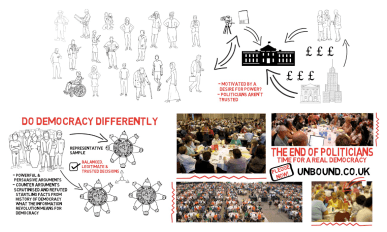
  • The idea: A new “compelling, inspiring” book on sortition, The End of Politicians, by director and co-founder of the Sortition Foundation, Brett Hennig, is being crowd-funded now by book publisher Unbound: https://unbound.co.uk/books/the-end-of-politicians

The-End-of-Politicians-screeenshot

  • The meeting: The first Sortition Foundation Annual General Meeting will be held at 6pm on Wednesday April 6th in central London. Venue to be confirmed depending on numbers, so please RSVP if you intend to come along.
  • The Strategy: A strategy meeting on how to progress the Citizens’ Parliament campaign (http://www.citizensparliament.uk/) will also be held on Wednesday April 6th from 1-4pm in central London. Exact venue will also depend on numbers, so please RSVP if you want to come along.

Read on for more details on all of the above.

Continue reading

Irish senior coalition party wants more allotted bodies

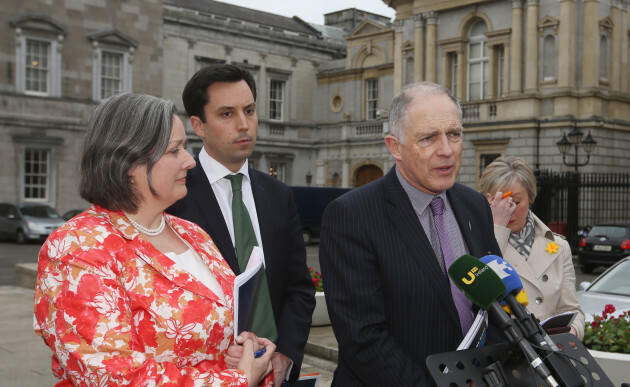
During a recent presentation of their party’s government reform plans, four parliament members from the Irish senior governing party Fine Gael said that “the party wants ’randomly selected’ members of the public to review issues like climate change, Seanad Reform and the Eighth Amendment”, thejournal.ie reports. The report adds:

Fine Gael has previously suggested the issue of the Eighth Amendment could be put to a public forum similar to the Constitutional Convention.

The party has expanded on that with its proposal for a ‘Citizens’ Assembly’ consisting of members of the public who could carry out a “detailed review of a limited number of key issues”.

Their findings would be referred to the appropriate Oireachtas Committee and then to the government.

Marcella Corcoran Kennedy TD insisted that the Citizens Assembly would not be a ‘talking shop’ that would put issues like abortion on the long finger: “Because it would be established by the Oireachtas, you could set specific timelines so there’s plenty of scope there to make the Oireachtas involved to a greater degree with the result of the discussions of the Citizen’s Assembly.”

On the issue of climate change, Corcoran Kennedy said that putting it to a Citizen’s Assembly would help make the issue “part of the dialogue of every citizen in this country”.

Sortition and multiple authorities

There are often powerful considerations in favour of having distinct authorities with distinct jurisdictions and constitutions and procedures to address certain problems that are not well treated if approached from the point of view of the state, whether that word refers to nation-states or members of a federation.

An obvious case is that of a river system that impinges on many states in a long chain from the sources of the various streams that contribute to it to its final discharge into the sea, if it gets that far. What each state does or permits in the light of its own interests often impinges on many of the others, particularly those nearer to the end of the chain. One solution where all the states in question are part of the same federation is simply to hand the problems of conflicting interests over to the feds, who should be able to take an impartial view.

In practice that is often unsatisfactory. It may reduce the riverine interests to pawns in federal politics. It may lead to federal meddling in the whole range of state interests in land management to the detriment of those interests. Different federal authorities may intervene in ways that are influenced more by a desire to have a uniform policy on some matter across the federation than by attention to the particular problems of that river system. So it seems most desirable to have an authority that is focussed on arriving at good solutions to the complex problems, ecological, commercial, recreational and developmental that it throws up. In ensuring a balanced input into the decision processes of such an authority sortition on various bases is likely to give better results than standard voting practices. It is not just a matter of the divergent interests of the states, but of balancing various ecological considerations against each other and against a variety of commercial or consumer interests. I’ll return to this point below.

Continue reading

Aspects of decision-making

1. Public affairs and rational ignorance.

The argument: It is rarely rational for anybody to vote or engage in some other political activities because the chance of influencing the outcome is so infinitesimal that it does not merit the slightest effort.

Reply. That is one consideration, but it is not only a false picture of the thinking of most people, but not the only rational consideration. Many, I think most, voters also recognise two other dimensions to their role as voters.

One is that they see voting as an expressive act and feel it is important to them to express themselves in this way. That is why opposition voters still turn out to vote in what is a safe seat for the incumbent party. Moreover, voters are concerned that in expressing their support for a candidate or a party they are ding something that reflects credit on them. So they are concerned to exercise what influence they can on that candidate or party to adopt policies that they find admirable.

Another reason why the selfish approach is not rational is that people quite rightly do not take an entirely selfish attitude to public goods. Their identity as members of a particular community is closely bound up with the quality of the public goods in which they can share as members of the community. So they do have an interest in the quality of the community’s educational institutions, even though they do not expect any particular pay-off to them from those institutions. Moreover, they are usually well aware that the sort of cost-benefit analyses that reduce benefits to measurable benefits to individuals leads to a penny-pinching approach to funding policy decisions that is often destructive and counterproductive in its effects. It is not rational.

That is not to say that it is improper in choosing to support one rather than another of competing proposals about, say, an educational program, to do so because it suits one’s own interests better. Practical decisions are rarely one-dimensional. They involve diverse, often competing, considerations in varying degrees in different contexts.
Continue reading

Demarchy and the ways of the world

1. Demarchy assumes that enough people will engage in the complex of serious activities it is supposed to work on to convince people that the outcome of those activities can claim to represent public opinion.

Looking at the way in which public opinion is in fact formed in our society that seems an absurd assumption.

Even if we go back to Habermas’s beloved 18th century coffee house it is utterly unrealistic. Public opinion emerges from a host of conversations in which what is going on or what is proposed is talked about in terms of familiar images. What is prized in conversation in all sorts of social contexts, from groups of labourers on lunch break to elite dinner parties is wit, the remark that encapsulates a way of looking at a subject in a new light that is at least in some respect plausible.

The cardinal sin in conversation is to insist on spelling out in detail just where that slant on the subject is misrepresented. People are not expected to take casual remarks seriously. That is utterly boring and destructive of conversation. Nevertheless there is overwhelming evidence that people are very strongly influenced by the cumulative effects of the caricatures that prevail in representations of ideas and states of affairs and come to be seen as expressing public opinion.

Even very sophisticated people succumb to this sort of conversation, because they are very aware that political affairs are usually so complicated that there is little chance of arriving at a rationally justified analysis and verdict on them. One just despairs or hopes that the obscure processes of social change will tend towards decisions one can live with. But there is no prospect of getting reliable decisions about political matters by discussion. So Demarchy is nonsense.

Reply: I concede there is a great deal of truth in this picture, but as a generalisation it is too sweeping. At the risk of being boring I shall try to explain why. There are several aspects to it.
Continue reading

The practicalities of demarchy

1. In order to be THE voice of public opinion the council advancing that claim would need to be unique and unchallenged. But if anybody can set up a rival council, that is impossible. If anybody takes it seriously, it will be challenged and rivals set up.

Answer. There are two stages in the proposal: a fully open public discussion and the council attempting to draw a practical policy from that discussion.

The public discussion will be unique if the Foundation sponsoring it has adequate resources to publish and render accessible on line every word that anybody thinks relevant to the problem under discussion. If anybody sets up a rival forum, all of its content will be posted on the original site, where it could have been posted at no cost. So if somebody refuses to allow certain material to be posted, they are refusing to offer it for public scrutiny.

How might they justify that refusal?

Perhaps it is copyright, and they demand to be paid for it. In a genuine case, the foundation might agree to pay whatever any other user would pay for it. In some cases a reference to sites on which it has been published might suffice.

In other cases the appeal might be to confidentiality, for example, in the case of survey documents. That sort of confidence protects the identity of contributors to the survey, not its content. When it comes to privacy about the actions of individuals and organisations, such privacy can never be invoked in a way that favours a competing open forum. It has to remain private.

Some may argue that the way in which the problem is described by the foundation in initiating discussion is subtly biased to exclude certain viewpoints. In that case they need to state their case and argue it publicly.

A completely open forum, including full documentation on the proceedings of the foundation, can be reduplicated, but the only point that could have was to try to exclude certain contributions. And that cannot be done with impunity.
Continue reading