Sortition Foundation: a new campaign for government by sortition

Last week a new campaign was launched to demand government by sortition.

sortition-definition2

Its aim is to promote sortition and build a movement demanding the replacement of elections with sortition.

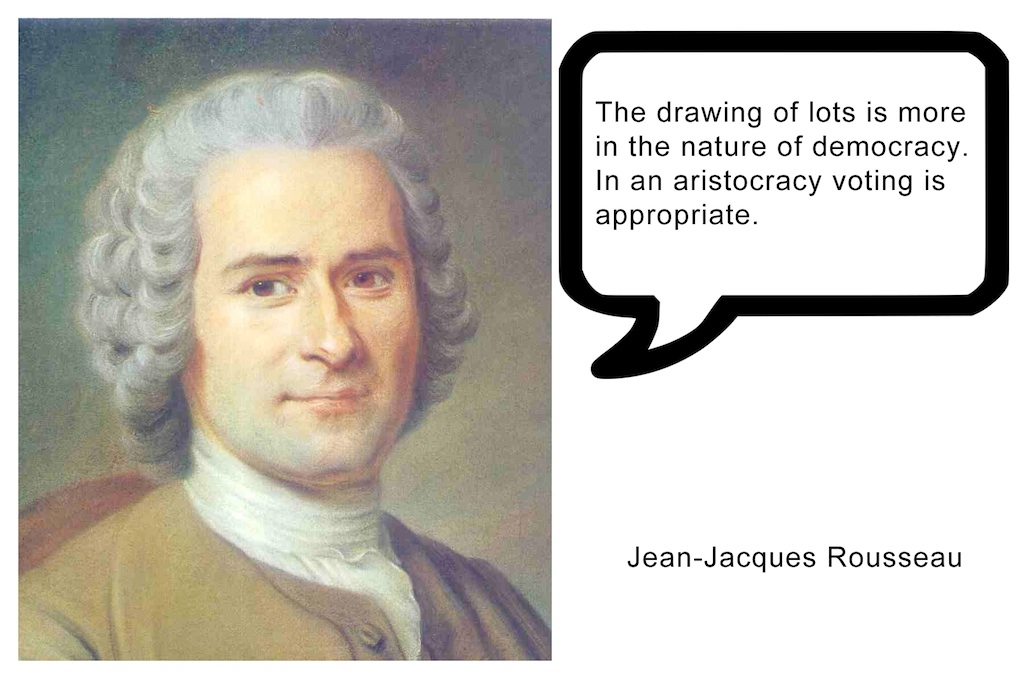
rousseau-1024

To support or promote it, visit http://www.sortitionfoundation.org/, like it on Facebook: https://www.facebook.com/SortitionFoundation or follow it on Twitter @SortitionNow

For more information, or to give feedback or offer to help, please use
the contact page: http://www.sortitionfoundation.org/contact

[Editor’s note: this post was modified after posting as the group changed its name]

New Democratic Seeds / Gentils Virus Manifesto

The Chouardists are at it, this time with a new site (in five languages) calling for an allotted constitutional assembly. They explain their project in six “chapters” that you can see along with a visitor count on the left margin. Here is the main page followed by the first part. They have also included what appears to be an endless number of videos of Chouard and some other resources.

It is the explicit proposal which should rally the millions of citizens whose political impotency is programmed in the constitution.

Because it is not the role of the people in power to write the rules of their own power

“We want a democratic Constitutional Assembly, therefore randomly drawn.”

By reading the 6 chapters of this website, you will understand that if you want to change anything in the mechanisms of our current society, you will have to make this message your one and only claim: from its application the rest will follow. To understand the strength of this message, please take a few minutes to read through the six chapters of the website, they are very short.
Continue reading

Down with Elections! Part 2

DOWN WITH ELECTIONS!

Part 1 Part 2 Part 3 Part 4 Part 5 Part 6

PART 2

Direct Democracy

One possible alternative to representative democracy is “direct democracy”. In this, every citizen votes on every decision. This happens in clubs and associations of course, where it works quite well. When members vote on which candidates should fill an office (Honorary President, Secretary etc), they generally know the candidates personally, and so are well able to judge their capabilities, and in any case the responsibilities and powers mandated are very limited, both in scope and in time (annual elections are the rule). Moreover, club members very often vote directly on practical issues, and these are almost always on matters well understood by the members. Further, they are free to propose amendments, and so when the matter comes to the vote, they are voting on the question which they want to decide, and not on some ambiguous question which a party in power can interpret to suit itself. They are also free to put matters on the agenda, and to call for a vote of no-confidence in office-bearers.

Direct democracy also occurs occasionally in representative democracy in the form of a referendum, where its use is often much more dubious. A lot depends on the way in which the choice is framed: a party in power may put it in such a way as to split the opposition. The matter may be technical; often the full ramifications of the choice are not made clear to the public; they cannot propose amendments, or discuss it beforehand on an equal basis, because debate is largely controlled by the media or the government. The referendum in France on the proposed European Constitution in 2007 exemplified these problems: the public was presented with a long and incomprehensible (at least to non-specialists) document whose implications were not at all clear. An irritated public voted against it (mostly in order to spite President Chirac), and in doing so pointed out another defect of referenda: the voters’ verdict is not necessarily given on the question that is officially posed.

Proponents of direct democracy would extend the principle to every decision made by the community, and some of them suggest that only measures passed unanimously should be implemented. To the obvious objection that this is impractical in a large modern state of tens or hundreds of millions, the true believers reply that the state should be abolished, to be replaced by small autonomous communities of a few thousand.
Continue reading

El partido mejicano Morena seleccionará candidatos para el Congreso y los ayuntamientos por sorteo

Morena — Movimiento Regeneración Nacional— es un nuevo partido mejicano de izquierdas fundado por Andrés Manuel López Obrador que en 2006 y 2012 concurrió sin éxito como candidato a la presidencia de México representando al PRD, uno de los dos partidos más importantes del país.

En lo que parece ser el uso más significativo del sorteo en los más de doscientos años de Gobierno representativo, Martí Batres, presidente del partido, anunció en diciembre que Morena seleccionará por sorteo a parte de sus candidatos —los de representación proporcional (RP)— al Congreso y al Senado.

Martí Batres señaló que “Mientras los partidos tradicionales reservan las candidaturas plurinominales (RP) para asegurar que sus principales dirigentes accedan a cargos de elección, en Morena estos espacios se sortearán entre la militancia”, mencionó Batres,  según un comunicado de prensa.

De ese modo, explicó, “se garantiza que hasta el más humilde compañero de base” tenga posibilidades de acceder a una diputación.

Continue reading

Batres: Morena will select congressional candidates by sortition

Morena – Movimiento Regeneración Nacional, National Regeneration Movement – is a new left-leaning political party in Mexico. Morena was founded by Andres Manuel Lopez Obrador (AMLO), who was a presidential candidate for the PRD, one of the two major parties in Mexico, in 2006 and 2012 – losing both bids.

In what seems to be the most significant application of sortition of the modern age, Martí Batres, the party president, announced in December that Morena will select some of its candidates for the upcoming congressional elections by sortition:

The National Regeneration Movement (Morena) will select its candidates for proportional representation congressional seats by lottery, party president, Marti Batres, said Friday.

“While the traditional parties use the PR candidacies to secure elected positions for their main leaders, Morena will allot these candidacies among the members,” said Batres, according to a press release.

This, he explained, “ensures that even the humblest party supporter” can become a congressional delegate.

Continue reading

“Down with Elections!” A Pure Sortition Proposal, Part 1

This is my latest thinking on the subject, and rather long-winded, I’m afraid, so I’m posting it in six parts.

Some of it is reheated leftovers, my apologies, but my mind works slowly, I have to save it labour if I can. For the same reason, the title has been pressed into service again.

It’s written for the general public, not the erudite intellectuals of this forum, but I’d like to know if there are any errors of fact, in fact any suggestions would be welcome.

DOWN WITH ELECTIONS!

Part 1 Part 2 Part 3 Part 4 Part 5 Part 6

PART 1

Introduction

“DOWN WITH ELECTIONS!”?

How could anyone except a would-be dictator be so stupid, so irresponsible, or so perverse as to wish to see the end of elections?

In the developed and supposedly democratic world, we are accustomed to think that freedom and democracy, if not quite synonymous, go hand in hand; that one is not possible without the other. We assume, usually without giving the matter much thought, that elections are necessary for democracy and that they guarantee freedom.

It is easy enough to see why this assumption is so common.
Continue reading

The January Parliament

The Week:

The January Parliament: marking 750 years of British democracy

On 20 January 1265, knights, burgesses and aldermen met in London for the first real parliament in British history. Of course, the representatives were ‘elected’ in a far less democratic way than they are now, but the meeting is still seen by academics as the birth of British parliaments.

The January Parliament was summoned by French-born noble Simon de Montfort.

Montfort ordered each county of England to send two knights, says the Telegraph. Towns were asked to send two burgesses and two aldermen. The delegates were ‘elected’ locally – in some cases chosen by lot.

Robbins: Democracy: What Would It Be Like?

Arthur D. Robbins writes in the Sri Lanka Guardian:

What would it be like if we really lived in a democracy? These days just about everybody seems to be enjoying the benefits democratic government, that is if you believe government propaganda and you are one of the credulous many who are eager for a sense of well being at any price. But what is usually called democracy is in fact an oligarchy of elected representatives responsible to the business interests who bankrolled their campaign. If people were actually given the opportunity to choose democracy, they might do so, provided they understood what the word actually means. Our one uncontested example is ancient Athens.

Note the difference between “equal speech,” or “political speech,” the right to debate and legislate, and what today we call “free speech,” the prohibition against being denied the right to speak. We could be speaking on a street corner or marching in a protest. “Free speech” says we have the right to do that. It says the right cannot be taken away. “Free speech” has no particular context. We are granted the right to say what we want, provided, it turns out, we do not threaten the governing powers. “Free speech” is a civil right. It is not a political right. It does not give us the right to set national policy. “Equal speech” in ancient Athens did.
Continue reading

Chwalisz: Are we electoral fundamentalists?

Claudia Chwalisz writes in 3am magazine:

Representative democracy today seems to be at an impasse. Low voter turnout, falling party membership, plummeting trust in politicians, the fierce rise of populist parties. These trends, together with political fragmentation, disengagement among young generations, and backlash against the political elite who have failed to govern responsibly, highlight democracy’s dilemma. Though much has been written about this democratic crisis, less has been proposed in terms of solutions. Belgian historian David Van Reybrouck’s recent book, Contre les élections [Against Elections], attempts to fill this gap of ideas. Although it has not yet been translated into English, as is obvious from what I discuss below, his analyses are critically important in the current climate.

Chwalisz’s long article mostly revolves around Van Reybrouk’s book, but also mentions Gilens and Page. She seems to some extent skeptical of Van Reybrouck’s progressivist outlook and ends thusly:

[T]he dilemma of how to get elected elites to relinquish their grip on the seats of power remains unresolved. Perhaps the starting point is to question ourselves: are we, in fact, electoral fundamentalists?

2014 review – sortition-related events

Tomas Mancebo highlighted the proposals for using sortition that were part of the constitutional process at Podemos – a party which emerged this year as a highly popular alternative to the established parties in Spain.

Adam Cronkright wrote about his work with Democracy In Practice in Bolivia applying sortition to student governments.

Together with Tomas, I find the fact that sortition was relatively prominently proposed and discussed (although ultimately rejected) as part of the power structure within Podemos as the most significant sortition-related event of 2014.

Other 2014 sortition-related events of significance were:

  • Russell Brand’s anti-electoral message, although originally announced in 2013, continued to resonate and generate largely outraged responses throughout 2014.
  • The idea of sortition continued to be actively discussed in French. A new French movie – J’ai pas voté – featured a string of critics of electoralism and sortition advocates. Etienne Chouard and David Van Reybrouck joined forces in April for a conference called “The Tired Democracy”.
  • While Chouard’s more militant message seems to be limited to French media, Van Reybrouck’s softer message made it through the language barrier and was featured on the BBC.
  • An empirical study by Gilens and Page indicating that median (as measure by income) public opinion has very little effect on policy in the U.S. got significant media attention. Another study, by Norton and Kiatpongsan, showing that there is little association between people’s expectations (and perceptions) about inequality and reality was widely discussed as well.
  • Ever eager to find ways to legitimize itself, established power made exploratory maneuvers to exploit the idea of sortition.

Happy new year and best wishes to all!