The ancient Greek view on what democracy is

This topic came up recently. Here is the most thorough discussion of this matter in the primary sources that I am aware of. Aristotle is describing here (Politics, 1317a-1318a) what he considers as the conventional wisdom of his time:

And for this inquiry we must take into view all the features that are popular and that are thought to go with democracies; for it comes about from combinations of these that the kinds of democracy are formed, and that there are different democracies and more than one sort. In fact there are two causes for there being several kinds of democracy, first the one stated before, the fact that the populations are different (for we find one multitude engaged in agriculture and another consisting of handicraftsmen and day-laborers, and when the first of these is added to the second and again the third to both of them it not only makes a difference in that the quality of the democracy becomes better or worse but also by its becoming different in kind); and the second cause is the one about which we now speak. For the institutions that go with democracies and seem to be appropriate to this form of constitution make the democracies different by their combinations; for one form of democracy will be accompanied by fewer, another by more, and another by all of them. And it is serviceable to ascertain each of them both for the purpose of instituting whichever of these kinds of democracy one happens to wish and for the purpose of amending existing ones. For people setting up constitutions seek to collect together all the features appropriate to their fundamental principle, but in so doing they make a mistake, as has been said before in the passage dealing with the causes of the destruction and the preservation of constitutions. And now let us state the postulates, the ethical characters and the aims of the various forms of democracy.
Continue reading →

Papirblat: Getting selected to the Belgian Senate via the lottery

Shlomo Papirblat reports from Brussels in the Israeli newspaper “Haaretz”:

A proposal to select the members of the Belgian Senate at random gains surprising support from politicians in Brussels. The chairperson of the socialist party: “Traditional politics is ailing and new ways have to be considered.”

Senior politicians in Brussels are supporting a legislative reform that could revolutionize Belgian democracy: according to the plan members of the Senate – the upper chamber of the nation’s parliament – would be selected in a lottery that would be held once every four years among the citizenry. The chairperson of the socialist party in the Belgian parliament, Laurette Onkelinx, a former vice prime minister, is saying that “traditional politics is ailing and new ways have to be considered.”

In an interview prominently published Wednesday in the highly regarded “Le Soir” Onkelinx explains that “today’s politicians are generally required to get involved in burning social issues but they are behind – they can’t keep up. On the other hand, more and more grassroot and activist-developed social initiatives are involved in generating solutions.” When addressing the question of who can democracy of “professionals” can be combined with present-day requirements, she said that she thinks that “sortition needs to be adopted to bring normal people to the legislature, at least half the members of the house.”

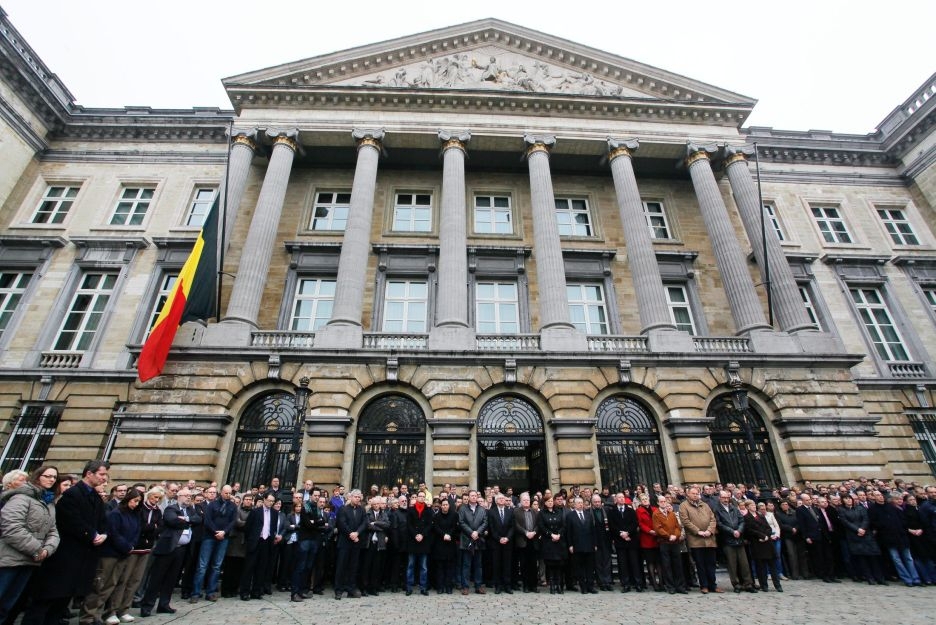
Parliament members standing outside the federal parliament building in Brussels, 2012

Continue reading →

Timo Rieg: Why a citizen’s parliament chosen by lot would be ‘perfect’

Sortition makes an appearance in the German public discourse. swissinfo.ch has an English translation of a German article which proposes short-term allotted bodies with decision making power whose agenda is externally determined. The article’s author is described as follows:

Timo Rieg, a German journalist and biologist. He developed and tested the “Youth Citizens Jury”, a form of youth parliament in which members are selected through a draw. He is the author of 18 books. His most recent publication, Democracy for Germany, examines a combination of citizens’ parliament, a directly elected government and referendums.

An excerpt from the article:

‘Citizens’ parliament’

One could firmly establish [a] procedure, which could be called the “citizens’ parliament”. Week by week, 200 new members, selected each time by a draw, could meet in the citizen’s parliament. They could listen to experts and lobbyists in a plenary session, have discussions with their jury and small groups, ask questions, suggest changes and entrust the governing authority to make improvements.

The outcome of this process would be a clear recommendation, a law (or its repeal), and the result is, unlike today’s parliament, always representative! Thus the citizen’s parliament is a “mini-populus”, an almost exact miniature replica of the general public.

All schools of thought, all social backgrounds, all occupations, artistic interests and hobbies would be proportionally represented. No one and nothing would be forgotten, and yet it’s both technically and financially a manageable size.
Continue reading →

Creating a Framework for Sortition

Dr. Roslyn Fuller is a lecturer in International Law based in Ireland. She is a regular contributor to Irish and international media on world trade, privacy, whistle-blowing and the War on Terror. A great fan of the classics, she has been researching democracy for over a decade and is the author of Beasts and Gods: How Democracy Changed its Meaning and Lost its Purpose, to be published by Zed Books in November 2015. [Welcome to Equality-by-Lot! -YG]

When I first started researching ancient, democratic Athens, I was struck by the layers of randomness built into the political system. Sure, it wasn’t a utopia, but under Athenian democracy wresting control of the decision-making process was at least a difficult and continuous task, because the thrust of the system worked against what Robert Michels would have termed ‘the Iron Law of Oligarchy’.

Lottery selection for most office-holders, as well as for Athens’ enormous juries was one aspect of that randomness. The more I read, the more I was impressed not just with the practice of sortition, but the way the Athenians went about it: dropping their pinakia (identity-tickets) into baskets, having them shaken up, the presiding official randomly drawing a ticket, that person becoming the pinakia-inserter and in turn randomly drawing tickets, dropping the kyboi, or coloured balls, randomly down the kleroterion’s funnel. The Athenians were clearly determined to bastard-proof their system. In my view, their paranoia was justified, and represented nothing more than healthy respect for the criminal (or oligarchic) mind.

But there’s not much point in creating such a fool-proof sortition system if the overarching politics doesn’t change as well. As we all know, in Athens the process of sortition didn’t run in parallel to a sophisticated and expensive electoral system; it ran in parallel to the Assembly. Whatever else one may want to say about Assembly, it was the national focal point for the issues of the day. Assembly attendance was also somewhat random (if self-selecting) in that it generally depended on who showed up of their own volition. A rhetor never looked out on the exact same Assembly twice, and while the ‘professional’, often affluent, rhetors certainly wielded a great deal of influence, they never did know when some unknown citizen would pop out of the woodwork and carry the day against them. Power was possible; power consolidation more of a challenge.

It was this Assembly that was down with sortition in its various forms. It’s hard to look at Athens and see how sortition could have existed side-by-side with the kind of entrenched and powerful electoral politics practised today.
Continue reading →

Down With Elections!, the book

My book “DOWN WITH ELECTIONS!” will be available as an e-book on Amazon and Smashwords from 1st September for the princely sum of 99c US or equivalent. It’s a revised and corrected version of the articles published earlier on this forum.

The links are:
Smashwords (epub, most ebook readers), Amazon (mobi – Kindle).

Readers of this forum can have it free from my Dropbox account. It would be nice if you post a comment on Amazon or Smashwords. (Thanks)

Dropbox links:
epub, mobi, HTML, PDF, ODT, DOC.

“Lottery Voting: A Thought Experiment” by Akhil Reed Amar

“Lottery Voting: A Thought Experiment” is a 1995 article by Akhil Reed Amar, perhaps the most influential Constitutional Law theorist in the US.

In the article Amar proposes using the lottery to determine representation only after a standard election campaign has determined the percentage of support each candidate has received.

In this case then, the ‘statistical representation’ (which he champions) would be only of those citizens willing to go through the process of standing for election.

This is much less representative — and less attractive to me — than eliminating campaigning altogether… and using only two parameters to enter the lot: 1.) registration for it, indicating a willingness to serve if chosen; 2.) a simple civics test (such as the Naturalization Test in the U.S.).

A permanent allotted anti-corruption body is a realistic meaningful reform

From an interview with investigative reporter Lee Fang about the recent retirement of Eric Holder from his job as Attorney General of the US and his resumption of his job at the law firm Covington & Burling:

Lee Fang: One of the perhaps most cynical and and most prevalent ways that you can legally bribe a government official or an elected official is to wait to give them a multi-million dollar check, not while they’re in office, but as soon as they retire. So if a politician helps a bank or an oil company, that oil company can’t directly buy them a boat or give them a million-dollar check. But if they wait until that official retires from office, as soon as they step out the door of Congress and find an employment contract with a lobbying firm or a big bank, then they can accept a multi-million-dollar payday; and so it’s simply delayed bribery, in my perspective.

Continue reading →

Smith and Dumienski: Citizens’ juries could reduce Auckland’s democratic deficit

Nicholas Ross Smith and Zbigniew Dumienski of the Politics and International Relations Department at the University of Auckland write at the New Zealand Herald, New Zealand’s largest circulation newspaper, arguing that using randomly selected juries to make some council-level policy suggestions may be a good starting point for organically growing a more democratic governance system:

A report by Bernard Orsman published in the New Zealand Herald on the state of Auckland City Council found that 88 of the 99 positions in the council’s boardrooms and executive teams were filled by “white men from wealthy suburbs.”

The reported demographic composition of the decision-making bodies in Auckland Council suggests that we are facing a potentially harmful democratic deficit. Yet, before anyone suggests quotas or other bureaucratic mechanisms aimed at diversifying the Council’s management structure, it would be good to consider a very different and far more democratic approach currently tried by our friends across the ditch: citizens’ juries as bodies that could breathe new, more democratic and vibrant spirit into our city’s old structures.

The democratic deficit evident in Auckland City Council is part of a broader trend in democracies worldwide, both at the local and national levels, which are increasingly seen as departing from the core democratic principles that they are supposed to uphold. Meaningful deliberations and political equality are the soul of democracy.

Increasingly, our electoral system is virtually devoid of the former and its outcomes suggest the erosion of the latter. Interestingly, such an outcome would have perhaps been predicted by the founders of democracy in classical Athens who were concerned that elections and campaigning contains in themselves anti-democratic and oligarchic seeds.
Continue reading →

Linker: An absolute democracy would assign political offices by lot

Damon Linker’s argument against compulsory voting weaves in Plato and the Socratic argument for aristocracy. His reasoning is an interesting modernization of the classical aristocratic mindset. His point about the contestability of excellence is good, and he makes use of it as a justification of electoralism.

A democracy gives every adult citizen a very small say in who rules. An individual doesn’t have to prove that he’s thoughtful or informed to exercise that right. As Plato argued 2,300 years ago, this makes democratic politics exceedingly peculiar. We don’t take a vote to determine the medical treatments that doctors prescribe, and neither do we ask for a show of hands about how to construct a bridge or a building. And yet we think it’s perfectly reasonable to ask for everyone’s opinion about what policies our country should pursue at home and abroad.

That’s because in politics, unlike in medicine and engineering, the act of determining who does and does not possess knowledge and wisdom is exceedingly contentious. (One might say it’s a political act in itself.) So we solve — or rather, we sidestep — the problem by letting everyone have a say.
Continue reading →

That persuasive juror may just be the one who is in no hurry to go home

The persuasive juror who manages to sway the majority through his passion, eloquence and irresistible logic is part of Western cultural lore. It appears that one commenter on this blog even perceives himself as having played that very role.

The following exchange raises the possibility that the ability of a single juror to sway a whole jury is attributable to much more mundane dynamics – dynamics that are put in place by the unanimity rule. The key paragraph is the last one.
Continue reading →