Minipublics beyond representation

[This serves, in a sense, as my response to the discussion on the French climate assembly post.]

Now that minipublics are no longer limited to local level “experiments” but are regularly involved in consequential political occasions, constitutional amendments (Ireland), long term city planning (Australia, Germany, US), responses to major political crises (France, Iceland, Ireland), institutionalized checks within representative government (East Belgium, Oregon)–to name a few—the question of their “representativeness,” and, more fundamentally, their legitimate democratic role is no longer academic. Given the response rate problem, those who accept invitations to a citizens’ assembly or jury (however scientifically sampled) are different in some respects from those who do not, and the number of participants in any such minipublic will, regardless of sampling, be exceedingly small compared to the population. Sortinistas and participatory democrats have raised the question of how a not entirely representative, unelected minority could legitimately affect political outcomes for the overwhelming majority who do not take part in the minipublic. In contrast to the “allotted citizen,” with the implication of egalitarian empowerment, some would disparagingly label participants in a minipublic chosen by lot an “aleatoric elite”–ignoring the standard implication of non-ephemerality in the term “elite.” But this focus on strict representativity misses the strongest reason for using minipublics chosen by lot in the first place, and it distracts us form their most promising participatory democratic uses.

After summarizing the strongest arguments articulated by both sortinistas and participatory democrats for the strengths and political potential of minipublics, I suggest another dimension on which they can function. Allotted minipublics can serve as unique spaces of political action and contestation, different from the space of electoral struggle, the space of confrontation in protest, or “enclave” spaces within activist groups and political parties. An electoral campaign is mostly fighting, a protest mostly “manifesting” strength or conviction, a party/union/organization meeting mostly strategizing or venting; but a minipublic provides a rare opportunity for the “everyman,” in a time of cognitive and political “bubbles,” to confront or act with a plurality of points of view, no one of which she/he can anticipate.
Continue reading

First German National Citizens’ Assembly on DemoPart: the Rise of the “Alloted Citizen”

On September 28 in Leipzig, “Phase 2” of the first ever German citizens’ assembly “Bürgerrat Demokratie” concluded its second and last weekend of deliberation on whether and how to “complete or improve [ergänzen]” Germany’s representative democracy “with elements of direct democracy or citizen participation.” On November 15, a day dubbed “Tag für die Demokratie,” the 160 participants, together with 100s more from the “regional conferences” from Phase 1, will ceremoniously present their recommendations to the President of the Bundestag, Dr Wolfgang Schäuble. I was present in Leipzig on all four days of the assembly as observer along with a few researchers, journalists, and an evaluation team from Goethe University’s “Democracy Innovation” lab. A camera crew filmed the entire event, including the small group discussion at one of the tables. The documentary will be released sometime in 2020.

This was a civil society initiative prompted by the “Grand Coalition” [GroKo] agreement between the SPD and CDU/CSU. Article 13 (pg 136) of that agreement includes a promise to research (via an expert commission) the possibility that “our precious representative parliamentary democracy could be completed with elements of direct democracy or citizen participation.” Nearly two years later, that expert commission has still not even begun to materialize. Seizing the opportunity, a civil society initiative called Mehr Demokratie (more democracy) raised money and organized this even in “four phases” with the help of two institutes that run participatory fora for local and regional governments and organizations: Nexus and Ifok. Of high interest to “sortinistas” will be this brochure about “Losverfahren” (procedure by lot) also handed out to the participants last Saturday at the end of the assembly.
Continue reading

IPSA World Congress, 25-29 July 2020

The Call for Papers is currently out for the World Congress of the International Political Science Association. The congress will take place on 25-29 July 2020 in Lisbon. I am currently involved with an effort to assemble a panel or two for this meeting. The focus will be on combining sortition with election and other institutional mechanisms.

The Call for Papers can be found here: https://wc2020.ipsa.org/wc/home. If you have any interest in joining a panel like this, please let me know ASAP. The deadline is coming rather fast–10 October, in fact.

The principles of representative government and the French sortitionists

A fun paper paper by Samuel Hayat, “La carrière militante de la référence à Bernard Manin dans les mouvements français pour le tirage au sort”, Participations 2019/HS (Hors Série) [original in French, abstract in English], tells the story of how Bernard Manin’s book The principles of representative government came to play a role in the sortitionist movement in France. The bottom line, according to Hayat’s telling, is that it is all Etienne Chouard’s doing. Hayat also claims that Manin’s book was not the source of the reformists’ interest in sortition but rather that they, and in fact mostly Chouard himself, used the book, with its impeccable academic credentials, as a legitimating force for their position.

Hayat’s paper seems to serve as the starting point for Antoine Chollet (“Les postérités inattendues de Principes du gouvernement représentatif : une discussion avec Bernard Manin” by
Antoine Chollet and Bernard Manin, Participations 2019/1 (N° 23)”, [original in French, abstract in English]) and for his claim that Manin’s book was misunderstood by both activists and scholars as a polemic in favor of sortition, when in fact Manin is pretty happy with elections, which he sees as mixing democratic and aristocratic elements.
Continue reading

Sortition in France – discussion and application

Discussion and application of sortition continue to be very active in the Francophone world. Here are some recent examples:

Guyancourt: “Décidons ensemble” [“Let’s decide together”] are forming their list of candidates for the municipal elections by knocking on door number 20 in each street.

From the Popular initiative to sortition: the responses to the crisis of representation – a discussion with Yves Sintomer, Dimitri Courant, and Clément Mabi.

Random interactions in the Chamber: How allocating legislators’ seats at random affects their behavior.

Allotting candidates for the Paris municipal elections.

An allotted citizen council in Sion, Switzerland will publish positions on the propositions on the Swiss ballot.

The French Citizen Convention on the Climate

Le Monde reported on August 26th (original in French):

The citizen convention on the climate: the allotment of 150 participants has commenced

This citizen convention, which is one of Emmanuel Macron’s responses to the “Gilets Jaunes” crisis, will propose measures to combat global warming.

The allotment of 150 Frenchpeople who will take part in the Citizen Convention on the Climate has begun on Monday, August 26th and will last until the end of September, before meeting for the first time at the beginning of October. This citizen convention, aimed by Emmanuel Macron as one of the rseponses to the grand debate that followed the “Gilets Jaunes” crisis, will propose measures to combat global warming, as France is far from meeting its obligations.

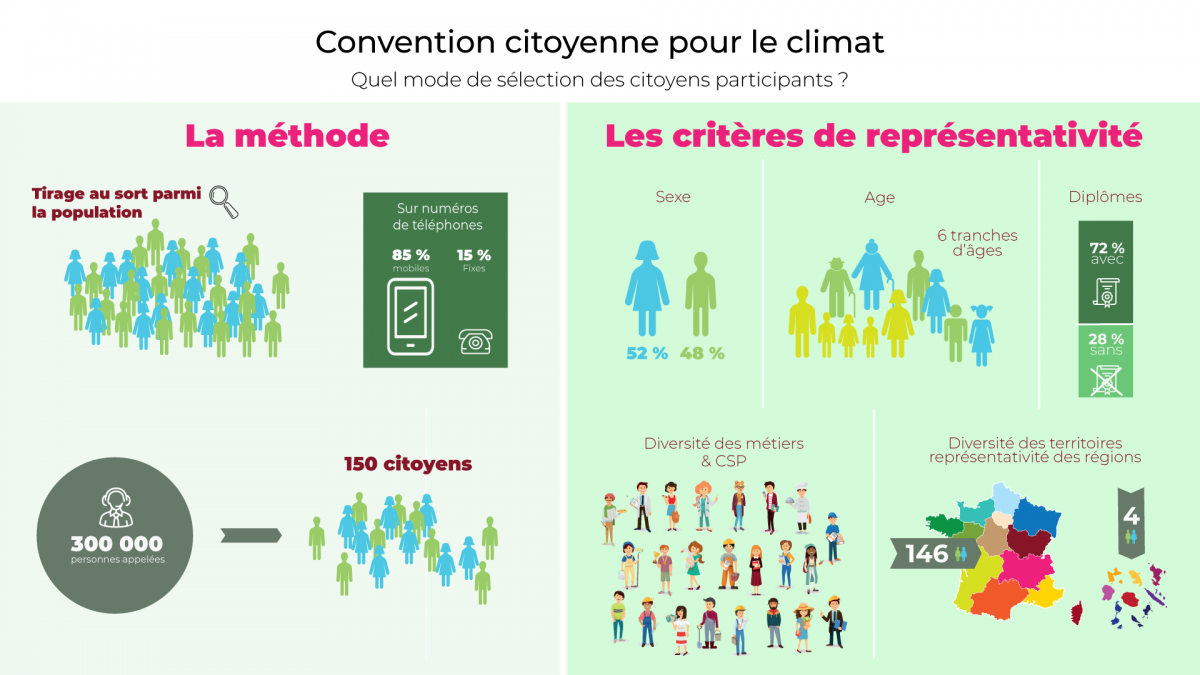
Telephone numbers are going to be automatically generated – 85% mobile numbers and 15% landline numbers – and about 25,000 people will be called, in order to select 150. Some criteria have been set in order to get the best representation: 52% women and 48% men, 6 age groups (starting at age 16), levels of educational attainment, a diversity of professions. Regional population will also be taken into account with 4 oversea representatives, as well as representation of urban centers, their surrounding areas and the rural areas.
Continue reading

Procaccia: Lotteries Instead of Elections? Not So Arbitrary

Ariel Procaccia, an associate professor in the computer science department at Carnegie Mellon University, has an opinion piece in Bloomberg News advocating sortition. Some excerpts:

Have you ever thought that 535 random people off the street would do a decidedly better job than the duly elected members of the U.S. Congress? If so, you’ve been scooped by a few millenniums; the idea of selecting government officials at random, known as sortition, is neither as outrageous nor as original as it seems.

In the fourth and fifth centuries BC, some of the central organs of the Athenian government were populated by selecting random volunteers. For example, the members of the Council of 500 — whose responsibilities included developing legislation, overseeing the executive branch and managing diplomatic relations — were selected at random for one-year terms.

During the Renaissance, sortition was all the rage. For centuries it played a key role in the process of selecting the Doge of Venice, as well as in populating the branches of the Florentine government. It was also employed widely throughout the Kingdom of Aragon, which is part of modern-day Spain. [King Ferdinand II of Aragon spoke highly of the virtues of sortition. Unfortunately, he also established the Spanish Inquisition and ordered the expulsion of practicing Jews from his kingdom, so he is hardly an authority on governance.] Sortition actually endured as a system of government into the 20th century: San Marino’s two heads of state were selected at random from 60 councilors as recently as 1945. [The two heads of state constitute a non-negligible fraction of the minuscule country’s population.]

Procaccia mentions in quick succession David Van Reybrouck, Terrill Bouricius, citizens’ assemblies, Ireland, and the German-speaking Community of Belgium, and finishes off with:

Admittedly, even the Belgian initiative is still a long way off from a Bouricius-style sortition utopia — and the jury is still out on whether we’d want to go that far. But it’s comforting to think that the best fix for our political chaos may be a bit of randomness.

Roslyn Fuller: Don’t be fooled by citizens’ assemblies

Highly recommended post by Roslyn Fuller on UnHerd.com:

I believe that the biggest threat to democracy is the belief among the current societal elite that what they want and what democracy is are the same thing – and that tweaking the rules of the game to get what you want is therefore right, just and somehow unto itself democratic.

This trend that sees democracy as a set of particular decisions, rather than just as a method for making decisions, has been well under way for some time and tends to divide the world between ‘informed’, ‘correct’ decisions, and ‘uninformed’ ‘incorrect’ decisions. ‘Correct’ decisions are automatically democratic; ‘incorrect’ ones are not.

One of the ways that is currently in vogue for ensuring ‘informed’, ‘correct’ decisions is to hold so-called citizens’ assemblies, a democratic ‘innovation’ that many leaders currently feel assured will bring them the results that they want.

This is followed by a nuanced (and sceptical) examination of the use and abuse of randomly-selected citizens’ assemblies, focusing on (wilful) misunderstandings of Irish CAs:

British politicians and intellectuals apparently feel themselves entitled to just blithely repeat these myths as a justification for holding such assemblies on all manner of decisions in Britain.

Sixty residents chosen for the Cambridge Citizens Assembly

CambridgeshireLive reports:

Citizens Assembly set up to inform Council transport decisions

A citizens’ assembly has been established by the Greater Cambridge Partnership to make recommendations which will inform its infrastructure development plans.

The assembly is made up of 60 residents “chosen through a civic lottery process so that it fairly represents the population”.

It will meet to address the following question: How do we reduce congestion, improve air quality, and provide better public transport in Greater Cambridge?

Its members will also hear from experts and be supported by an advisory group.
Continue reading

Are citizens’ assemblies little more than institutional band aids?

The following are some excerpts from an article by Tom Gerald Daly, from the University of Melbourne, in Pursuit (a publication of the University):

Australian democracy: crisis, resilience and renewal

Given the global rise in authoritarian populist parties and political forces that are opposed to the key tenets of liberal democracy, Australia’s own democracy appears on the surface to be in relatively good health.

For instance, most democracy assessment indices (although far from perfect as reflections of reality) have not registered any declines for Australian democracy for the past decade.

That said, a dominant view has taken hold that Australia’s political system is in crisis, paralysis and even decline. The public images of both the federal government and parliament has been tarnished by a variety of factors, especially the regularity with which Prime Ministers have been ousted between elections – since 2007 Australia has had six prime ministers, when in the previous 36 years (1971-2007) there were only six.

Some polls suggest that public faith in the political system and democracy has plummeted. A broad survey of polling data in December 2018 showed that fewer than 41 per cent of Australian citizens are satisfied with the way democracy works in Australia, a stark drop from 86 per cent in 2007.

There is a strong case then for some reform of our political institutions.
Continue reading