


 3.3 Legislature by Lot with Professor John Gastil
Above is the link to a podcast interview by Real Democracy Now! John Gastil is a Professor in the Communication Arts and Sciences and Political Science at the Pennsylvania State University as well as a Senior Scholar in the McCourtney Institute for Democracy. He studies political deliberation and group decision making across a range of contexts.
In September 2017 John and Erik Olin Wright, as part of the Real Utopias project, held a three-day workshop called Legislature by Lot. Participants included several contributors to this site, Equality by Lot. John was interviewed shortly after this workshop to learn more about what was discussed.
John described this workshop as ‘a deliberation about deliberation’.
John spoke about
- the origins of the Legislature by Lot workshop [1:32]
- the different ways to implement sortition (random selection) [3:54]
- some of the arguments in favour of a legislature selected by lot [5:44]
- different models of sortition [7:40]
- responding to criticisms of legislature by lot [10:11]
- how to design an oversight body to support a legislature selected by lot [14:10]
- the prospect of institutional change and transition strategies [18:34]
- moving the agenda of using sortition forward [23:43]
- how much work is happening around the world to test and promote the use of sortition [28:35]
- what representation and accountability means for bodies selected by sortition [30:29]
- deliberation, consensus, contention and voting [34:35 and 38:50]
- what the workshop agreed on [43:18]
- what might happen after the workshop: building links between researchers and practitioners [45:34]
- responses to critiques of empowered mini-publics [49:35]
- when the book arising from the workshop will be published [53:07]
Filed under: Academia, Books, Elections, House of Lords, Proposals, Sortition, Theory | 1 Comment »
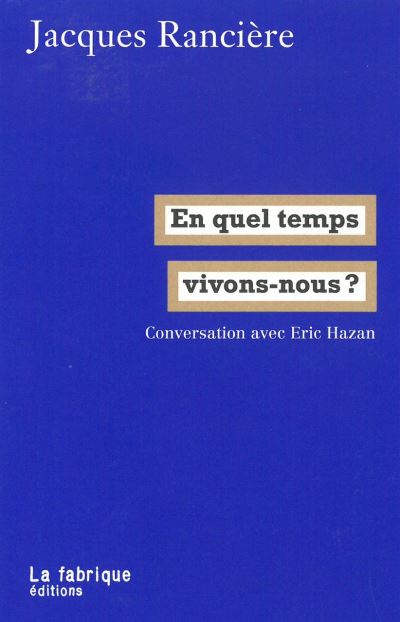 05. The question today is that of rethinking forms of organization, ways of being together for the long term, outside of the electoral forces.
 Aude Lancelin: Let’s remain with France insoumise and the phenomenon of Mélenchon during the presidential elections. You are very sceptical regarding the figure of a tribune (Mélenchon) who is going to speak in the name of the suffering of the people and champion their cause. This posture is suspect in your view. What is the basis of your criticism?
 Jacques Ranciere: There are several things. First, adopting this posture means also adopting the posture that the system imposes, namely the posture that there is an official political game and that there are the people of the depths who are not represented, or are represented by the extreme right from which they must be separated. It is this idea that the people exist, that there are those who represent the people, that is what de Gaulle pretended to do. I don’t think that this is a democratic idea that makes it possible to mobilize and advance. That is the first point. The second point is that I find it paradoxical to become a candidate of the supreme office of the system saying: if you elect me, here is my program. And at the same time to say: but pay attention, this system is bad and therefore everything is going change. I think there is a fundamental contradiction. You are saying to me that my anti-presidential stance is somewhat paradoxical or difficult to follow. But I think it is still more difficult to follow a stance which on the one hand asks to be vested with the powers of the president of the 5th republic and at the same time says I want to 6th republic and i am going to throw all of this up in the air. It is either one or the other. If we say: it is necessary to throw the 5th republic up in the air, we say: I am here to throw the 5th republic up in the air. Period.
 The intended outcome of the workshop will be a book whose prospective title is “Legislature by Lot: An Alternative Design for Deliberative Governance”, to be published by
  On the other hand, I want to emphasise the supreme importance of getting it right in dealing with the dangerous world we have created. I postulate that this goal can only be achieved by a rational process in which any citizen who wishes to do so may take an active part. One takes an active part in a rational process by putting forward considerations for or against a proposal that others can be expected to recognise as having a certain amount of validity. Mere will or gratuitous assertion do not count.
 Take the instances I referred to from the history of science, Newton first, challenging the old mechanists’ rejection of action at a distance. He set out to look at a very precise and limited problem: how to explain the stability of the planetary orbits. No grandiose questions about the nature of the universe. He found that they could be explained very precisely if one postulated the existence of a particular predictable force that could also explain many other phenomena. It was no open day for any old suggestion about other forms of attraction.
 Adam Cronkright
 Ali
Ali Ahmed R. Teleb
 avanderven
 avergne
 Alex Kovner
 azakaras
 Brett Hennig
 campbellwallace
 Simon Threlkeld
 Nick Coccoma
 codyhipskind
 Common Lot Sortitionist
 Conall Boyle
 constitutionalism
 davidschecter
 graytmatter
 gtridimas
 H.J. Hofkirchner
 Hanspeter Rosenlechner
 James Kierstead
 John Burnheim
 jgarry20151
 Jochen Krattenmacher
 johnedwardtaylor
 johnhuang865
 Jonathan Crock
 keithsutherland
 Jacob Richter
 kkoreilly
 lukewhito
 SimonPek
 Nathan El
 Nicholas Gruen
 Owen Shaffer
 Patrick Chalmers
 Paul Gölz
 peterstone
 Pierre-Etienne Vandamme
 pronfeld
 Emil
Emil rcaze
rcaze richwbrown
 Roger Knights
 roslynfuller
 Pierre-Etienne Vandamme
 shaharavin
 tbouricius
 Ted Wachtel
 Joshua Laferriere
 theodorestathis
 towardsautonomyblog
 Wayne Liebman
 Yoram Gat
 Oliver Milne
 Equality by lot