Shaw: A transfer of power from the elite to the masses

Ethan Shaw advocates sortition in International Policy Digets:

Voter reform in America aims to increase turnout in elections, however, this focus dismisses the glaring weaknesses of the American democratic process. Congressional approval ratings are abysmally low, and you have probably heard the phrase “Congress is not doing their job” countless times. The problem is not about the accessibility to the ballot box; it is the inconsequentiality of voting that keeps people home on election day. So how does one solve the systemic issues with Congress that promotes voter apathy? By going back to the birthplace of democracy.

A Civic Duty to Legislate

The United States should have mandatory legislative service. Ancient Athenian citizens were randomly selected to serve a 1-year term in a legislative assembly. This process is known as sortition and has been purported by democratic reformists across the globe. In the American political discourse, sortition has never been fully discussed as a viable replacement to the current legislative infrastructure. Many individuals scoff at the idea, worried that random selection will create a legislature full of inept buffoons.

Continue reading

US Sortition Foundation meeting: Inside the first US climate change citizens’ assembly

Announcement by Owen Shaffer.

The next US Sortition Foundation online Chapter Meeting features an inside view of how a citizens’ assembly, and a movement, is built! Maxim Lowe and their team from Washington state are developing a citizens’ assembly to address climate change. They solicited the support of five state legislators, and all are working together to build the citizens’ assembly. More information about their movement can be found here. Note their media attention under “About Us.”

We meet online on Tuesday 7 July at 9pm Eastern US Time, 6pm Pacific. Email Owen Shaffer at dShaffer@Lander.edu for more information.

Macron “accepts all but three” of the CCC’s 149 recommendations

RFI reports:

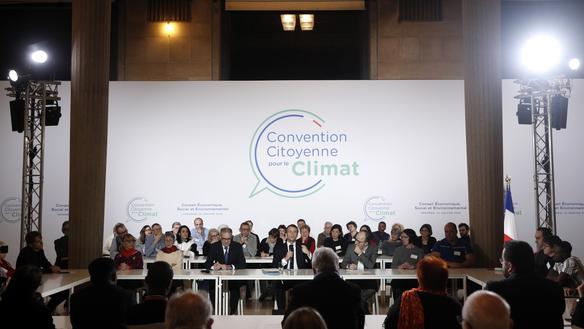
A day after a powerful push by the Greens in French municipal elections, President Emmanuel Macron on Monday vowed to speed up environmental policies – promising an extra €15 billion to fight global warming over the next two years, and throwing his support behind two referendums on major climate policy.

Macron was responding to proposals put forward by the 150-member Citizens Climate Convention (CCC), a lottery of French people chosen to debate and respond to the climate challenges facing society.

During a meeting in the gardens of the Elysée Palace, Macron told convention members that he accepted all but three of their 149 recommendations which would, he promised, be delivered to parliament “unfiltered”.
Continue reading

Feertchak: The Citizen Convention for the Climate does not meet with unanimity

With the Citizen Convention on the Climate publishing its report, Alexis Feertchak writes in the Le Figaro about early reactions.

The Citizen Convention for the Climate does not meet with unanimity
June 20th, 2020

The 150 allotted citizens are voting this weekend for as many environmental proposals. But since its introduction, reactions to this body have been mixed.

“Involve citizens in the governance of transportation at the local level as well as at the national level.” The “technical” tone of this proposal makes it sound more like a recommendation in report of the state bureaucracy than a conclusion of a citizen assembly chosen by lot. It is one of the points that are regularly made on the social networks: if we involve citizens directly in democratic deliberation, we should have been able to get more original results than that one.

Rather than being original, the 150 proposals or so, showing a leftist slant economically, seem quite familiar. Responding to the proposal of reducing the work week to 28 hours (a proposal that was eventually not presented), increasing the minimum wage, taxing dividends, etc., Philippe Bas, senator for [the center-right party] Les Républicains and head of the laws committee, twitted: “The results of the so-called citizen convention are a disappointment: a rehashing of the hymn book of the environmental lobby, (…) economic ignorance, total lack of legitimacy. Sortition exposed as a democratic deception!”
Continue reading

Wachtel: Let’s Choose Legislators Randomly from the Phone Book

Ted Wachtel is the founder of a political organization called “Building A New Reality“. He is a sortition advocate.

Let Legislative Juries Decide Laws

In a new article in Dissident Voice I explain how laws can be decided by legislative juries, and why this is far preferable to laws being decided by elected politicians and the ballot initiative. This is an update and further statement of the legislative juries proposal I first published in 1998. I set out four ways in which I am in favour of laws being proposed to legislative juries, my preferred approach to deciding the details and arrangements for jury lawmaking, and some of the role agenda juries can play.

It would be far better and far more democratic if laws are decided by legislative juries rather than by elected politicians.

Legislative juries would decide proposed laws by majority vote, using secret ballot, after a fair hearing on a level playing field with supporters and opponents of the proposed law having equal time to present their case to the jury.

It is essential that rule by the people be exercised in an informed manner, including with regard to deciding laws, because informed views are a far better basis for a decision than poorly informed and uninformed views.

Continue reading

Massol: Participative democracy: a job for professionals

Nicolas Massol writes in Liberation.

Participative democracy: a job for professionals

The growth of citizen participation initiatives, such as the Climate Convention, has been made possible thanks to a lot of organizational work by specialized businesses.

Participative democracy is not a business for amateurs. To be convinced of that, it is enough to have a look at the sophisticated organization of the Climate Convention. All this beautiful engineering was designed and put together by professionals of citizen participation. For them this unprecedented experience is going to usher in a profession of a future. It is a future which has been in the making for 20 years in which, from participative budgeting to a Grand national debate, initiatives for directly involving citizens in political decision-making have been growing, with the support of the authorities. “Municipalities account for 80% of the initiatives”, estimates Alice Mazeaud, co-author of “The market of participative democracy” (2018). The Convention, on the other hand, was financed directly by the Prime Minister’s office, to the tune of over 4 million Euros. Not enough to speak of a real “participation business”, but still enough to create a small ecosystem.

And so, the organization of the Convention was handed to a consortium of businesses: The Harris Interactive polling institute carried out the allotment, Eurogroup Consulting set up the database available to the citizens, and for moderating the discussions, Res Publica and Missions publiques – two consulting firms for participative democracy – were hired. “My profession is to make sure the collective discussion advances”, says Gilles-Laurent Rayssac, the president of the first of those. A technical role, according to Judith Ferrando, the co-director of the second one: “Our moderation techniques promote the success of deliberation, but we stay in the wings, a little like in the theater.”
Continue reading

Allotted body to advise the German SPD

The German SPD party announced that an allotted body advising party leadership has met for the first time. The body has 20 people, randomly drawn for one year of service among party members. The newspaper Die Welt has interviews with four of the members.

The Bundestag gives sortition a spin

Ahmed Teleb wrote to point to the following Tweet thread.

Continue reading

Táíwò: Power over the police

In the context of the recent mass outrage over the murder of George Floyd by a policeman in Minneapolis, Olúfẹ́mi O. Táíwò of the Pan-African Community Action reiterates the proposal made by Max Rameau to enforce citizen control over police via allotted citizen boards.

The core problem with policing and incarceration is the same problem that plagues our whole political system: elite capture. The laws, the regulations, the bailouts, and the wonks who write and evaluate all of the above are all powerfully influenced—if not functionally controlled—by elite political and corporate interests. We cannot put our faith in elected representatives and merely vote our way out of this problem: elections are more dominated by dollars than ever, and grassroots energy around political figures is increasingly shaped by identity politics, which faces its own elite capture problem.

Instead, we need to give power back to the people—directly. Under one specific proposal, offered by the Washington, D.C.–area group Pan-African Community Action (of which I’m a member), communities would be divided into districts, each of which would be empowered to self-determine how to maintain public order. Each district would hold a plebiscite to decide what to do with its current police department, immediately giving the community the direct voting power to abolish, restructure, downsize, or otherwise reconstruct their departments.
Continue reading