Participation Toolkit

A book named “Participatory methods toolkit: a practitioner’s manual” was published in 2005 by the King Baudouin Foundation and the Flemish Institute for Science and Technology Assessment (viWTA).
This toolkit has a “citizens jury” part that may be of interest to us.

Page 21:

4) Participants

Recruitment

In some methods, the participants are supposed to be representative of the population at large. However, this may be unrealistic to achieve perfectly in practice. Purchasing random sampling phone numbers may prove financially unviable.

In this case, the advisory committee and project management will need to establish recruitment criteria and decide on another method, such as newspaper advertising. In newspaper recruitment, panellists are somewhat self-selected because they have to initially respond to an advertisement. In any method of recruitment an element of bias is introduced at the selection stage by the preferences of the selection committee. Recruitment is usually done three to four months prior to the first activity.
Continue reading →

Lysander Spooner, trial juries, and legislative juries

Lysander Spooner (1808-1887) was a prominent 19th century American legal theorist, abolitionist (abolition of slavery), and competitor with the U.S. Postal Service until they shut him down. A biography and collection of his work are here.

Spooner continues to be cited in the U.S., including for example by Justice Scalia writing for the Supreme Court majority in 2008 in District of Columbia v. Heller.

Spooner was a strong advocate of “jury nullification.” He argued that trial juries have the right and duty “to judge of the justice of the law, and to hold all laws invalid, that are, in their opinion, unjust or oppressive, and all persons guiltless in violating, or resisting the execution of, such laws.” (An Essay on the Trial by Jury, published in 1852, page 5.)

In the following passages Spooner is talking about trial juries. Although he never mentions the possibility of legislative juries, his line of reasoning is to a large extent strikingly applicable to them. By “legislative juries” I mean juries that can veto and repeal the laws the government passes, and pass laws the government does not support.[i]

Lysander Spooner (italics and bold are as in the original, block quote function not used because it may change everything quoted to italics):

“By such trials [where juries do not judge the law] the government will determine its own powers over the people, instead of the people’s determining their own liberties against the government; and it will be an entire delusion to talk, as for centuries we have done, of the trial by jury, as a ‘palladium of liberty,’ or as any protection to the people against the oppression and tyranny of the government.” (Ibid., 10.)

“The authority to judge what are the powers of the government, and what the liberties of the people, must necessarily be vested in one or the other of the parties themselves—the government, or the people; because there is no third party to whom it can be entrusted. If the authority be vested in the government, the government is absolute, and the people have no liberties except such as the government sees fit to indulge them with. If, on the other hand, that authority be vested in the people, then the people have all liberties, (as against the government,) except such as substantially the whole people (through a jury) choose to disclaim; and the government can exercise no power except such as substantially the whole people (through a jury) consent that it may exercise.” (Ibid., 10.)
Continue reading →

The Paradox of Democratic Selection: Is Sortition Better than Voting?

Book chapter just uploaded to academia.edu by Anthoula Malkopoulou

Sortition, or the selection of political officers by lot, has its antecedent in the direct democratic tradition of ancient Athens. Its transfer into a modern context of representative democracy poses rightful scepticism not only about the practical difficulties, but more so about the theoretical inconsistencies that arise. Modern systems of political representation are based on the aristocratic idea of ‘government by the best’, who are to be selected through a competitive call for candidates (Manin 1997). Sortition, on the other hand, replaces this aristocratic criterion of competition and evaluative election with the democratic mechanics of direct and equal distribution of political office by chance. Hence, the very expression ‘democratic (s)election’ includes a paradoxical contradiction in terms, between the democratic concept of equal access to public office and the aristocratic idea of government by the (s)elected best. My aim in this chapter is to shed some light on this contradiction by critically discussing the benefits and pitfalls of using sortition today, comparing it throughout the chapter with voting and the general effects of electoral representation.

Full text

Constitutional reform: could the Irish approach be useful also for Italy?

More from Improving Democracy:

Constitutional reform in Italy
Italy has incurred a stalemate situation similar to that in which Ireland found itself some time ago relating to a project of constitutional reform. On December 4th 2016 Italians were called to vote on a constitutional reform, previously approved by Parliament, but without the necessary qualified majority, for definitive approval. The electoral turnout at the referendum was quite high in relation to similar prior experiences, recording a vote of over 65% of people eligible to vote. As for the outcome: 40,88% of the voters voted “YES”, while nearly 60% voted “NO”.

[…]

Could the Irish approach be a viable solution for Italy?
Here is precisely where the Irish approach, based on the creation of an advisory body of citizens, may come to rescue the opportunity of change and assure alignment with the real thoughts and feelings of the people.

In Ireland, after the economic crisis, citizens developed a sense of mistrust towards the political parties. There has been a strong movement pressing to change parts of the Constitution, which in that country always requires final approval through a referendum in the end. The political parties, on the other hand, were unable to come to an agreement. The Labour Party in its 2011 program for elections included the promotion of a Convention on the Constitution with the intent of involving citizens directly in the process. After the elections, the program was approved by Parliament. The Convention, proudly referring to itself as “a new venture in participative democracy in Ireland” on its own web site, was formed at the end of 2012 and started its work in January 2013. The body was formed by 100 people, 66 citizens randomly selected and broadly representative of the Irish society, 33 parliamentarians, nominated by their respective political parties and an independent chairman skilled in coaching complex assemblies. The Convention had a mandate to debate and elaborate specific proposals on 8 constitutional issues, plus 2 to be autonomously selected by the Convention itself. Parliament was committed to debate the proposals in the following four months and to prepare the consequent bill for approval through referendum.

Full text: 1, 2 (PDF).

Improving Democracy: Open letter to the institutional and political leaders – No. 3

Roberto Barabino sent the latest open letter issued by the Improving Democracy campaign.

Leaders’ action or the alliance of intermediate bodies to renovate democratic systems?

In summer 2016, as every year, the world’s elite gathered in Davos, Switzerland, for the World Economic Forum, which showed a significant discontinuity compared with previous editions. Instead of trying to propose forced globalization as an advantage for everyone, as it had done in the past, they chose to tell the truth: the assertive technological innovation and, in particular, artificial intelligence, will not benefit everyone, but it will lead to an unemployment rate never seen before and possibly irreversible. The first solutions suggested by the founder of Microsoft Bill Gates (to tax robots) and by Klaus Schwab, the organizer of the Forum (universal basic income) show that the fears of those in power regarding social and political consequences of such a reality are high.

The full letter (PDF).

New Law Requiring Deliberative Poll Process for Constitutional Amendment in Mongolia

Here is an email from today (May 3, 2017) from James Fishkin to the National Coalition for Dialogue & Deliberation (NCDD) listserv:

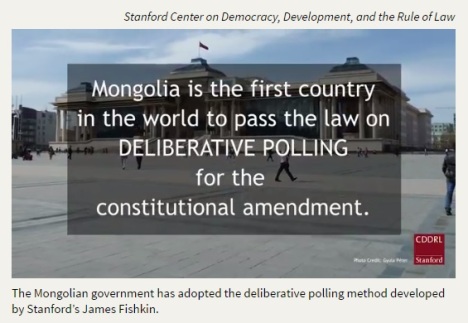
Dear all: I am just off the plane from Mongolia where a national Deliberative Poll considered several proposed elements of a constitutional amendment, as now required by law. National random sample of 669 deliberated a whole weekend and produced results, now with the parliament. Here is a pre-event press report and video:

http://news.stanford.edu/2017/05/02/collaboration-stanford-leads-mongolian-parliament-passing-law-public-opinion-polling/

This development raises interesting possibilities for how citizen deliberation can be institutionalized. Hope you will find it of interest. More information will appear on the http://cdd.stanford.edu web site when available.  Best regards to the NCDD list. Jim Fishkin

Of particular interest, the above-linked press release announces:

The Mongolian government recently passed a law requiring that an immersive research method that analyzes public opinion developed by Stanford’s James Fishkin be conducted before its constitution could be amended. According to Fishkin, who devised the process called deliberative polling almost 30 years ago, it marks the first time that a country has incorporated the process into its law. … The measure was supported and passed into law on Feb. 9.

Fishkin.jpg

See also: http://www.news.mn/r/328704.

Strictly Eating Chances: You can’t eat chances? Oh yes you can!

I say this despite David Wasserman’s snide comment on the claims made by us lottery enthusiasts. We would say that where there are more qualified applicants than places available, a lottery’s the thing. Some will then win a place — “eat”— but everyone will benefit by having had the chance of winning.

But what is the value of a chance when you win nothing? Rationally we should conclude that the value of nothing is zilch, zero, nada.

In another swipe at advocates of lotteries for sharing Wasserman comments:

if it makes sense to treat an expectation as a good, it also makes sense to ask whether the value of that good increases the longer it is held by the recipient.

It’s nice to see a bit of sarcasm from a philosopher whose main concern is medical ethics!

Instead, I’d like to take up Wasserman’s challenge, and propose that your ‘expectation’ — your ticket to the lottery — can indeed be made more valuable by spinning out the process.

Take for example the way the TV hit show Strictly Come Dancing (in the US it’s called Dancing With the Stars) operates. They start with a dozen or so stars. Each week they dance competitively, and by a complex process one star is eliminated. Over the next weeks the process is repeated, one ‘loser’ every week until there are three left. It is then decided by a Grand Finale.

I take it as axiomatic the producers know how to give the public good entertainment value. That’s show business!
Continue reading →

The allotted Irish Citizens’ Assembly sends its recommendations to the Oireachtas

Wikipedia:

The Citizens’ Assembly (Irish: An Tionól Saoránach) is a citizens’ assembly established in Ireland in 2016 to consider several political questions: abortion, fixed term parliaments, referendums, population ageing, and climate change. It will produce reports to be considered by the Oireachtas (parliament).

[…]

On 26 July 2016, Mary Laffoy, a judge of the Supreme Court of Ireland, was chosen by the government as chairperson of the assembly.

The 99 other members are “citizens entitled to vote at a referendum, randomly selected so as to be broadly representative of Irish society”. As with the 66 citizen members of the Constitutional Convention, these 99 plus 99 substitutes were selected by an opinion polling company; Red C won the tender and began selection at the start of September. The Electoral (Amendment) Act 2016 was passed to enable the electoral register to be used in this process. Media were asked not to photograph the citizen members before the inaugural Assembly meeting. By the 27 November 2016 meeting, 11 of the 99 had been replaced by substitutes.

The Irish Post:

THE Irish Citizen’s Assembly has voted overwhelmingly in favour of abortion in a landslide vote.

[…]

The citizens involved in the vote had attended five two-day meetings since November 2016 and had heard from a series of legal and medical professionals.
Continue reading →

Ganesh Sitaraman’s sortition version of the Roman tribunes

Ganesh Sitaraman proposes a sortition version of the tribunes of the Roman Republic in his new book The Crisis of the Middle-Class Constitution: Why Economic Inequality Threatens Our Republic.

Angus Deaton, the Nobel Prize winning Princeton economist, describes the proposal in his review of the book in the New York Times (March 20, 2017):

Perhaps the least familiar and most intriguing policy proposal that Sitaraman discusses is the idea of reviving the Roman tribunate: 51 citizens would be selected by lot from the bottom 90 percent of the income distribution. They would be able to veto one statute, one executive order and one Supreme Court decision each year; they would be able to call a referendum, and impeach federal officials.

Such a proposal seems fanciful today, but so is campaign finance reform, or greater redistribution. Yet we do well to remember Milton Friedman’s dictum that it takes a crisis to bring real change, so that our job in the meantime is to develop alternatives to existing policies that are ready for when “the politically impossible becomes politically inevitable.”

Sitaraman is an associate law professor at Vanderbilt Law School.

“Representation Against Democracy: Jacques Rancière on the French Presidential Elections”

From an interview with Jacques Rancière on the French Presidential Elections (translated from the original in French):

How would you organise collective life without representatives? By drawing lots — a measure you supported in your 2005 book Hatred of Democracy?

We should distinguish between delegation and representation. In a democracy, logically enough some people will carry out certain activities on other people’s behalf. But the delegate plays her role only once, which is not true of representatives. Drawing lots was once the normal democratic way of designating delegates, based on the principle that everyone was equally capable. I proposed bringing it back in order to reverse the drive toward professionalisation. But that is no simple recipe, any more than non-renewable mandates are. These tools are only of interest if they are in the hands of a vast popular movement. Democracy does not exist without these pressures emerging from outside the system, pressures that shake up the institutions of the state — like the “squares movements” did recently. Democracy presupposes that institutions autonomous of state structures and state agendas are able to make these egalitarian moments last.