Posted on March 3, 2017 by Yoram Gat

Janette Hartz-Karp, a professor at the Sustainability Policy Institute at Curtin University, has a sortition advocacy piece in The Conversation. It covers well known ground: history, diversity, deliberation, applications in Australia, etc.
The opening of the “What’s the obstacle to reform?” section is interesting:
So why isn’t deliberative democracy happening more often? Simple. Those in power are wary about sharing their power.
Unlike the Athenians, we don’t believe that every citizen is capable of participating in important decision-making. We assume most people are too self-interested to make decisions for the common good.
This seems to conflate two different ideas:
- Resistance by the elite,
- Anti-democratic sentiments in the population.
The first idea is clear and presents a general phenomenon. Power concedes nothing without a demand.
The second idea, however, is more intriguing. How resistant are the people themselves to democratic rule? If they are, why? An empirical study of this question could be useful.
The article also generated a lively conversation in the comments.
Filed under: Academia, Athens, History, Press, Sortition | 44 Comments »
Posted on March 2, 2017 by Brett Hennig
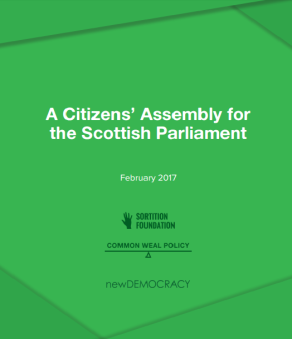 A paper I’ve co-written with Common Weal Scotland and newDemocracy Foundation has just been published, proposing a sortition second chamber for the Scottish Parliament.
Initial (somewhat inaccurate) press coverage by The National was okay, except for the unhelpful headline.
A (sold out) talk at Edinburgh University will discuss the merits of the proposal.
The full paper is here.
Filed under: Press, Proposals, Sortition | 38 Comments »
Posted on March 1, 2017 by Yoram Gat
 The following excerpt is from the 2004 edition of Rod Hague and Martin Harrop’s textbook Comparative Government and Politics (The “Functions of legislatures” section, p. 253):
We have suggested that the essence of assemblies is that they ‘represent’ the wider society to the government. But how can we judge whether, and how well, that function is fulfilled? What features would a fully representative assembly exhibit?
One interpretation, plausible at first sight, is that a representative assembly should be a microcosm of society. The idea here is that a legislature should be society in miniature, literally ‘re-presentating’ society in all its diversity. Such a parliament would balance men and women, rich and poor, black and white, even educated and uneducated, in the same mix as in society. How, after all, could a parliament composted entirely of middle-aged white men go about representing young black women – or vice versa? To retain the confidence of society, the argument continues, a representative assembly must reflect social diversity, standing in for society and not just acting on its behalf (Anne Phillips, The Politics of Presence, 1995).
Continue reading →
Filed under: Academia, Books, Juries, Sortition | 19 Comments »
Posted on February 25, 2017 by Simon Threlkeld

My article in response to Justin Trudeau (Canada’s prime minister) breaking his electoral reform promise on February 1, and more generally about the absurdity of politicians deciding the rules they are elected under. (Trudeau, before and after the 2015 Canadian election repeatedly promised to make it the last one held under first-past-the-post.)
It is neither democratic nor desirable that the prime minister and the House of Commons keep deciding Canada’s election rules. There is a far better alternative.
In Classical Athens, the birthplace of Western democracy, much of the decision-making was done by juries chosen from the citizens by lottery. A modern version of Athenian juries could be used to decide election rules today.
Politicians should not decide the rules they are elected under because fair and democratic decision-making requires that those who decide do not have a conflict of interest. Election rules are far too important to our democracy to be compromised by the strong self-interest of politicians in rules that favour themselves.
Continue reading →
Filed under: Athens, Elections, History, Press, Proposals, Sortition | 1 Comment »
Posted on February 20, 2017 by keithsutherland
Contributors to this blog who argue the case for full-mandate, voluntarist sortition will find support for their arguments in a forthcoming book chapter by John P. McCormick, author of Machiavellian Democracy. According to McCormick, electoral representation involves rule (primarily) by the rich, whereas democracy by lot is rule by the poor — a perspective that he derives from Aristotle, mediated by Machiavelli, Montesquieu [and Marx]:
The hoplites of ancient Greece and the plebeians of Republican Rome established institutions that granted ultimate legislative authority to the majority qua the poor . . . Athenian democracy and the Roman Republic exhibited primary institutions intended to insure that the poor would rule over or share rule equitably with the rich. (pp. 2-3)
Given this dichotomy it matters little which individuals are selected by preference election or sortition, as the two mechanisms will privilege (respectively) economic elites and the poor, and the resulting political decisions will (presumably) reflect the preferences of these two socio-economic groups.
Continue reading →
Filed under: Academia, Athens, Books, Elections, History, Juries, Sortition, Theory | 40 Comments »
Posted on February 18, 2017 by Yoram Gat

Nicholas Gruen, an Australian economist, consultant, commentator and former adviser to the Australian federal government, has two lengthy articles in The Mandarin advocating introducing a sortition-based body into the Australian political system. Gruen’s proposal is to create an allotted body with 6 year terms and some measure of legislative veto powers.
It is unfortunate that as a background for his discussion, Gruen offers the familiar story of the failures of the electoral system stemming from the elite’s pandering to the voters’ uninformed whims. This explanation seems to never lose its appeal despite clashing both with the fact that in practice policy outcomes in electoral systems overwhelmingly serve the elites and with the truism that those in power tend to serve their own interests.
The articles are of the interest for being another step in sortition’s journey into mainstream politics, and in particular for taking a step beyond the ad-hoc issue panel setup that is by now familiar in Australia. But beyond those points, the articles are interesting for Gruen’s suggestion for how sortition can be promoted:
I’d like to go hunting for the funds – from philanthropists and from ordinary concerned folk like you and me via crowdfunding – to simply establish a people’s chamber outside our official constitutional institutions.
Continue reading →
Filed under: Elections, Press, Proposals, Sortition | 5 Comments »
Posted on February 17, 2017 by keithsutherland
One of the issues dividing commentators on this blog is whether participation in sortition-based assemblies should be mandatory or voluntary — see, for example. Those of us advocating legislative juries based on Athenian nomothetic panels advocate quasi-mandatory participation in order to ensure accurate descriptive representativity. Those, however, who argue for full in-depth participatory deliberation claim that mandatory participation would be ‘disastrous’, as it is hard to see how a a ‘full-charge’ legislature — essentially like existing elected legislatures but with members selected by lot — could function with (in effect) conscripted members.
A paper by Vincent Jacquet in the European Journal of Political Research, examines why it is that the overwhelming majority of randomly-selected persons refuse the invitation to participate in deliberative minipublics. Given that the descriptive representativity of the minipublic (vis-a-vis the target population) is one of the principal rationales for sortition, acceptance rates are extremely poor, ranging from 1% (America Speaks) through 3% (Belgium), 5.7% (Ontario), 6.2% (Netherlands), 7.4% (British Columbia) to 20% in Deliberative Polls. As a result there is a danger that voluntary participation risks the ‘over-representation of better educated and politically active individuals’ as ‘the [overwhelming] majority of the recruited population refuse to participate (pp.2-3).
Stratified sampling can enable some correction but this is generally on the basis of crude population metrics and ‘[voluntary] participation follows the social unequal distribution pattern of political engagement . . . participants are better educated, mostly men and older than the average population . . . participants are more politically interested and have a higher sense of efficacy’ (p.3). Such ‘statistical biases’ might suggest that deliberative minipublics privilege the usual suspects, the added disadvantage being that nobody has chosen ‘descriptive’ representatives and there is no way to kick the rascals out. There is a danger that
Using mini-publics to shape public policies may create new deliberative elites — randomly selected but distinct from the wider population precisely because they have taken the time to deliberate. (p.14)
Continue reading →
Filed under: Academia, Deliberation, Participation, Sortition | 15 Comments »
Posted on February 6, 2017 by Brett Hennig
Spring is coming and the Sortition Foundation has an action-packed March chock-full of events, not least of which is our second Annual General Meeting happening on Wednesday March 15 at 8:30pm at Mildreds Restaurant in Kings Cross. If you plan on coming along please send us an email to let us know.

Otherwise if you are in (or near) Brighton, London, Bristol, Liverpool, Edinburgh or Cambridge then here is an event or two for your calendar:
Brighton: 7pm Monday March 13 @ The Blue Man Cafe: The End of Politicians book launch and G1000 information evening (Facebook event)
 London: 6pm Tuesday March 14 @ Centre for the Study of Democracy, University of Westminster: Reinvigorating democracy through random selection (Facebook event)
London: 7pm Wednesday March 15 @ Housmans Bookshop: The End of Politicians book launch and G1000 information evening (Facebook event)
Continue reading →
Filed under: Action, Books, Sortition | Leave a comment »
Posted on February 3, 2017 by keithsutherland

In my sortition thesis I argue that both elements of Athenian democracy — isonomia and isegoria — need to be representative when applied to large modern states. Representative isonomia is achieved via large randomly-selected juries, but isegoria requires different mechanisms — including competitive commercial media — to ensure the accurate representation of public opinion. This presupposes a bottom-up model in which commercial newspapers “refine and enlarge” the opinion of their readers (in order to increase subscription revenue). This has been much criticised by advocates of the Lasswell propaganda thesis — the critique specifically aimed at the concentrated ownership of the MSM — arguing that “the freedom of the press is guaranteed only to those who own one”.
The top-down Lasswell thesis has been thrown into doubt by the Brexit referendum — the Daily Mail supported Brexit and the Mail On Sunday supported Remain. Both newspapers are owned by the strongly Remain supporting Lord Rothermere, whereas the position of the broadsheets owned by Brexit-supporting Rupert Murdoch was the other way round (Sunday Times for Brexit, The Times for Remain).
Continue reading →
Filed under: Ballot measures, Press | 3 Comments »
Posted on February 3, 2017 by keithsutherland
Forthcoming book chapter by Dirk Jörke and Anthoula Malkopoulou
Equal participation is a sine qua non of democracy. Yet, today equal voting rights are insufficient for embodying this principle. On one hand, the use of voting rights is not equal among the population. On the other, elections have increasingly become a post-democratic facade, because decision-making has shifted to unelected bodies or non-transparent network meetings. Are more direct democratic procedures the solution to this predicament? This chapter argues that they are not. For once, deliberative citizen assemblies bring inequalities in from the backdoor, as they permit knowledge, skills and other resources more available to advantaged citizens to weigh in positively. Likewise, introducing random selection as a way of distributing public office may allow advantaged citizens to dominate, if the pool of candidates is voluntary and thus self-selected. We argue that reforms should generally focus not on introducing more direct participation, but on reducing the inequalities of participation in representative systems.
The other alternative being large non-deliberative juries with mandatory participation.
Full text
Filed under: Deliberation, Juries, Participation | 30 Comments »


 Adam Cronkright
 Ali
Ali Ahmed R. Teleb
 avanderven
 avergne
 Alex Kovner
 azakaras
 Brett Hennig
 campbellwallace
 Simon Threlkeld
 Nick Coccoma
 codyhipskind
 Common Lot Sortitionist
 Conall Boyle
 constitutionalism
 davidschecter
 Ethan McCutchen
 graytmatter
 gtridimas
 Henry Tuttle
 H.J. Hofkirchner
 HpR
HpR James Kierstead
 John Burnheim
 jgarry20151
 Jochen Krattenmacher
 johnedwardtaylor
 johnhuang865
 Jonathan Crock
 keithsutherland
 Jacob Richter
 kkoreilly
 lukewhito
 SimonPek
 Nathan El
 Nicholas Gruen
 Owen Shaffer
 Patrick Chalmers
 Paul Gölz
 peterstone
 Pierre-Etienne Vandamme
 pronfeld
 Emil
Emil rcaze
rcaze richwbrown
 Roger Knights
 roslynfuller
 Pierre-Etienne Vandamme
 shaharavin
 tbouricius
 Ted Wachtel
 Joshua Laferriere
 theodorestathis
 towardsautonomyblog
 Wayne Liebman
 Yoram Gat
 Oliver Milne
