Sortition, “a beacon for billions”

A few days ago, the Portland Press Herald published a bold, “completely original” plan for city government, about which “political philosophers will be writing for millennia”. Sortition is an important part of this plan.

First, competitive elections will be abolished. No more “vote for me.” No more sloganeering. No more name recognition. Instead of popularity contests, members of every representative office in our city will be elected by sortition, or through a lottery system, with officials chosen at random for a term of one year. We will have 66 districts, each containing roughly 1,000 people. This will make our city a true government of the people. The mechanics of election-by-sortition are simple: An algorithm will randomly select a name from the city’s draft rolls.

Next, we are proposing a tricameral system of government: a 66-person Popular Assembly of Legislative Supremacy (“PALS”), a House of Landlords and Yeomanry (“HOLY”) and a three-person Supreme High-most Unlimited Council of Knowledge Systems (“SHUCKS Troika”). Our nine-person City Council will be gone. So will be our city manager. All three new branches have key roles, but the PALS shall be our chief lawmaking and deliberative body.

Sortition shall select the members of the 66-person PALS branch. The idea is simple: It could be you. PALS will be a raucous parliament made up of average citizens, all chosen at random.

Dymond: Citizens’ assemblies, a choreographed charade

Gillian Dymond writes in The Conservative Woman:

AN article in the online publication Civil Service World last February announced that former civil servant Sue Gray is working with Labour on plans to introduce citizens’ assemblies should the party, as is likely, win the next election. These assemblies are very much in vogue, with recent examples having allegedly helped secure ‘yes’ votes for abortion and gay marriage in the Irish Republic. The less enthusiastic amongst us, however, might conclude that they are just another charade to be played out within the parameters of permitted debate, with a view to ensuring, in the words of Nick Cohen back in 1999, that ‘the public can only want what the public gets’.

Choice of subject matter is only one of the many ways in which citizens’ assemblies may be subverted and controlled.

How, for instance, are the questions put to participants chosen, and what are the implications of the wording in which they are framed?
Continue reading

Deliberation and structure

This post is a transcript of a discussion that has been going on in email over the last few days. I suggested that we continue this on Equality-by-Lot so more people can respond if interested, and so that a public record is produced which can later be referred to. All are invited to continue the discussion in the comments thread.

The discussion was part of a longer thread, but the transcript starts with the following message from Chris Forman:

I’m leaning to the premise that it’s the sum of the daily interactions between people that adds up to the behavior of society writ large. The purpose of lotteries and deliberation is to build connectivity and relationships from which good policy flows.

A simple plan to transform US society is to hold social events with a lottery element in them. I think simply connecting random people in local communities and supporting those connection meetups with well structured events and follow up activities could be a recipe that many many civic organizations could get behind.

Could be a really useful tool for organizations trying to reach broader demographics while training people in the value of lotteries, and building up support for lotteries through direct experiences.

Could transform society.

I replied:

Meeting with random people could be fun (although it could also be tedious). But the notion that mass participation is by itself a path to democracy is unconvincing. It ignores the fact that governance takes structure. Our current non-democratic government is based on structure, and democratic government would also require structure.

Continue reading

Irish citizen assembly process terminates in rejection by referendum

A referendum in Ireland on March 8 resulted in a “no” vote for constitutional changes. The rejected proposals were the product of a process involving an allotted citizen assembly. An article by Rory Carroll in the The Guardian offers an illuminating review of the aftermath of the failure of the proposed changes at the polls.

Irish referendum fiasco puts future of lauded citizens’ assemblies in doubt

Debates involving 99 randomly selected people were hailed as a model for the world, but some say faith has been eroded

When Ireland shattered its history of social conservatism by passing a 2015 referendum on same-sex marriage and a 2018 referendum on abortion, progressives credited its citizens’ assembly.

Ninety-nine randomly selected people, who are brought together to debate a specific issue, had weighed evidence from experts and issued policy recommendations that emboldened the political establishment, and voters, to make audacious leaps.

Governments and campaigners around the world hailed Ireland as a model for how to tackle divisive issues and a modern incarnation of the concept of deliberative democracy that dated back to ancient Athens.
Continue reading

Heiress is letting 50 strangers give her €25 million fortune away

Fortune tells the story of Marlene Engelhorn who is busy dispensing with €25 million which she inherited.

Engelhorn settled on an idea: Let 50 strangers decide how to give it away.

Those strangers, all of whom live in Engelhorn’s native Austria, will meet for the first time this weekend at a hotel in Salzburg. Dubbed the Guter Rat, or Good Council, they were chosen through a statistical process run by research group Foresight and range in location, age, race, socioeconomic background and other demographic factors chosen in an effort to be representative of the overall Austrian population.

Engelhorn’s goal is not only to give away €25 million, but also to spark conversations on wealth inequality. She’s frustrated that her windfall wasn’t taxed — Austria eliminated its inheritance tax in 2008 — and doesn’t see traditional philanthropy as a good solution because it still gives her too much power.

“I’m just one brain, I’m just one person and so to me, this is a huge relief knowing that the process of redistribution is much more legitimate and thorough and democratic than I could ever do it,” she said in an interview. “Nobody needs another foundation.”

Continue reading

A Brown University student proposes sortition at Brown

Continuing what is a bit of a tradition, Evan Tao, a Brown University student, proposes employing sortition to select student government at Brown.

Over the past decade, many countries have held citizens’ assemblies in which citizens are randomly selected to deliberate and make policy recommendations to legislators. Hundreds of these assemblies have been held around the world with great success. An Irish citizens’ assembly’s proposal to legalize abortion was sent to a national referendum; in France, an assembly submitted recommendations on combating climate change to the incumbent government. Citizens’ assemblies can be effective pilot programs, proving to the public that sortition works. Ideally, they will become regularized and eventually hold direct legislative power in local government.

If I’ve convinced you that lotteries are preferable to elections, and you’re wondering what to do about it, we can start right here at Brown. Our student government election process has room for improvement. I don’t know about you, but I only voted for the people who asked me to or who had cute posters, neither of which seem like a good indication of the best future leader. Voter turnout in the class of 2026 first-year elections was only 33.5 percent. And, as we saw with the recent Undergraduate Finance Board budget surplus fiasco, who our student government representatives are matters. Let’s make it an opt-in lottery at Brown—and then take it to the rest of the country.

Iain Walker: Gaza needs democracy without elections

Iain Walker, executive director of The newDemocracy Foundation, has an opinion piece in The Jerusalem Post. Walker offers Israel and its allies advice about what government they should set up in Gaza (once they tire of killing tens of thousands of its inhabitants).

Gaza needs democracy without elections

Instead of elections, Athenian democracy used a simple random draw among citizens (known as “sortition”).

Prime Minister Benjamin Netanyahu receives regular criticism for failing to share the plan for Gaza after the military role concludes. The lack of an official position on this subject could stem from the fact that all over options are unattractive, and so a new approach is required.

Israel as an occupying force is undesirable, it would draw global criticism and simply push off the problem to a later date.

Equally, traditional electoral democracy is an unworkable option.

With polls reflecting up to 80% support for Hamas among Gaza residents, elections would only allow for some incarnation of Hamas to emerge newly empowered – an untenable situation following its acts of terror targeting civilians.
Continue reading

Galloway vs. the British duopoly

George Galloway’s recent landslide win the UK was certainly a rejection of the British duopoly by the Rochdale voters. Despite his obvious loathing of the people put into power by the UK electoral system, and the policies they pursue, Galloway seems to still adhere to Van Reybrouk’s rule – “we despise elected officials, we venerate the elections” – and avoid offering a systemic change that would be more likely to promote different people and different policies.

Kalypso Nicolaidis proposes a permanent EU citizen assembly

CEPS is “a think tank and forum for debate on EU affairs”, founded in Brussels in 1983. CEPS has a project it calls Ideas Lab whose aim is “to provide a high-level intellectual forum for exchanges concerning the wide range of current and pressing issues faced by the EU”. In this forum, Kalypso Nicolaidis, chair of global Affairs at the New Florence School of transnational governance at the European University Institute in Florence, is proposing to set up a permanent allotted EU citizen assembly.

Nicolaidis writes:

Why Citizens’ Panels haven’t quite cut it…

Continue reading

Citizen trust in European government

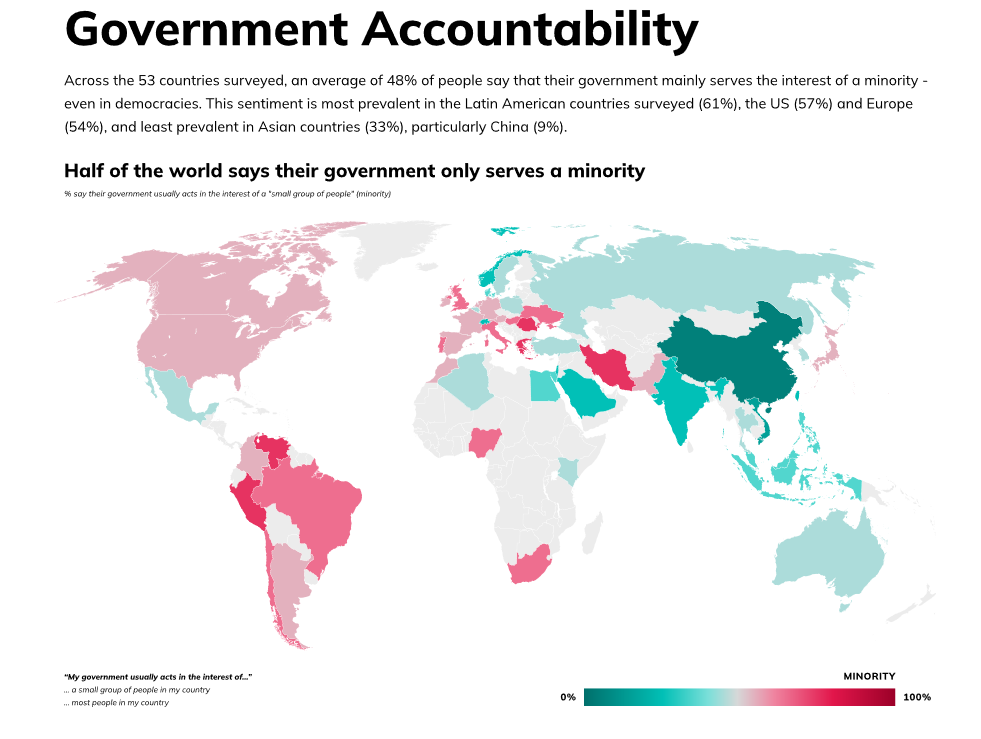
Eurobarometer data shows that the trust European citizens have for their governments has recovered significantly from the depths of distrust felt in the wake of the 2008 financial crisis. At the bottom, in 2013, only a quarter of European expressed trust in their governments and parliaments. Now the average EU government and parliament enjoy a level of trust of 36% and 39% respectively. These numbers have been fairly steady over the last 5 years and are comparable to the numbers before the crisis.

It seems then this is the European “normal”: those who distrust their government outnumber those who do by a 3 to 2 margin or more. Currently, of the 27 EU countries, there are only 6 countries in which a plurality of citizens trust their governments.