Posted on April 1, 2016 by peterstone
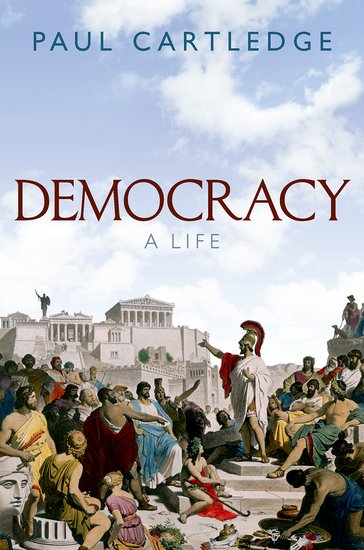
Just read a short piece by Paul Cartledge in which he talks about the history of sortition, a topic treated more extensively in his book Democracy: A Life (Oxford University Press). He even manages to plug my own book, The Luck of the Draw: The Role of Lotteries in Decision Making (also Oxford University Press) along the way. Check it out:
It is quite easy to compile a checklist, perhaps even a decalogue, of differences between their democracy (or rather democracies, as there was no one identikit ancient model) and ours (ditto). And in no respect did they and we differ more than on the issue of sortition, that is, the application of the lottery to the conduct of politics (another Greek invention, both the word and the thing, with – again – the accent to be placed on difference as well as similarity between theirs and ours). We today take the exercise of voting in either general or local elections to be the very quintessence of what it is to do ‘democracy.’ The ancient Greeks took the exact opposite view: elections were elitist and for the nobs, appropriate more for oligarchy (the rule of the few rich) than for democracy (the rule of the masses, most of whom were poor), whereas sortition, the lot, was the peculiarly democratic way of selecting most office-holders and all juror-judges to serve in the People’s jury-courts.
Continue reading →
Filed under: Academia, Athens, Books, History, Participation, Sortition | 5 Comments »
Posted on March 26, 2016 by peterstone
Just saw the following event announced on PHILOS-L. Anyone know the speaker?
*****
Why Chance Matters
with Prof. Mauricio Suárez
(Complutense University of Madrid & UCL)
Tue 12 April, 18.00 (drinks from 17.45)
@The Conservatory, Bloomsbury Publishing
50 Bedford Square, London.
Organised by UH Philosophy & Bloomsbury Philosophy
Free entry- all welcome – no booking required.
Please arrive early to secure a seat and enjoy a drink on us!
Facebook group for the event: https://www.facebook.com/events/463239327215030/
Abstract
Chance has been raising intellectual passions at least since the concept of probability emerged firmly in the 17th century, in connection with both evidence in jurisprudence and regularities in so-called “games of chance”. Probabilistic thinking soon spread everywhere: from actuarial science to population statistics, from the calculus of expectations to decision theory, from measures of experimental error to quantum mechanics. Ideas of pure chance and randomness infected general culture and even the arts. Yet, there have been many attempts to deny the reality of chance. Those in denial have typically tried to explain away chance in terms of something else, something less “fickle”, “elusive” or “ephemeral”. But there is deep disagreement as to what that something else may be. Objectivists aim to analyse chance in terms of proportions in real or virtual populations. Subjectivists aim to analyse it away as a feature of the architecture of cognition – such as information, or partial degree of belief. Yet none of these denials of chance seems to apply across the board and, as I show, they are all subject to important conceptual objections anyway. I conclude that chance matters, not only to many areas of philosophy but also to social policy, and how we conduct our lives in general.
Continue reading →
Filed under: Academia | Leave a comment »
Posted on March 22, 2016 by Yoram Gat
A recent article by Hélène Landemore:
Rousseau’s Mistake: Representation and the Myth of Direct Democracy
Abstract: For Rousseau, democracy was direct or it wasn’t. As he famously put it, “the moment a people allows itself to be represented, it is no longer free: it no longer exists. The day you elect representatives is the day you lose your freedom” (Social Contract, III, 15). In other words, representative democracy is no democracy at all. Rousseau isn’t alone in this belief, and today the disappointed of representative government have turned to celebrating anew the virtues of direct democracy as more true to the ideal of popular sovereignty, self-rule, and genuine political equality. This paper defends the thesis that Rousseau was, in fact, mistaken and that there is no salvation to be found in the ideal of direct democracy. If democracy as a political regime is always, in fact, representative, then the interesting question is not: direct or representative democracy? But instead: What kind of representation should we aim for? The paper argues that beyond the familiar electoral model there are at least two other models of representation that present attractive features: the first is based on sortition and the other on self-selection.
Continue reading →
Filed under: Academia, Athens, Elections, History, Press, Sortition | 5 Comments »
Posted on March 8, 2016 by Yoram Gat

John Keane, Professor of Politics at the University of Sydney, writes in The Conversation a response to David van Reybrouck’s “tired democracy” argument, which Keane presents as an argument for “the replacement of periodic elections, the ritual of citizens choosing parliamentary representatives, by government based on random selection and allotted assemblies of citizens considered as equals”. It may be worth noting that this description overstate’s van Reybrouck’s position significantly and contradicts Keane’s own disclaimer later on about “a deep prevarication in [van Reybrouck’s] work about whether or not elected legislatures should be replaced in their entirety by a ‘parliament of allotted citizens’”.
Keane responds to van Reybrouck by enumerating the mystical wonders of elections:
Democratic representation […] defies the distinction between mimicry (mandating, or issuing instructions) and self-sacrifice by delegation. It rather involves freely and fairly choosing others to take decisions for a fixed period of time. Representation means keeping continuous public tabs on politicians, then throwing them from office at the next election, or when their time is up. It’s much too simple to say that voting is equivalent to throwing away votes. Representation by election is a clever way of rotating leaders. It is equally a method of reminding citizens publicly that the body politic contains disagreements, and that those who act as if there’s consensus can turn out to be politically dangerous.
Continue reading →
Filed under: Academia, Elections, Press, Sortition | 18 Comments »
Posted on March 7, 2016 by roslynfuller
Greetings, everyone. Please excuse my long absence, due to – of all things – running in an election. I recently had the pleasure of reviewing ‘Democracy’s Beginning: The Athenian Story’ by Thomas N. Mitchell former Provost of Trinity College, Dublin for the Irish Times:
Alien and fascinating
It is common knowledge that democracy was invented in ancient Athens, but Mitchell explodes the myths of what that democracy was like. In Athens, all citizens had an equal say in public affairs (known as isegoria), staffed enormous citizen juries, were chosen for office by lottery, and were paid to participate in politics. In describing this way of life, Mitchell paints a picture of a society both alien and fascinating, underscoring the vibrancy of this long-lost civilization with a collection of maps and photos in the centre of the book.
His close scholarship shines in documenting the transition of Athens from financially and morally bankrupt oligarchy to emancipated democracy 2,500 years ago. It was not an easy or linear process, and the book tracks the many clashes of ideas and personalities with a commendable attention to detail that beautifully captures the essence of ancient Greek culture and politics.
From Solon’s economic balancing act, through the political reorganisation of Cleisthenes, the assassination of Ephialtes and, finally, Pericles, one of the most respected but sober leaders of the early democracy, Democracy’s Beginning explores this innovative and fearless experiment in “people power”.
Full review here. I would highly recommend the book to anyone interested in Athenian democracy. It is extremely comprehensive and highly readable.
Filed under: Academia, Athens, Books, Elections, History, Sortition | 6 Comments »
Posted on February 15, 2016 by Common Lot Sortitionist
A review of Landemore’s Democratic Reason by Alfred Moore published in Contemporary Political Theory:
Landemore argues that rule by the many is better than rule by the few or the one because it can harness ‘democratic reason’. Democratic Reason refers to the collective political intelligence of the many, which in turn is a function of individual epistemic competence and the cognitive diversity of the group. [S]he claims that a group containing diverse perspectives, interpretations, heuristics and predictive models, will be better at making decisions than a less diverse group of people, even if they are individually smarter. As the key feature of democracy is that it is an inclusive decision procedure, and inclusion tends to increase cognitive diversity, democracies are likely to outperform rival regime types.
Filed under: Academia, Books, Deliberation, Press | 1 Comment »
Posted on February 9, 2016 by peterstone

I recently appeared on the Irish Radio show “Talking History.” I was part of a discussion of democracy with Paul Cartledge, the esteemed classicist; Roslyn Fuller, whose work has been discussed on this blog; and Iain Walker, from New Democracy in Australia. Much discussion of Athens and sortition. The show can be heard here:
https://www.newstalk.com/Is-democracy-the-best-we-have
Filed under: Academia, Athens, Elections, Press, Sortition | 1 Comment »
Posted on February 8, 2016 by John Burnheim
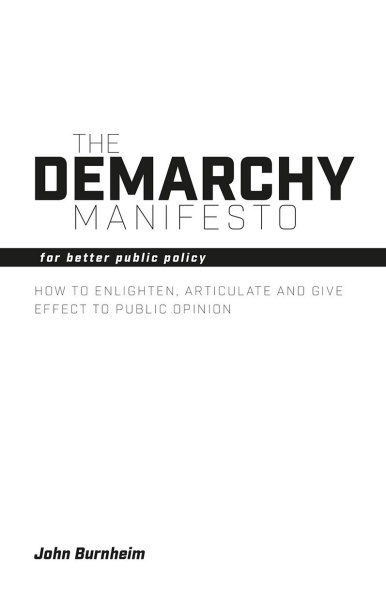
Many kleroterians are bound to be disappointed in my new book The Demarchy Manifesto, due to be release from Imprint Academic on March 1, because it makes no proposals for replacing voting in favour of sortition in existing institutions, but only in the new voluntary institutions I propose. I believe it is necessary to start this way, since it is extremely difficult to persuade people to give up their vote, but they are prepared to consider sortition where it gives them access to a chance of participating that they do not at present have. This is just an instance of a general pattern in the way that the presentation of options makes a great difference to the evaluations people make of alternatives. You might like to look at this article in the US edition of The Conversation for February 6.
The book suggests that we can snatch the initiative in discussing and formulating public policy from the political parties and produce proposals that they have to accept on pain of voter backlash. I think that there is just a chance that my proposals would consolidate the middle ground whereas the existing procedures encourage the extremes. More fundamentally I aim to move attention from “who gets what” to the sort of public goods that we all can take pride in.
An excerpt from the Introduction to the book:
What I call ‘demarchy’ is primarily a process of transferring the initiative in formulating policy options from political parties to councils representative of the people most directly affected by those policies. The task of those councils would be to distil from public discussion the most acceptable policy in a particular matter. It would be up to voters to insist that the politicians heed them. There is no question of constitutional change, no new parties or new laws, no call for a mass conversion of opinion, but a suggestion about how to initiate a change in accepted practice, starting with actions that may seem of little significance in the big picture, but are still justified by their specific purposes. My focus is on how policy is produced and adopted. I am not concerned with questions about the philosophical basis of state power, or human rights, or crime and punishment. The precise forms these things take in practice are a matter of conventions, which I do not propose to challenge. There is already much debate about these matters. I am concerned about what I see as a more important, but neglected, question.
I begin by concentrating on how to establish some new practices and initiatives in policy formation, empowering those most affected to take the initiative in formulating what they want. It is no advantage to have a choice of products if none of those on offer meets your requirements. The best situation is to be able to say exactly what you want and commission specialists to supply it. Or is that analogy anachronistic and inappropriate in the era of mass production and distribution? I try to analyse our unique problems. My ultimate aim is to transform our political culture. I intend to show how different practices of policy formation are appropriate to different problems at every level from the local to the global and how they might come to be accepted.
Continue reading →
Filed under: Academia, Books, Proposals, Sortition | 49 Comments »
Posted on February 3, 2016 by keithsutherland
This article [PDF], by Anthoula Malkopoulou, is a commentary on the work of political theorist Kari Palonen on parliamentarianism. In response to recent scepticism, Palonen’s support for the ‘classical paradigm of elected Members of Parliament looks outdated and insufficiently responsive to the challenge of rising inequalities’:
On one hand, sceptics point to the inherent aristocratic or elitist character of elections, embodied in the perceived superiority of representatives compared to the represented (Manin 1997, 134–149). This is sustained not only by century-long anarchist polemics against bourgeois parliamentary democracy, or populist shaming of political corruption, but also by legitimate i.e. republican concerns about election engineering or illegitimate political lobbying. On the other hand, many scholars are worried by the growing social inequalities enabled by the predominance of economic liberalism since the 1980s (Rosanvallon 2013). These are often exacerbated by corresponding inequalities in political influence that further benefit the wealthy and socially advantaged classes (Hill 2013; Malkopoulou 2014). In this respect, legitimising the current system of parliamentary government and providing its apology sounds far too elitist and self-defeating.
In response to such scepticism, Kari has showed some interest in opening his parliamentary model of deliberation to new modes of inclusion . . . his ideal-typical democratic innovations include the practice of rotation, election of singular representatives who are not linked to political parties, and recently, support for the random choice of representatives (Palonen 2014, 345). This turn is linked to the dissociation of random selection from Habermasian consensus and its support by klerotarians as a device that is independent of the process of deliberation (Stone, Delannoi and Dowlen 2013).
Continue reading →
Filed under: Academia, Elections, Sortition, Theory | 12 Comments »
Posted on January 25, 2016 by keithsutherland

A recent exchange on this forum included the following claims:
TA: The early Populists have been much misunderstood and caricatured, including by Hofstadter. If “populist” is to be defined non-arbitrarily, its meaning is a leader whose policy positions for the most part agree with those of the vast majority of the population. Bernie Sanders is a populist, Trump is not.
TB: I’ve been a personal friend and political ally of Sanders for over 40 years, and I agree that the “populist” label fits Sanders based on the historic use of the term dating back to the People’s Party. However, I think the term has been so over-used (and misused) by the mass media that it isn’t particularly useful any more. Any independent-minded politician, whether a leftist charismatic visionary, a demagogue, or proto-fascist is assigned the label.
According to Cas Mudde, most people use populism as a Kampfbegriff (battle cry) to defame a political opponent. The term is in fact just as applicable to politicians and political parties on the left and the right, Trump and Sanders, Front National and Podemos. In an article for Open Democracy Mudde claims that
populism is best defined as a thin-centered ideology that considers society to be ultimately separated into two homogeneous and antagonistic groups, ‘the pure people’ and ‘the corrupt elite’, and which argues that politics should be an expression of the volonté general (general will) of the people.
Continue reading →
Filed under: Academia, Theory | 19 Comments »


 Adam Cronkright
 Ali
Ali Ahmed R. Teleb
 avanderven
 avergne
 Alex Kovner
 azakaras
 Brett Hennig
 campbellwallace
 Simon Threlkeld
 Nick Coccoma
 codyhipskind
 Common Lot Sortitionist
 Conall Boyle
 constitutionalism
 davidschecter
 graytmatter
 gtridimas
 H.J. Hofkirchner
 Hanspeter Rosenlechner
 John Burnheim
 jgarry20151
 Jochen Krattenmacher
 johnedwardtaylor
 johnhuang865
 Jonathan Crock
 keithsutherland
 Jacob Richter
 kkoreilly
 lukewhito
 SimonPek
 Nathan El
 Nicholas Gruen
 Owen Shaffer
 Patrick Chalmers
 Paul Gölz
 peterstone
 Pierre-Etienne Vandamme
 pronfeld
 Emil
Emil rcaze
rcaze richwbrown
 Roger Knights
 roslynfuller
 Pierre-Etienne Vandamme
 shaharavin
 tbouricius
 Ted Wachtel
 Joshua Laferriere
 theodorestathis
 towardsautonomyblog
 Wayne Liebman
 Yoram Gat
 Oliver Milne
 Equality by lot