Robert Dahl was a prominent political scientist and an early advocate of using sortition in government. He proposed advisory allotted bodies in his 1970 book After the Revolution and made a similar proposal (“mini-populi”) in his 1989 book Democracy and Its Critics.
Democracy and Its Critics presents, among other ideas, a careful and coherent critique of the power of “guardian” bodies like the supreme court. In general, Dahl was noted for being unusually clear in his argumentation in a field whose main occupation is a struggle to explain the advantages of a government system in terms of an ideology which is in plain conflict with it. As an illustration, here is a striking passage from Dahl’s A Preface to Democratic Theory (1956):
The absence of specific meaning for terms like “majority tyranny” and “faction” coupled with the central importance of these concepts in the Madisonian style of thinking has led to a rather tortuous political theory that is explicable genetically rather than logically. Continue reading →
I was watching a talk by Michael Sandel yesterday dealing with his book What Money Can’t Buy: The Moral Limits of Markets (2012). He discusses the fact that people have to queue to attend congressional hearings, federal court hearings, etc. Apparently, you can hire someone to wait in line (all night, if need be) to save your place for you. There are even services that you can contact that specialize in this.
There is often discussion about whether lotteries and queues are interchangeable, equivalent, etc. It strikes me that this is a clear case where a lottery would be superior to a queue. (Not sure if they discuss lotteries at all in here, as I haven’t had the time to finish the video yet.)
A recent segment on the BBC radio show Analysis is titled “The Philosophy of Russell Brand”. The audience is warned ahead of time to hold on to their hats as “Jeremy Cliffe enters a world without rules, without government, but with plenty of facial hair”. Following this introduction, and the expected sound bites from the Brand-Paxman interview, the segment talks about the attention Brand received, the Occupy/Indignados protest movement and features interviews with Paolo Gerbaudo, David Graeber, Michael Hardt, Peter Turchin, Daniel Pinchbeck, and a few friends of Cliffe. Continue reading →
As was mentioned here before, some time ago Prof. Alexander Guerrero and his ideas about the use of sortition in government were the subject of an article in The Boston Globe.
I thank Prof. Guerrero for alerting me to a recently published essay of his about sortition in the online magazine Aeon. The essay presents Guerrero’s proposal, but starts with an interesting analysis of the failure of elections and follows the proposal with an analysis of the promise of sortition.
The lottocracy Elections are flawed and can’t be redeemed – it’s time to start choosing our representatives by lottery
[…]
The celebrity comic Russell Brand is gesticulating wildly, urgently, in a hotel room, under the bright lights of a television interview. ‘Stop voting, stop pretending, wake up. Be in reality now. Why vote? We know it’s not going to make any difference. We know that already.’ He is responding to his interviewer, Jeremy Paxman, who is taking him to task for never having voted.
We are brought up to think that voting is important, that it is a necessary condition of being a politically serious person, that we can’t complain about politics if we don’t vote. This last principle has echoes of the more reasonable parental admonition, said of lima beans or cauliflower: don’t knock it until you’ve tried it. But that principle is based on sound epistemological grounds: you might, for all you know, like cauliflower or lima beans. The voting thing is, as Brand argues, stupid. There are ways of participating in public affairs other than voting. For example, one can become a celebrity and call for revolution in a television interview.
In order to spark a discussion of the significance or relevance of “epistemic democracy” to the use of randomly selected assemblies, juries, or other minipublics, I paste my (very positive) review of Democratic Reason. A short paper by David Estlund called “Introduction to Epistemic Approaches to Democracy” names at least four flavors of epistemic democracy. I believe Landemore’s is it’s “purest” form and therefore a good one to discuss.
How relevant or significant is the epistemic approach? How relevant or significant is the work on diversity and group decision making? How much does all this depend on empirical work not yet done by political scientists?
What empirical studies are out there that Kleroterians would recommend to other sortinistas and to the general public?
Review of Democratic Reason
This book follows the recent trend in democratic theory termed “epistemic democracy” in a novel way. Rather than relying on liberal philosophy or an analogy with science, it begins with results in mathematics, decision theory, psychology and cognitive science. It also mentions an evolutionary basis for the superiority of group decision making. Continue reading →
Bob Moore wrote to call attention to the website of Democracy for the USA – a new organization that advocates replacing elections with sortition. Democracy for the USA is based in Chicago and bills itself as an outgrowth of the Occupy Chicago movement aiming to rectify the deficiency of Occupy’s platform – the lack of a workable alternative to the electoral system.
THE BIG IDEA
The heart of democracy is the community meeting. Of course there are already neighborhood meetings, but these do not determine government policy; they are not effective instruments of popular power. In a democratic USA, by contrast, the people will exercise sovereign rule collectively through regular and frequent community meetings across the country. Unlike the political system now in place, there will be no bodies of politicians–a Congress, state legislatures, city councils–drafting our laws. There will be no lobbyists, no groups such as ALEC, usurping the process. Neither will there be a president, governors, or mayors directing the government. Instead, through Community Assemblies and Executive Councils staffed by ordinary citizens selected by lot, everyone will truly have an equal voice in policy-making and an equal opportunity of serving in government.
In essence it is really this simple. We will not get anywhere flailing away within the confines of the current political structures. We will be like rats running around in a maze, succeeding perhaps in making life a little less unbearable for some people in spots, but ultimately getting nowhere fast. In the meantime the earth will be consumed and we will find ourselves in a condition of serfdom or worse. We have no option: we have to make the necessary change from the current system to democracy.
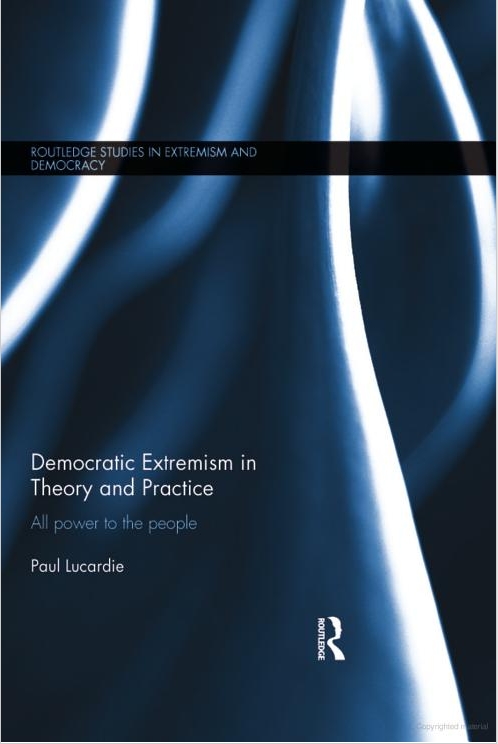
Paul Lucardie sent the following excerpts from his new book ‘Democratic Extremism in Theory and Practice. All power to the people’ (London: Routledge, 2014).
Author’s comment: Democratic extremism may appear to be an oxymoron, as ‘democracy’ is usually associated with moderation, pluralism and tolerance. Yet one could also regard democratic extremism as the opposite of autocratic and aristocratic extremism: whereas the latter imply that all decisions are taken by a dictator, a class of landowners or perhaps (in a more modern variety) the Central Committee of a ruling Communist Party, the former means that all decisions are taken by the people and that a political elite does not play any significant role. Examples of extreme democracy are rare, as far as I could find out. More common are cases of what I would call radical democracy: not all decisions but most important decisions are taken by the people, some are left to a political elite. Even more common, however, are mixed regimes where most decisions are taken by an elected aristocracy (professional politicians) and some by the people. In fact most so-called representative democracies are, in my opinion, mixed regimes, if not elective aristocracies. Continue reading →
The call for papers has gone out for the 4th Annual General Conference of the European Political Science Association. It will be held in Edinburgh, Scotland, on June 19-21, 2014. This is the first year that the conference has had a political theory category for proposals. I have been asked to serve as head of the political theory section, and so I am anxious to see political theory make a big splash at the conference. Obviously, I don’t think the conference will be amenable to ten sortition-related panels, but one sortition-related panel is a different matter…
The proposal submission deadline is December 13, 2013. For further details, or to propose a paper and/or panel, please visit http://epsanet.org/conferences/general-conference-2014.html. And if you have any questions, please do not hesitate to ask. Let’s talk.
At the moment, this blog, Equality by Lot, is all about an endless stream of opinions, opinions, …, and discussions, discussions… Would it not be an idea to start with a rules based protocol, such as L. Leòn’s protocol, and to ask people to add rules or to eliminate rules (with a short explanation of why)? It would make things much more down-to-earth and much more exciting.


 Adam Cronkright
 Ali
Ali Ahmed R. Teleb
 avanderven
 avergne
 Alex Kovner
 azakaras
 Brett Hennig
 campbellwallace
 Simon Threlkeld
 Nick Coccoma
 codyhipskind
 Common Lot Sortitionist
 Conall Boyle
 constitutionalism
 davidschecter
 graytmatter
 gtridimas
 H.J. Hofkirchner
 Hanspeter Rosenlechner
 John Burnheim
 jgarry20151
 Jochen Krattenmacher
 johnedwardtaylor
 johnhuang865
 Jonathan Crock
 keithsutherland
 Jacob Richter
 kkoreilly
 lukewhito
 SimonPek
 Nathan El
 Nicholas Gruen
 Owen Shaffer
 Patrick Chalmers
 Paul Gölz
 peterstone
 Pierre-Etienne Vandamme
 pronfeld
 Emil
Emil rcaze
rcaze richwbrown
 Roger Knights
 roslynfuller
 Pierre-Etienne Vandamme
 shaharavin
 tbouricius
 Ted Wachtel
 Joshua Laferriere
 theodorestathis
 towardsautonomyblog
 Wayne Liebman
 Yoram Gat
 Oliver Milne
 Equality by lot