The benevolent dictator

The concept of the “benevolent dictator” occasionally plays a role in political discussion of democracy. The general thrust of the “benevolent dictator” argument is that democracy cannot be defined in terms of its outcomes because “a benevolent dictatorship” can produce any given outcomes, while still, by assumption, being anti-democratic.

Ober (2006), for example, says this:

Democracy is shown to be a non-instrumental good-in-itself (as well as an instrument in securing other goods) by extrapolation from the Aristotelian premise that humans are political animals. Because humans are by nature language-using, as well as sociable and common-end-seeking beings, the capacity to associate in public decisions is constitutive of the human being-kind. Association in decision is necessary (although insufficient) for happiness in the sense of eudaimonia. A benevolent dictator who satisfied all other conditions of justice, harms her subjects by denying them opportunity to associate in the decisions by which their community is governed.

This line of argument – the participative conception of democracy, or Schumpeter’s “classical doctrine” – sounds very high minded. Beyond the policy objective, political participation enriches the participators and ennobles them. As an argument against sortition, or against an outcomes-based conception of democracy it is, however, less than convincing.
Continue reading

Wang Shaoguang: Representative and Representational Democracy, Part 2

Part one is here.

A useful part of Wang Shaoguang’s article “Representative and Representational Democracy” (2014) is his critique of the arguments for elections as a democratic mechanism (and in fact as the most fundamental component of democracy). The whole matter of the justification for elections in terms of their expected outcomes is usually avoided by electoralist dogma. Instead the discussion is framed using formalisms: elections are judged as being “legitimate” because they follow some supposed principles of “representativity”. The issue of how those principles themselves can be justified other than in terms of system outcomes is not addressed.

On the rare occasions when the expected outcomes of elections are addressed, two mechanisms are offered as connecting elections with desirable outcomes – Wang refers to these as the “authorization theory” and the “accountability theory”. These arguments go at least as far back as the Federalist papers. Wang first presents and critiques the authorization theory:

According to authorization theory, during elections each political party puts forth its policy positions and promotes its candidates, while the people have the right to choose to support whichever party or candidate they want, and they will vote for the party and candidates of their choice. In the sense that those who are elected start governing only after they have been invested with the authority of the people, this system is of course democratic.
Continue reading

MeRA25 and sortition

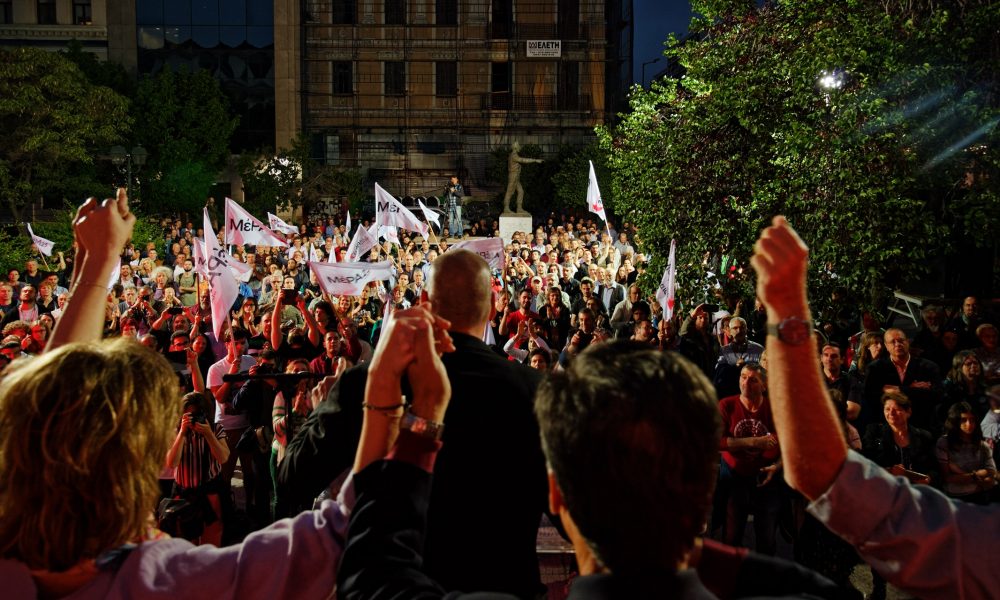
MeRA25 is a Greek party headed by former Syriza finance minister Yanis Varoufakis. MeRA25 has recently made two moves pushing sortition forward in the Greek political agenda.

First, in July MeRA25 tabled a bill proposing that senior public servants would be elected by an allotted committee. The bill calls for

Establishment of a new, autonomous General Secretariat for Public Revenue, whose General Secretary will be selected by neither the government nor the lenders. Instead, they will be elected by a Social Committe for Selection of Senior Personnel, 1/3 of which is comprised of parliamentarians, 1/3 by judges selected by sortition and 1/3 by tax professionals – accountants selected by sortition.

Secondly, MeRA25 is selecting its own central committee members with some of them selected by election, some by appointment and some by sortition:

The 1st Central Committee is comprised of the members of the current Extended Political Secretariat, 15 members chosen by sortition amongst all MeRA25 members (who are also DiEM25 members), 2 members from every Administrative Region (excluding Attica) put forward by the Secretary in concert with the Committee for the Organisation of the Congress and Movement Outreach, and 1 member from every electoral district, selected by the members of that district through e-voting.

Wang Shaoguang: Representative and Representational Democracy, Part 1

As a powerful state which is not electoralist, it is not surprising that China produces political theory which rejects the equation of democracy with elections. It is characteristic of the weakness of Western political science that it makes no serious attempt to explore and engage with this theory.

Wang Shaoguang is a prominent Chinese political scientist. His article “Representative and Representational Democracy” was originally published in the Chinese language social science journal “Open Times” in 2014. A translation to English of the article appears on the website “Reading the China Dream” which regularly translates articles by Chinese establishment intellectuals. The article makes several intertwined arguments regarding democracy and elections. While focusing, naturally, on the Chinese system as an alternative to the Western electoralist system, Wang does make a mention of sortition as well.

In the following excerpts Wang first notes the crisis of the Western government system and makes the straightforward observation, often avoided in the West, that the Chinese system enjoys more popular support than most Western governments. Rather surprisingly, it seems to me, instead of translating this fact to a frontal attack on the Western system, Wang then makes the apologetic (and fairly familiar) multi-culturalist argument that democracy is perceived differently in different cultures. Wang asserts that while the formality of elections is a main feature of the Western or American conception of democracy, in the East “substantive” aspects are considered essential.

Today, even though Thatcher’s “There is No Alternative” and Fukuyama’s “End of History” have already become standing jokes in academic and intellectual circles, their variants proliferate and circulate constantly. Though most people no longer use these particular expressions, many still firmly believe that the “today” of Western capitalist countries is the “tomorrow” of other countries (including China).
Continue reading

Malcolm Gladwell on sortition

Malcolm Gladwell is a well-known popular science author. Gladwell has a podcast called “Revisionist History”. A recent episode of the podcast is devoted to sortition, with much of it being about Adam Cronkright’s work in applying sortition to student bodies in schools in Bolivia. Gladwell himself visits a school in the US and finds that the students are receptive to the idea. He also mentions the idea of using a lottery to allocate research funds.

Testart on democracy, democratic debate and citizen power, Part 2/2

This is the second part of a translation of a 2017 interview in Le Comptoir with Jacques Testart, a prominent French biologist, and long-time advocate for citizen power. The first part is here.

Le Comptoir: Citizen juries have so far been employed in a consultative role. Can you explain what those procedures are and within which frameworks they do they work?

Testart: The democratic procedures for citizen juries or assemblies are very vague. The principle is always to ask a group of allotted people to express their opinion on a certain problem. Citizen conferences, which are the most well-formed model, were invented by the Danish parliament in the 1980’s, perhaps because the Danish MPs are less conceited than ours. They noted that they were unqualified to politically manage technological and medical problems.
Continue reading

Bellon: The sortition pandemic

A column by André Bellon, July 7th, 2020.

This is not the first time that I opine on sortition, but addressing this matter seems to me more and more necessary in view of the avalanche of commentary which has accompanied the celebrated “Citizen Convention for the Climate”.

If the advocates of sortition were able to appear for a while like dreamers, they are now showing their toxicity. They are now are now no longer merely asking us for a convention aimed to enlighten public decision making. They are now demanding an allotted parliament. Considering, with much justice, that the elected do not represent the voters any more, they are not trying to redefine the mandate of the elected. They are proposing to suppress the voters.

An so, Jacques Testart conjures up an allotted constitutional assembly. Just that! The legal expert Dominique Rousseau, who constantly criticizes universal suffrage – which he falsely associates with abbé Sieyès – asks for a new deliberative assembly formed by sortition. To justify his request, he declares: “The nation has its chamber, then national assembly. The territories have theirs, the senate. The citizens, who are everything in society but nothing in its institutions, should have their chamber as well”. Beyond this far-fetched argument, Rousseau feels that in order to be truly represented, the citizens should no longer be voters. To be consistent, he opposes the popular initiative process (référendum d’initiative citoyenne) because it could “ask about the reestablishment of the death penalty, citizen preference or the preventative detention of sexual deviants?”.
Continue reading

Shaw: A transfer of power from the elite to the masses

Ethan Shaw advocates sortition in International Policy Digets:

Voter reform in America aims to increase turnout in elections, however, this focus dismisses the glaring weaknesses of the American democratic process. Congressional approval ratings are abysmally low, and you have probably heard the phrase “Congress is not doing their job” countless times. The problem is not about the accessibility to the ballot box; it is the inconsequentiality of voting that keeps people home on election day. So how does one solve the systemic issues with Congress that promotes voter apathy? By going back to the birthplace of democracy.

A Civic Duty to Legislate

The United States should have mandatory legislative service. Ancient Athenian citizens were randomly selected to serve a 1-year term in a legislative assembly. This process is known as sortition and has been purported by democratic reformists across the globe. In the American political discourse, sortition has never been fully discussed as a viable replacement to the current legislative infrastructure. Many individuals scoff at the idea, worried that random selection will create a legislature full of inept buffoons.

Continue reading

Macron “accepts all but three” of the CCC’s 149 recommendations

RFI reports:

A day after a powerful push by the Greens in French municipal elections, President Emmanuel Macron on Monday vowed to speed up environmental policies – promising an extra €15 billion to fight global warming over the next two years, and throwing his support behind two referendums on major climate policy.

Macron was responding to proposals put forward by the 150-member Citizens Climate Convention (CCC), a lottery of French people chosen to debate and respond to the climate challenges facing society.

During a meeting in the gardens of the Elysée Palace, Macron told convention members that he accepted all but three of their 149 recommendations which would, he promised, be delivered to parliament “unfiltered”.
Continue reading

Wachtel: Let’s Choose Legislators Randomly from the Phone Book

Ted Wachtel is the founder of a political organization called “Building A New Reality“. He is a sortition advocate.