Moral, Legal, and Practical Imperatives to Restore the American Republic
By Nick Coccoma, Max Goodman, and Dr. Paul Zeitz of #unifyUSA.
American democracy is falling apart, a slow-motion car wreck we’ve been watching for years. But this crash wasn’t caused by an outside force. We’ve been run off the road by our own founding document: the U.S. Constitution. We know—sacrilege! Yet it must be said. And as legal scholar Rosa Brooks puts it, it’s our collective worship of the document that’s tying us down:
How did it happen that the United States, which was born in a moment of bloody revolution out of a conviction that every generation had the right to change its form of government, developed a culture that so many years later is weirdly hidebound when it comes to its form of government, reveres this piece of paper as if it had been handed by God out of a burning bush, and treats the Constitution as more or less sacred? Is it really such a good thing to have a document written almost 250 years ago still be viewed as binding us in some way? How would we feel if our neurosurgeon used the world’s oldest neurosurgery guide, or if NASA used the world’s oldest astronomical chart to plan space-shuttle flights?
She’s right. The Constitution’s like a Macintosh computer from 1984. Innovative when it first came out; painfully inadequate for the tasks of today. We’ve tried to keep it running with patches and workarounds, but there’s only so much you can do with outdated hardware.
Many people know this, yet they despair of making updates. Along with being the oldest on earth, the Constitution’s also the most difficult to change. Article V presents an absurdly high bar to clear. Since 1791, we’ve revised it only 17 times.
Patrick Deneen is a professor of political science at Notre Dame university. He is a fairly prominent public intellectual in US politics, popular especially among the Republican elite. His 2018 book, Why Liberalism Failed, drew quite a bit of attention.
A piece by Deneen has recently been published by the Notre Dame magazine. It is a surprisingly, even impressively, good. The heavy punches just keep coming. Here are some excerpts.
Democracy and Its Discontents
The claim that our democracy is imperiled should rightly strike fear in the souls of citizens, but it ought also to give pause to any student of politics. During most of the four decades I have studied and written about democracy, political scientists, and especially political theorists such as myself, would begin not with a claim about the relative health of democracy, but rather with a seemingly simple question: What is democracy?
Yet according to a dominant narrative among today’s academics, public intellectuals, media personalities and even many citizens, it is largely assumed that we know what democracy is. Continue reading →
Reddit user “totalialogika” wrote the text below in the Reddit r/PoliticalScience forum. The commenters on that forum dismissed the text with various versions of “Sir, this is a political science sub. Please go rant somewhere else”. This raises the question of what makes a certain text a piece of “political science” as opposed to “a rant”. Is it merely that the style needs to conform to certain customs, or is there more to it than that?
Sortition might be the only way
We need to rely on Jury Duty rule to eliminate corrupt and sociopathic politicians, especially those who make a career out of their rhetoric.
And for those who claim “expertise” and “experts” are the only thing that can rule. It is expertise to pervert the rule of law and to promote special interests and experts versed in hollow promises and empty talk meant to address emotional and not rational responses from the denizens.
The degeneration of today’s political system in America is the symptom of how inadequate is an archaic system setup by a few million settlers at the 18th Century for the interests of a patriarchal racist and male dominated country, and now inadequate to serve the need of a 350 million people strong superpower. There were of course attempts at putting lipstick on the pig i.e Civil Rights reforms and more access for minorities and women, but those are as ineffectual and “for show”. Continue reading →
David Cottam is a British historian and former principal of Sha Tin College, an international secondary school in Hong Kong, and a columnist in the China Daily Hong Kong Edition. In a recent column he writes about sortition.
Hong Kong, currently a hybrid of democratic and meritocratic government, is ideally placed for developing [a system with an element of sortition]. Like ancient Athens, its compact size and well-educated population would readily facilitate such a move. Introducing an element of sortition into the Legislative Council would answer the call for greater representation of the people without risking a return to the sort of partisan conflict and obstructionism that previously characterized the legislature. This would establish Hong Kong as a model of modern government, truly representing the people but without the vested interests and divisiveness of warring political parties. Such a system would also reflect Hong Kong’s unique amalgam of Western and Chinese influences, combining democratic values with the nonpartisan Confucian values of harmony and social cohesion. Indeed, this could provide an excellent model of government, not just for the Hong Kong Special Administrative Region, but for any place wanting to enhance political participation, reduce partisan division, and ensure that the common good rather than party interests always prevails.
I think advocates of sortition should be pointing out the many ways it might be adapted to various different circumstances of our political life. This elides the more fundamental discussion of a preferred constitution, but rather naturalises the idea of sortition as part of the political repertoire. It shows its promise and versatility in helping to detox the current system.
Accordingly here’s something tweeted today —with the full text reproduced below the tweet.
People say an open convention would tear the Democrats apart.Yet again, the Dems are letting powerplays within their party determine their candidate. But Kamala is the Claudine Gay candidate. High DEI score, low on accomplishment, talent and charisma. Dems could get the right answer and unite their party — and the country using a variant of the way Venetians chose their officeholders and became the most stable polity in Europe for 500 years. An elective constitutional monarchy no less (like the US). I’d pick 50 Democrats and 50 American voters by lottery, have them meet, deliberate and each vote SECRETLY (like Venetian electors did). If you remove all the incentives to get the answer wrong, people usually get it RIGHT. Who knew?
The first step toward the application of sortition for the democratization of society is not to convince elites that sortition would be a good tool for them to use, as many academics seem to believe, but to disseminate the idea widely among the population, so that it becomes a live political possibility. For this to happen, the few who are aware of this idea need to tirelessly take advantage of every opportunity to advocate for sortition.
Chandre Dharmawardana and Phil Wilson are advocates for sortition (each in their own country and situation), whose writings have been citedhere before. Each of those has recently written again, demonstrating the spirit of consistent dedication to the cause of democracy.
In my opinion, a way around [the practical and theoretical problems with elections] is to abandon electoral methods and return to the method of SORTITION advocated by Aristotle and used in several Hellenic cities during the time of Pericles. Continue reading →
Already weakened by the vast impersonal forces at work in the modern world, democratic institutions are now being undermined from within by politicians and their propagandists. The methods now being used to merchandise the political candidate as if he were a deodorant positively guarantee the electorate against ever learning the truth about anything. —Aldous Huxley, Brave New World Revisited, 1958, VI.
We vote, indeed we perceive political reality, through the people with whom we are in contact. Most of us are reached by the mass media only in a two-step process, by way of other people’s perceptions and reactions to them. —Hanna F. Pitkin, The Concept of Representation, 1967, p. 223.
… it has also become evident that if one acts ruthlessly …, cleverly organized propaganda can accomplish swift and drastic changes in opinions and attitudes, especially in difficult and critical situations; it can … also instill patently false ideas about actual conditions. — Daniel Boorstin, The Image, 1961.
Regarding one of those Pernicious P’s, Wikipedia says the following [2024-07-01] about the influential author Edward Bernays and his book, Propaganda (1928):
[Bernays] outlined how skilled practitioners could use crowd psychology and psychoanalysis to control them [the masses] in desired ways. Bernays later synthesized many of these ideas in his postwar book, Public Relations (1945), which outlines the science of managing information released to the public by an organization, in a manner most advantageous to the organization.
Among the major handicaps a reformer can encounter is the opposition of the indignant virtuous …. —E.S. Turner, Roads to Ruin: The shocking history of social reform, 1960.
Cristina Lafont’s 2020 book, Democracy Without Shortcuts, unfairly attacks lottocracy as invidiously exclusionary. A false equivalence is asserted between lottocrats’ current “existential” criticism of the political capability of mass publics and misogynists’ past “essentialist” criticism of the political capability of women (and sometimes of other marginalized groups). Lafont writes, for instance:
… The empirical evidence provided to supposedly ‘prove’ women’s ignorance, irrationality, apathy, and irresponsibility, and the arguments put forth to perpetuate their subjection to others in the not too distant past, are remarkably similar to the arguments and evidence currently provided by the ‘voter ignorance’ literature. Continue reading →
The imbecility of men is always inviting the impudence of power. —Emerson, Representative Men, ch. 1.
The incompetence of the masses … furnishes the leaders with a practical and to some extent a moral justification. —Robert Michels, Political Parties, 1915, 111.
The weaker the interest and knowledge of the electorate, the more decisive become the efforts of organized groups in molding opinion. This situation alone implies a tendency toward oligarchy within democracy …. —Herbert Tingsten, The Problem of Democracy, 1965, p. 102.
Democracy is the most difficult of all forms of government, since it requires the widest spread of intelligence, and we forgot to make ourselves intelligent when we made ourselves sovereign. —Will and Ariel Durant, The Lessons of History, 1968, p. 273.
Proxy Electors will be better informed than effectively “imbecilic” mass-voters, because they will be focused on a single responsibility. They will not have a dozen other political issues competing for their attention. They will instead be exposed to opportunities to delve deeply into their sole topical area, such as online lectures by experts, testimony by insiders and whistleblowers, audiobooks by investigative reporters, etc. Much of it should soak in.
Back in 2017, after a minor campaign of harassment, Guardian columnist George Monbiot weighed in on sortition. At the time his verdict was that the idea was nothing short of “a formula for disaster” and instead he offered his readers the usual electoral fixes such as campaign finance reforms, voter education and proportional representation. Well, seven years later, Monbiot has had a significant change of heart:
General elections are a travesty of democracy – let’s give the people a real voice
Our system is designed for the powerful to retain control. Participatory democracy and a lottery vote are just two ways to gain real representation
[G]eneral elections such as the one we now face could be seen as the opposite of democracy. But, as with so many aspects of public life, entirely different concepts have been hopelessly confused. Elections are not democracy and democracy is not elections. Continue reading →


 Patrick Deneen is a professor of political science at Notre Dame university. He is a fairly prominent public intellectual in US politics, popular especially among the Republican elite. His 2018 book, Why Liberalism Failed, drew quite a bit of attention.
 David Cottam is a British historian and former principal of Sha Tin College, an international secondary school in Hong Kong, and a columnist in the China Daily Hong Kong Edition. In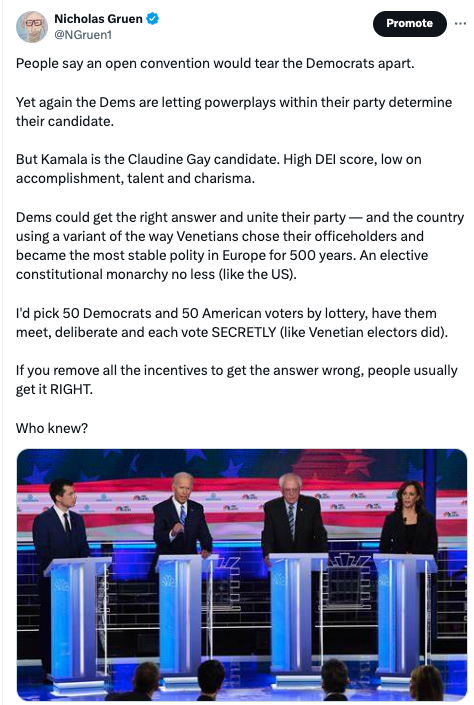



 Adam Cronkright
 Ali
Ali Ahmed R. Teleb
 avanderven
 avergne
 Alex Kovner
 azakaras
 Brett Hennig
 campbellwallace
 Simon Threlkeld
 Nick Coccoma
 codyhipskind
 Common Lot Sortitionist
 Conall Boyle
 constitutionalism
 davidschecter
 graytmatter
 gtridimas
 H.J. Hofkirchner
 Hanspeter Rosenlechner
 James Kierstead
 John Burnheim
 jgarry20151
 Jochen Krattenmacher
 johnedwardtaylor
 johnhuang865
 Jonathan Crock
 keithsutherland
 Jacob Richter
 kkoreilly
 lukewhito
 SimonPek
 Nathan El
 Nicholas Gruen
 Owen Shaffer
 Patrick Chalmers
 Paul Gölz
 peterstone
 Pierre-Etienne Vandamme
 pronfeld
 Emil
Emil rcaze
rcaze richwbrown
 Roger Knights
 roslynfuller
 Pierre-Etienne Vandamme
 shaharavin
 tbouricius
 Ted Wachtel
 Joshua Laferriere
 theodorestathis
 towardsautonomyblog
 Wayne Liebman
 Yoram Gat
 Oliver Milne
 Equality by lot