On what the Council of 500 did and did not do

By Mirko Canevaro

[Editor’s note: this post is a response to comments on the post Athenian Constitutionalism: Nomothesia and the Graphe Nomon Me Epitedeion Theina and should be read together with the original article.]

There is a need to distinguish between decree-making and law-making (nomothesia). In decree-making, roughly 50% of fourth-century decrees found on stone are decrees of the Council (probouleumatic) ratified by the Assembly without discussion (unanimously). The other 50% were proposed directly in the Assembly, either because the Council enacted an ‘open probouleuma’ (invitation to discussion but with no actual proposal), or because the proposal of the Council had failed to be ratified in the Assembly.

I, for one, don’t see the Council as an ‘administrative magistracy’. Alberto Esu has a great chapter forthcoming showing just how important the Council was in ‘deliberating’, and how it actually had vast powers of decision on its own. And Ober, in Democracy and Knowledge, has made a powerful argument for the role of the Council in collecting and synthesising diffused knowledge through deliberation. (See also my piece on majority rule and consensus, about how many decrees were enacted by the Assembly without the debate, on the force of the deliberation that had been carried out in the Council, with the evidence for it. I argue that deliberation was possible and went on as a matter of course – the paper is controversial, but some have already agreed, e.g. Ober, Luraghi, Harris, even Hansen, and we don’t agree on much else… Let’s see how the debate proceeds.) It was not that central in nomothesia, but it was very central in decree-making, as a proper deliberative body.
Continue reading

Athenian Constitutionalism: Nomothesia and the Graphe Nomon Me Epitedeion Theinai

Many of us who argue the case for the implementation of sortition in modern lawmaking like to base their arguments on fourth-century Athenian practice. In my PhD thesis on the topic I argue (on the authority of Hansen and Blackwell) that there were eight stages involved, and a new paper by Mirko Canevaro (who disagrees with many of Hansen’s claims) argues that it was even more complicated. The following stages are from page 73 of his paper:

In fourth-century Athens, to pass a law,

[1] the demos first acted in the form of the Council of Five Hundred, selected by lot. The Council set the agenda for the Assembly and could be persuaded to put lawmaking (as the production of new laws – general permanent rules) in the agenda of the next Assembly.

[2] At that point, the Assembly (composed potentially of the whole demos, and in any case very rarely of fewer than 6,000 people) held a preliminary vote not on new law proposals, but on whether laws could be proposed at all. The institutional setup was such that the first vote in the Assembly was not on a particular solution, but on whether the demos recognised that there was a problem that needed solving through legislation.

[3] If the vote was successful, then volunteers could propose new laws, which had to be widely publicised for a month.

[4] At the end of the month, the Assembly would set a date for the meeting of the nomothetai to enact new laws.
Continue reading

Chalmers: The nakedness of elections

Patrick Chalmers writes:

TOULOUSE, France — In the Danish fable “The Emperor’s New Clothes,” it was a little boy who pointed out what no adult dared expose: The king was naked; his court, a cast of pompous fools beguiled by tricksters.

It’s time to do the same with our own reified system of government — representative democracy and its so-called free and fair elections.

Shocking? Of course it is. We’ve been taught to hold our voting rights as sacred — that despite our political system’s many flaws, representative democracy is, to paraphrase Winston Churchill, “the worst form of government, except for all the others.”

But what if there were, after all, a real alternative? What if there were something less corruptible than pure democracy by election? That something needn’t replace periodic elections, or at least not at once, but it could certainly guard us against their worst failings. Not least of those is the grossly outsized influence of narrow interests at the expense of everyone else’s.

Fishkin: Random Assemblies for Lawmaking? Prospects and Limits

James Fishkin’s contribution to the September 2017 workshop “Legislature by Lot” was titled “Random Assemblies for Lawmaking? Prospects and Limits”:

Abstract
A randomly selected microcosm of the people can usefully play an official role in the lawmaking process. However, there are serious issues to be confronted if such a random sample were to take on the role of a full-scale, full-time second chamber. Some skeptical considerations are detailed. There are also advantages to short convenings of such a sample to take on some of the roles of a second chamber. This article provides a response to the skeptical considerations. Precedents from ancient Athens show how such short-term convenings of a deliberating microcosm can be positioned before, during, or after other elements of the lawmaking process. The article draws on experience from Deliberative Polling to show how this is both practical and productive for the lawmaking process.

Keywords
Athens, corruption, Deliberative Polling, elections, minipublics, nomothetai, representative democracy, sortition

In arguing for short term “Delibertive Polls”, Fishkin offers three problems with long-term allotted chambers: (1) lack of technical expertise, (2) potential for corruption, and (3) not maintaining what he calls “the conditions for deliberation”.
Continue reading

Venice and Why Sortition is Not Enough

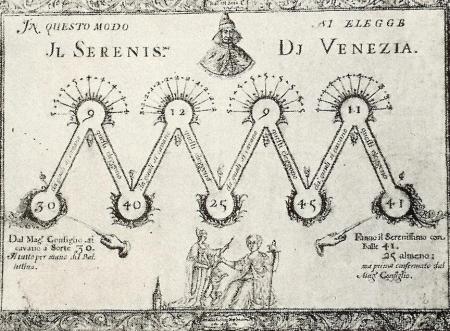
Without much commentary, given the high level of knowledge and debate on this blog, I share an important document about elections in Ancient Venice. As most here will know, I hold it that ‘pure’ sortition is a suitable and necessary tool for democracy. However, it is also an insufficient one, as has been criticised already at the time of sortition’s outset, with the powerful “Socratic Objection” as documented by Xenophon. Today, I describe the missing element specifically for appointments to positions of power.

As most here will know, the Ancient Venetians combined sortition with elections in multiple iterations to determine their leadership, the Doge. Their success with this add-on innovation was superior to the Athenians, as evidenced by the significantly longer duration of their system. Now, there clearly were flaws, room for improvement, as their system ended by reversal to today’s unfortunate party system but that’s for another day.

So far, most scientific papers on this topic have been descriptive. Now Miranda Mowbray, and Dieter Gollmann of the Enterprise Systems and Storage Laboratory at
HP Bristol expand the debate with this paper on the mathematical properties of the Venetian method in avoiding usurpation of power while still finding the best leadership. The authors have their mind on applications in distributed computing security, but for us here, the advantages for a more mundane topic such as democracy may be good enough to give it some thought.

Enjoy.

As an aside, the statutes of G!LT in Austria therefore employ the Venetian model for all executive leadership elections. My rationale is that the party system with its unholy alliance with mass media rewards showmanship and superficiality, as evidenced by the high proportion of TV Actors and Reality Show Stars in top jobs. Instead G!LT’s protocol ensures a reasonably self-experienced, direct, personal knowledge of a candidate’s ability and suitability for an executive position. For those who read German, here to the Statutes of G!LT. For those who don’t there is Google Translate.

1768: Scheme of a Political Lottery, for the Peace of the Kingdom

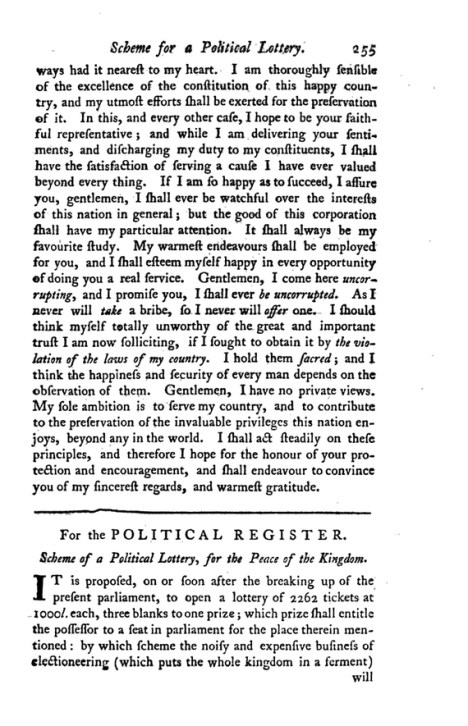
The following letter to the Political Register and Impartial Review of New Books, printed in London in 1768, offers sortition of parliament as a way to remedy the corruption of elections. Thanks to Terry Bouricius for drawing attention to this historical piece.

Scheme of a Political Lottery, for the Peace of the Kingdom

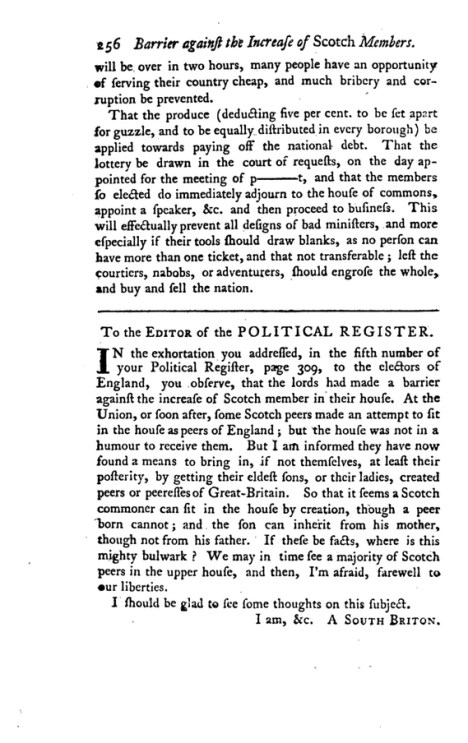
It is proposed, on or soon after the breaking up of the present parliament, to open a lottery of 2262 tickets at 1000l. each, three blanks to one prize; which prize shall entitle the possessor to a seat in parliament for the place therein mentioned: by which scheme the noisy and expensive business of electioneering (which puts the whole kingdom in ferment) will be over in two hours, many people have an opportunity of serving their country cheap, and much bribary and corruption be prevented.

The the produce (deducting five per cent. to be set apart for guzzle, and to be equally distributed in every borough) be applied towards paying the national debt. That the lottery be drawn in the court of requests, on the day appointed for the meeting of p——t, and that the members so elected do immediately adjourn to the house of commons, appoint a speaker, &c. and then proceed to business. This will effectually prevent all designs of bad ministers, and more especially if their tools should draw blanks, as no person can have more than one ticket, and that not transferable; lest the courtiers, nabobs, or adventurers, should engrose the whole and buy and sell the nation.

Hugo Bonin: Democracy by lottery

The newspaper Le Journal de Montréal has an article by Jacques Lanctôt about Hugo Bonin’s book, La Democratie Hasardeuse [Original in French, my translation].

Games of chance in politics

“With luck, things will turn out well.” Who has not heard this saying at some point? A chance encounter, a decision taken offhandedly, a delay that turned out for the best, any of those may change our life.

Hugo Bonin believes that luck may be beneficial in politics as well even if it is not a magical solution to all our problems of representation. In a well structured essay, well supported by numerous concrete examples stretching as far back as antiquity (Athens and Rome) and where a future that is almost within our reach is imagined, Bonin aims to show that sortition is a hundred-fold better than the so-called representative elections.

Sortition has its limits but its great merit is that it takes no account of distinctions between races, genders, ages or social classes. John and Jane Doe are worth just as much as the elitist clique of doctors, lawyers and businessmen who have been governing us for too long a time.

More “egalitarian”
In an electoral regime such as the one know here and elsewhere in the West, the voters vote to elect the supposedly better candidate. While in an allotment system, the notion of “better” does not exist because everybody are equally politically qualified. Thus, this is “an egalitarian and a democratic procedure” where all external considerations are excluded.

Random selection is already practiced here in Québec and elsewhere. We need only consider jury selection in a criminal trial. Made of lay people rather than experts, following the British law, this jury is called upon to analyze the evidence and render a decision after deliberation.
Continue reading

Luc Rouban on sortition

Luc Rouban, director of research at CNRS, is the author of the book La démocratie représentative est-elle en crise ? (Is representative democracy in crisis?). In an interview with Vie Publique that took place in March he addressed the idea of sortition along with other reform proposals. An excerpt [original in French, my translation]:

There is a lot of talk about sortition as a way to give all the citizens an equal chance of being chosen to participate effectively in politics. The idea is to revive the ancient concept of Greek democracy at the time of Pericles. But it is necessary to recall that in the Athenian model, the electoral body was composed only of active citizens, sufficiently wealthy to buy military equipment, and excluding women, slaves and metics, that is foreigners who lived permanently in the city which were half the the Athenian population. In addition, this model relies on mistophory, that is the remuneration of allotted citizens for carrying out the charges of office, which allowed the less fortunate to participate in democratic life. It is very evident that such a system would be difficult to generalize in modern democracies, except at the local level, for example in the framework of citizen juries such as those being increasingly used recently to give their opinion to the public authorities on matters of planning projects.

In general, sortition – despite the supposed equality which it leads to – poses a philosophical and judicial problem. In fact, if Article 6 of the Decleration of the Rights of Man states that “all citizens are equally eligible to public offices, places and public employments, according to their abilities with no distinction other than their virtues and their talents”, it is proper that the evaluation of abilities, of virtues and talents of candidates are at the heart of representative democracy. Sortition, by definition, annuls this evaluation, which is taking place by the citizens when they vote. At bottom sortition depends on chance assemblies and cannot lead to the selection of the most commendable citizens. In sum, these risks lead to see sortition as no more than useful for consultation on specific projects at the local level when the purview of decision is well circumscribed. But sortition, just like the referendum, cannot provide good results unless it is associated with procedures allowing to clearly describe the objectives of the debate and allowing the involvement of experts or representatives of organizations.

Frey and Tridimas on sortition

George Tridimas wrote to draw attention to the recent issue of the journal Homo Oeconomicus which has a set of comments (including one of his own) on a 2017 paper by the Swiss political economist Bruno Frey titled “Proposals for a Democracy of the Future” (PDF).
In the paper, Frey has a section called “True  Democracy  by  Random  Decisions?”. Some excerpts from that section:

The major advantage of random procedures in politics is to guarantee equal chance and therewith fairness, given the underlying body (e.g. Stone 2007). Each and every one in the underlying population has an equal chance of getting elected. It is therefore not necessary to introduce special quotas e.g. for the share of women. Interestingly, random procedures even take into account dimensions not yet discussed or even beyond imagination. Most importantly, the body politic is opened to new ideas and otherwise disregarded views. This also holds for preferences not yet even known but which may be important in the future.

The disadvantage of random decisions in politics is that capabilities, education and the intensity of desires are disregarded. This is the main reason why random choices in politics are rarely, if ever, taken from the population as a whole. The advantage of equality and fairness must be compared to the disadvantage of lower competencies. There are a great many possibilities to combine the two – a worthy subject for future research.

In addition to proposing combining sortition with elections, Frey also proposes deciding the outcome of referenda at random with the probabilities of the outcomes given by the vote shares.

Tridimas’s comment contains a review of the use of sortition in Athens. He concludes with a section called “Why Sortition may not Work”:

Clearly, the Athenian democracy was fundamentally different from the present representative democracy. Assembly deliberation, the rule of simple majority, absence of political parties, citizen participation through the courts, and sortition were a joint constitutional package, inexorably linked and mutually reinforcing. Therefore, an institution like sortition that served the direct democracy well may not be easily transferable to a representative democracy without the rest of the institutional structures. Cutting and pasting sortition from Athens to today is not the same thing as grafting it to the current institutional structure, and may fail to deliver ‘‘a better democracy’’.

Sortition in Jacobin magazine

Tom Malleson, assistant professor of social justice and peace studies at King’s University College at Western University, Canada, writes in Jacobin magazine that “we need a legislature by lot”.

Some excerpts make the following points. Electoralist regimes are not democratic:

[There is] widespread disillusionment that many of the world’s people feel towards their purportedly democratic systems. [T]he truth, widely known yet rarely acknowledged, is that the American political system is increasingly run not by the people, but by the rich. Plutocracy. Leading scholars of American politics Martin Gilens and Benjamin Page conclude their recent study with the observation that “the majority does not rule — at least not in the causal sense of actually determining policy outcomes. When a majority of citizens disagrees with economic elites or with organized interests, they generally lose.”

The standard reform proposals show little promise to fundamentally improve the situation:

What, then, is to be done? There has long been a conventional answer on the center-left: proportional representation and campaign finance reform — the former to enhance the representativeness of elections and the latter to reduce the distorting effects of money. This intuitive belief that the answer to our democratic problems is enhanced elections runs so deep that it is like an article of faith.

Yet should reformed electoral democracy really be the ultimate aim of our democratic hopes and dreams? Consider some of the places that are much closer to achieving an equitable electoral system, such as Canada, the UK, and particularly Western Europe. Such systems tend to function much more democratically than the US, but they run into the same basic problems with elections.

Money continues to play an important role, biasing elections towards the wealthy. Governments continue to be incredibly unrepresentative of the population — almost always composed of rich, white, middle-aged men. Even in Sweden, the young, the less educated, and the working class continue to be dramatically underrepresented (for instance, blue-collar workers make up about 9 percent of members of parliament despite comprising 41 percent of the electorate).

[T]he electoral process is inherently biased in favor of the rich — thereby undermining the cherished democratic ideal of political equality — because the precondition to winning an election is having the time and resources to communicate with the public and mobilize support, and that will always be done more effectively by those who have more money. This means that electoral democracy, regardless of campaign finance rules, will always be somewhat tilted towards the affluent.

Democracy and elections are incompatible:

If you lived in any previous historical era and told your neighbor that you believed in democracy, they would have understood what you meant. Yet if you had said that you believed in democracy and elections, they would have thought you’d lost your marbles.

For more than two thousand years, it was common knowledge that the only people who wanted elections were the rich and the powerful, since they were the ones who invariably benefitted from them. Those who genuinely believed in democracy, on the other hand, believed that political power must be kept in the hands of regular people and typically advocated the selecting of political positions by lot.

Continue reading