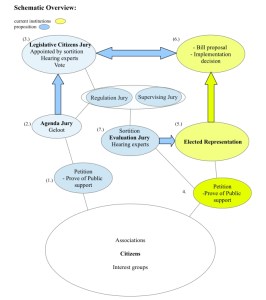
Sortition as a direct democratic system to appoint a real citizens representation, also called “citizen jury“

INTRODUCTION

According to historical sources our political system was developed AGAINST democracy (sovereignty of the people). An “Electoral Aristocracy” was installed (18 century). Nevertheless, this can be seen as a positive evolution compared with ruling by inheritance.

Later on some “democratic” elements were installed, for instance “free” or so called “democratic” elections with universal suffrage, the equality principle, freedom of speech, freedom of organisation, free press, … but some of them were weakened or eliminated afterwards.

But a “democratic element” is not yet a “democracy”. Freedom of organisation may be a “democratic element”, without it a democracy can not exists, on his own it is no democracy. This way “free elections”, to appoint a governor for instance, can be a democratic element but on his own it is by no means a democracy.
Continue reading

Let’s reimagine democracy: replace elections with lotteries

An article by Joe Humphreys, in the The Irish Times, November 19th, 2016:

What’s happening to our democracies? Donald Trump’s presidential-election victory in the United States, after a bitter campaign characterised by deceitful and incendiary rhetoric, is not an isolated episode. It’s the natural outcome of what David Van Reybrouck calls democratic-fatigue syndrome.

One of the most worrying facets of electoral democracy is what political scientists call rational ignorance. Citizens have negligible chances of influencing which candidates get elected and of influencing those candidates once elected. “Citizens thus have no incentive to become well-informed regarding political affairs,” says Dr Peter Stone of Trinity College Dublin.

The answer, says Stone, is to find new ways of invigorating democracy, suggesting a much greater role for “citizen juries” randomly selected to serve public roles. This notion of governing by lottery rather than election is at the heart of Van Reybrouck’s book, which has sought to popularise a concept that stretches back to ancient Greece, the birthplace of democracy. In Athens, in the fifth and fourth centuries BC, the most important governmental offices were appointed by sortition, or the drawing of lots.

G1000 Kick Off in the UK – Cambridge, September 24th

against-elections.jpgIf Brexit proved anything, it proved that what Christopher Achen and Larry Bartels say in Democracy for Realists: Why Elections Do Not Produce Responsive Government is true. People do not vote after careful consideration of facts and options, they vote to affirm their membership of various social groups and express agreement with the opinions of those groups, which may have little or nothing to do with the issue at hand being voted upon.

As David Van Reybrouck expressed so eloquently in his article, Why elections are bad for democracy (an extract from his book Against Elections) there is something very wrong with voting and elections and there is a much better way to do democracy: select a representative random sample of ordinary people, provide them with balanced information, and let them deliberate together to find out not what people do think, but what they would think, if given the time and information together with a good deliberative process.

From 11am to 4pm on September 24th, in Cambridge at the Six Bells Pub, a group of volunteers will meet to kick-off the process of bringing Van Reybrouck’s brainchild – a G1000 – to the UK for the first time. The dream is to bring a randomly selected group of 1000 residents together for one day in early 2017, to deliberate and decide together what is best for Cambridge.

But we need your help to make it a reality. We need people to donate their time and their energy to help organise such an event. We will need fundraisers, social media ambassadors, technicians, volunteers, cooks and a whole host of other help. Can you be one of these people? If so please join us, get in touch or come along to the G1000 Kick-off in Cambridge on September 24th.

[This post is from the Sortition Foundation blog: http://www.sortitionfoundation.org/g1000_kick_off_in_the_uk_cambridge_september_24th]

Reminder: “What is a G1000?” this weekend

G1000-style assemblyWhat is a G1000? Two free events, in Cambridge and London, organised by the Sortition Foundation, are happening this weekend.

We have been inspired by the Belgian G1000 and the Dutch G1000 and aim to hold one G1000 in London and one in Cambridge in late 2016 or early 2017, where a truly representative sample of 1000 people gather, deliberate with each other in a respectful environment, and decide together what is best for their communities. It is a way to do democracy differently.

Come along to find out all about a G1000 and how you can help make a G1000 happen in the UK!

For more information visit http://www.g1000.uk/calendar

Teaching students government skills

Adam Cronkright, co-founder of the Bolivian organisation Democracy in Practice, gives a Democracy Talk audio overview of the group’s findings so far with experiments in student government.

Democracy in Practice has been helping run student councils in a few different Cochabamba secondary schools since 2013, using lottery selection rather than elections to choose candidates.

Doing away with elections allows for a more representative body of students on council, making room for less charismatic or popular pupils to have a chance at government.

Changing selection methods is one thing, governing differently is another – with all the usual challenges of having representatives turn up on time, or at all, learning how to take collective decisions, not dominating proceedings and following through with promised actions.

An encouraging finding, Adam says, is that students can, and do, learn the necessary skills to govern. That raises hopeful prospects for better government in societies who manage to improve their citizens’ governance skills more generally.

An intriguing curiosity, albeit an anecdotal one according to Adam, is how students who appear to stand out as natural leaders, those who might usually get chosen in elections, are often not the best suited to actual government.

Catch the full audio interview below.
 

Sortition theory and practice: the G1000 comes to the UK

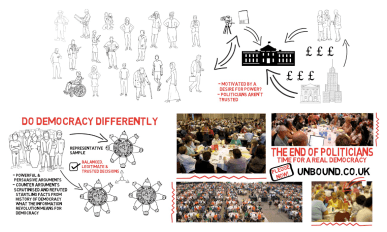
The End of Politicians screeenshotThe “short, powerfully argued and carefully researched” book The End of Politicians, by Sortition Foundation co-founder Brett Hennig, is now 75% funded and well on the way to being published by the crowdfunding publisher, Unbound. You can help get this book to 100% and get published by pledging and pre-ordering it here: https://unbound.co.uk/books/the-end-of-politicians

And the ideas in the book are on the way to becoming a reality – on the 10th and 11th of June Harm van Dijk and Jerphaas Donner, the founders of the G1000 in the Netherlands, are coming to the UK to help launch the G1000 in the UK. The aim of the G1000 is to bring a representative, random selection of people from a community together to deliberate about what they think is most important for their community.
Continue reading

Sortition: the idea, the meeting, and a strategy

[Latest news from the Sortition Foundation blog]

There’s exciting news from the Sortition Foundation:

  • The idea: A new “compelling, inspiring” book on sortition, The End of Politicians, by director and co-founder of the Sortition Foundation, Brett Hennig, is being crowd-funded now by book publisher Unbound: https://unbound.co.uk/books/the-end-of-politicians

The-End-of-Politicians-screeenshot

  • The meeting: The first Sortition Foundation Annual General Meeting will be held at 6pm on Wednesday April 6th in central London. Venue to be confirmed depending on numbers, so please RSVP if you intend to come along.
  • The Strategy: A strategy meeting on how to progress the Citizens’ Parliament campaign (http://www.citizensparliament.uk/) will also be held on Wednesday April 6th from 1-4pm in central London. Exact venue will also depend on numbers, so please RSVP if you want to come along.

Read on for more details on all of the above.

Continue reading

New Democratic Seeds / Gentils Virus Manifesto

The Chouardists are at it, this time with a new site (in five languages) calling for an allotted constitutional assembly. They explain their project in six “chapters” that you can see along with a visitor count on the left margin. Here is the main page followed by the first part. They have also included what appears to be an endless number of videos of Chouard and some other resources.

It is the explicit proposal which should rally the millions of citizens whose political impotency is programmed in the constitution.

Because it is not the role of the people in power to write the rules of their own power

“We want a democratic Constitutional Assembly, therefore randomly drawn.”

By reading the 6 chapters of this website, you will understand that if you want to change anything in the mechanisms of our current society, you will have to make this message your one and only claim: from its application the rest will follow. To understand the strength of this message, please take a few minutes to read through the six chapters of the website, they are very short.
Continue reading

Wilding’s Multibody Sortition in the UK

In a Huffington Post article a few days ago, Martin Wilding introduced the public to the idea of allotted panels and assemblies in a scheme somewhat similar to that of Terry Bouricius. He addressed the typical objections to sortition and urged people to organize local meetups to discuss the idea.

Wilding calls for local Community Assemblies consisting of deliberative Forums and voting Plebiscaries, a judicial Advocacy, and a Citizen’s Advice Bureau–mostly selected by lot I believe.

What if you could vote to exchange your right to vote for an equal opportunity to participate directly in government? How about if that meant an end to the political parties of which the data suggests you’re unlikely to be a member and the career politicians in whom opinion polls suggest you have no trust?

[…]

The status quo is not sacrosanct. The rules by which we are governed are not set in stone. If you feel your representatives don’t, in fact, represent you, you have the means to change the system that keeps them in business.

Or you could just carry on voting for the least unappealing option and hope that somehow things will change of their own accord.

There were a few comments on the comment thread of the article. I haven’t seen if there have been any responses elsewhere online. This could be a good place to discuss the scheme suggested and the article’s reception.

The rich or the powerful?

There has been a lot of debate on this blog recently as to whether or not political outcomes are unduly influenced by the rich; in this post I want to consider the influence of other nondemocratic agents – activists, civil society pressure groups, non-corporate lobbyists and academics in the social sciences and humanities. The reason for the inclusion of the last category is because most political leaders are educated in these disciplines – unlike, say, in China, it’s hard to identify political leaders who studied the natural sciences or engineering – so academics in these fields will have had a powerful influence in their formative years. There are more Oxford PPE (politics, philosophy and economics) graduates in the House of Commons than Old Etonians (35 to 20) and 50% of ministers and 28 percent of MPs were educated at Oxbridge, the vast majority in the above-mentioned subjects. Jeremy Waldron, in his inaugural lecture for his (Oxford) chair of social and political theory argued against the focus of the PPE syllabus on the ’57 varieties of luck egalitarianism’ as opposed to ‘political’ issues like representation, sovereignty and the rule of law, and it’s the resulting influence of the equality lobby that I want to address in this post. Some of the material is anecdotal, and some evidence of partisan influences in the formulation of a UN convention on disabilities equality.

The primary school in my village (pop. c.300) has recently constructed, at considerable expense, a ‘sensory room’ to meet the needs of one part-time disabled pupil. (Bear in mind this is happening at a time when local authority budgets are squeezed to the extent that rural residents are being told that they will need to grit their own roads this winter (and pay for the materials) as the council does not have the funds.) This is the result of government policy that insists that the disabled must be fully integrated in regular society, and has closed down most of the special schools that accommodated the specific needs of disabled children. Speaking to two parents of disabled children (one Aspergers and one cerebral palsy), they both volunteered that this politically-motivated policy has been disastrous for their children because, unlike their peers in special schools, their everyday growing-up experience provided a constant reminder of their neediness.
Continue reading