 Lysander Spooner (1808-1887) was a prominent 19th century American legal theorist, abolitionist (abolition of slavery), and competitor with the U.S. Postal Service until they shut him down. A biography and collection of his work are here.
Spooner continues to be cited in the U.S., including for example by Justice Scalia writing for the Supreme Court majority in 2008 in District of Columbia v. Heller.
Spooner was a strong advocate of “jury nullification.” He argued that trial juries have the right and duty “to judge of the justice of the law, and to hold all laws invalid, that are, in their opinion, unjust or oppressive, and all persons guiltless in violating, or resisting the execution of, such laws.” (An Essay on the Trial by Jury, published in 1852, page 5.)
In the following passages Spooner is talking about trial juries. Although he never mentions the possibility of legislative juries, his line of reasoning is to a large extent strikingly applicable to them. By “legislative juries” I mean juries that can veto and repeal the laws the government passes, and pass laws the government does not support.[i]
Lysander Spooner (italics and bold are as in the original, block quote function not used because it may change everything quoted to italics):
“By such trials [where juries do not judge the law] the government will determine its own powers over the people, instead of the people’s determining their own liberties against the government; and it will be an entire delusion to talk, as for centuries we have done, of the trial by jury, as a ‘palladium of liberty,’ or as any protection to the people against the oppression and tyranny of the government.” (Ibid., 10.)
“The authority to judge what are the powers of the government, and what the liberties of the people, must necessarily be vested in one or the other of the parties themselves—the government, or the people; because there is no third party to whom it can be entrusted. If the authority be vested in the government, the government is absolute, and the people have no liberties except such as the government sees fit to indulge them with. If, on the other hand, that authority be vested in the people, then the people have all liberties, (as against the government,) except such as substantially the whole people (through a jury) choose to disclaim; and the government can exercise no power except such as substantially the whole people (through a jury) consent that it may exercise.” (Ibid., 10.)
Continue reading →
Filed under: Elections, History, Juries | 15 Comments »



 In
In  There has been some debate on this site regarding the optimal length of service for a political jury. On the one hand most of those chosen by lot to participate will have had very little political experience, and will need a period of induction and this has led to suggestions for a service period of up to 2 years with overlapping tenure, so that at all times there will be jurors who will have served for at least a year to help guide new inductees. On the other hand others (including myself) argue for short ad hoc juries, allotted for each legislative bill, in order to ensure ongoing representativity (i.e. to combat the risk of jurors ‘going native’).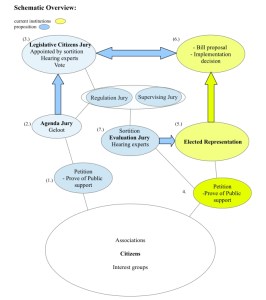
 The following excerpt is from the 2004 edition of Rod Hague and Martin Harrop’s textbook Comparative Government and Politics (The “Functions of legislatures” section, p. 253):
 Adam Cronkright
 Ali
Ali Ahmed R. Teleb
 avanderven
 avergne
 Alex Kovner
 azakaras
 Brett Hennig
 campbellwallace
 Simon Threlkeld
 Nick Coccoma
 codyhipskind
 Common Lot Sortitionist
 Conall Boyle
 constitutionalism
 davidschecter
 Ethan McCutchen
 graytmatter
 gtridimas
 Henry Tuttle
 H.J. Hofkirchner
 HpR
HpR James Kierstead
 John Burnheim
 jgarry20151
 Jochen Krattenmacher
 johnedwardtaylor
 johnhuang865
 Jonathan Crock
 keithsutherland
 Jacob Richter
 kkoreilly
 lukewhito
 SimonPek
 Nathan El
 Nicholas Gruen
 Owen Shaffer
 Patrick Chalmers
 Paul Gölz
 peterstone
 Pierre-Etienne Vandamme
 pronfeld
 Emil
Emil rcaze
rcaze richwbrown
 Roger Knights
 roslynfuller
 Pierre-Etienne Vandamme
 shaharavin
 tbouricius
 Ted Wachtel
 Joshua Laferriere
 theodorestathis
 towardsautonomyblog
 Wayne Liebman
 Yoram Gat
 Oliver Milne
