Lottocracy: Lectures by Alex Guerrero

Prof. Alex Guerrero – a long time sortition advocatehas three lectures on sortition as part of a Coursera course called “Revolutionary Ideas: Borders, Elections, Constitutions, Prisons”. The lectures about sortition are titled:

  1. The Lottocracy
  2. The Promise of Lottocracy
  3. Concerns About Lottocracy

The lectures present Guerrero’s proposal which centers around single-issue-specific allotted bodies but also contain discussions that address questions that are relevant to other forms of sortition-based governance. The total length of the lectures is about 1 hour and they seem to have in mind an audience that is similar in terms of interests and attitude to political science undergraduate students.

Pew poll asks about citizen assemblies, finds widespread support

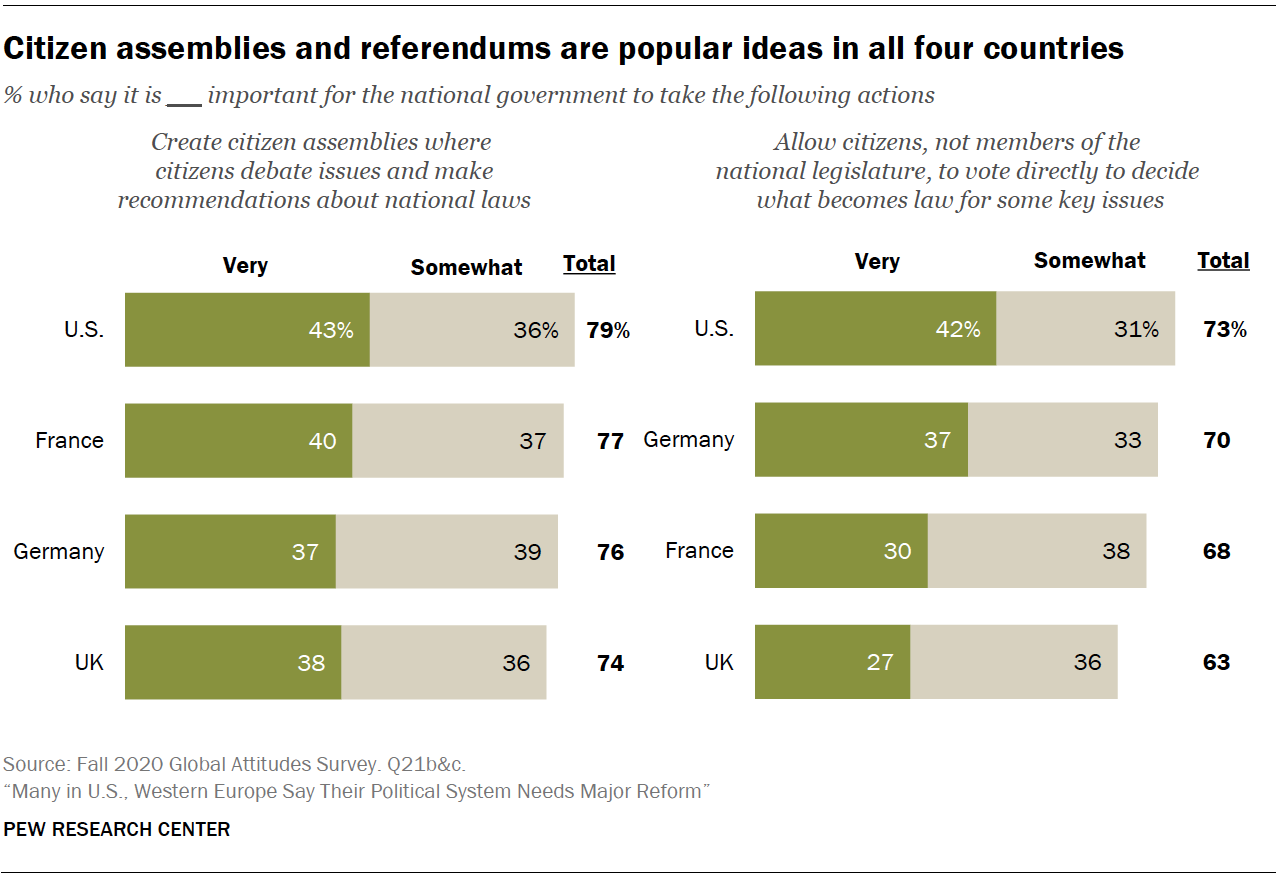
A Pew Research poll conducted in November and December 2020 asked people in France, the U.S., the U.K. and Germany about their attitudes toward the political systems in their countries. As usual, there was a lot of dissatisfaction. It turns out for example that in France and the U.S. about 20% of those polled think that the political system in their country “needs to be completely reformed”.

Interestingly, the poll had a question about “citizen assemblies”.

In all four countries, there is considerable interest in political reforms that would potentially allow ordinary citizens to have more power over policymaking. Citizen assemblies, or forums where citizens chosen at random debate issues of national importance and make recommendations about what should be done, are overwhelmingly popular. Around three-quarters or more in each country say it is very or somewhat important for the national government to create citizen assemblies. About four-in-ten say it’s very important.

Surprisingly, in my opinion, support for such advisory bodies is somewhat higher in all countries than support for binding referenda.

(Thanks Paul Gölz.)

Mathews: Citizens’ assembly for democratic governance of the internet

An op-ed by Joe Mathews in The Mercury News.

We need a new way to govern the internet, here’s how to do it
Joe Mathews, May 7, 2021

Today’s methods for governing the internet do not constitute a coherent system, much less a democratic one. Instead, internet governance is a contest for power between the most powerful tech companies, who put their shareholders first, and national governments, which prioritize their own political interests.

In this contest, both sides create the pretense of democracy. Facebook, based in Menlo Park, has created its own “independent oversight” board of global experts, though it’s unelected and chosen by Facebook. The European Union touts its tougher regulation of privacy and the internet — but those regulators are also unelected, and impose their rules on people far from Europe.

Which is why the internet needs a democratic government that operates beyond the reach of tech companies or national government. Such a system must be both local — to allow people to govern the internet where they live — and transnational, just like the internet itself.

I’d suggest that the internet’s democratic government combine multiple forms of democratic governance.

The center of such a government should be a citizens’ assembly — a tool used around the world to get democratic verdicts that are independent of elites. This citizens’ assembly would consist of 1,000 people who, together, would be representative by age, gender and national origin of the global community of internet users. They would not be elected individually, but rather chosen via randomized processes that use sortition (or drawing lots).

The assembly would be supplemented by an online platform that allowed people to report problems, make suggestions, or even petition for proposals that could be voted upon in a global referendum by internet users everywhere. The models for such a platform include Rousseau, the controversial online environment through which Italy’s Five Star Movement governed itself for a time, and Decide Madrid, the online participatory framework that has spread from the Spanish capital to more than 100 cities worldwide.

National governments and tech companies would try desperately to influence this government, but they would not be in charge of it. And each citizens’ assembly would dissolve after two or three years — making it harder for the powerful to lobby it.

The best possible system of representation and democracy we can imagine

Reddit user subheight640 has a post presenting an uncompromising argument in favor of sortition:

Why randomly choosing people to serve in government may be the best way to select our politicians

So I’m a huge advocate of something known as sortition, where people are randomly selected to serve in a legislature. Unfortunately the typical gut reaction against sortition is bewilderment and skepticism. How could we possibly trust ignorant, stupid, normal people to become our leaders?

Democracy by Lottery

Imagine a Congress that actually looks like America. It’s filled with nurses, farmers, engineers, waitresses, teachers, accountants, pastors, soldiers, stay-at-home-parents, and retirees. They are conservatives, liberals, and moderates from all parts of the country and all walks of life.
Continue reading

Rebooting Democracy candidate is running for Cambridge city council

Keith Garrett, co-founder of the Rebooting Democracy party (named after Manuel Arriaga’s book), is running for Cambridge city council. He was interviewed by Alya Zayed.

[Rebooting Democracy] puts forward a system whereby decisions are made by randomly selected members of the public, who discuss and deliberate the issues before coming to a decision, like a jury – a process known as ‘sortition’.

[Garrett] said: “I’ve stood before for the Green Party and nothing has changed. One of the key things in my life is climate change – although it’s not the focus of my party. I did everything I could and it makes no difference because you’re essentially trying to appeal to people in charge who have a set of vested interests. They’re career politicians. They’re interested in keeping their jobs and staying in that party machine.

“But actually, if you directly devolve decisions to a group of people, you give them true power, and it would solve most of our big world ills, like social inequality or climate change.”

He added: “You have deliberation, you talk, and you listen to each other. It’s ‘optimise’ not ‘compromise’. It’s about trying to find the best decision, not just the one that keeps everyone happy.”

If elected as councillor, he plans to use this kind of thinking to change the council’s decision making process.

Continue reading

Not a one-off threat

The Morning Star is a UK newspaper which describes itself as “a reader-owned co-operative and unique as a lone socialist voice in a sea of corporate media”.

In a recent editorial it writes:

Groups like Extinction Rebellion (XR) have raised the profile of the climate emergency, forcing politicians to acknowledge it. [But the] link between environmental action and anti-capitalism is one movements like XR have been reluctant to concede.

This probably stems from a desire to appeal to the broadest possible coalition willing to take action, but it is self-defeating.

Green parties that have reached the mainstream through accommodation with the capitalist system in Germany and Ireland have become pillars of the centrist, liberal and environmentally catastrophic status quo.

One approach to circumventing this promoted by XR especially is the Citizen’s Assembly, a representative body chosen by sortition (as a jury is, rather than by election) that stands outside the political system and would be tasked with decreeing solutions to the environmental crisis.

The suggestion has one key merit, in drawing attention to the inability of our current political structures to meet the biggest global challenge of our time.

But it falls into the trap of viewing climate change as a one-off threat that can be seen off independently of our political and economic system, rather than a process driven by the economic system itself.
Continue reading

The True Representation Pledge

This is the final chapter from my book published last year entitled “True Representation: How Citizens’ Assemblies and Sortition Will Save Democracy.”

What if we were to demand that every candidate for President, Senate and House of Representatives sign a True Representation Pledge? The pledge strategy can be used in any election, in any country, at the national, state, provincial or local level, wherever people want to demonstrate the potential of sortition and citizens’ assemblies, by targeting an important issue that politicians cannot resolve.

In signing the pledge, each candidate would promise, upon being elected to office, that:

  • They would quickly enact legislation to authorize and fund a national (or state, provincial or local) citizens’ assembly to decide an important issue, identified for the pledge.
  • The citizens’ assembly would be conducted with a briefing book prepared to fairly represent the pros and cons of a wide range of views on the chosen issue.
  • Continue reading

Landemore: Open Democracy, part 5

Rejecting “realism”

One of the strengths of Open Democracy is its normative ambition. Rather than lecturing readers about the need to be realistic and to accept elitism in various ways, Landemore insists that the democratic ideal of political equality should be taken literally. Calls for various forms of compromise are the norm throughout the scholarly literature of democracy. Often such calls are to some extent implicit (e.g., Dunn, see part 2 of this post series). Occasionally they are unabashedly explicit. In this genre Landemore focuses her wrath on Achen and Bartels.

Achen and Bartels take the Lippmann-Schumpeter-Dunn line of argument one step farther by explaining to their readers that while their impression that government does not in any way reflect public opinion is wholly justified by the facts, their frustration with this situation is wholly due to unrealistic expectations. Democracy implies elections, elections imply elite control, and elite control implies unresponsivity. It’s time to be realistic and readjust our expectations.
Continue reading

Police Oversight In The United States: Implications For Sortition Advocates/Activists

Recent scrutiny of police misconduct in the United States has provoked renewed interest in civilian oversight. Hundreds of police review boards exist. The vast majority have advisory, not disciplinary power. The boards are appointed, and their composition varies, often consisting of community advocates. Sortition activists in Los Angeles (Random Access Democracy) have had preliminary discussions with city council members in two California cities (Petaluma and Culver City) about the possibility of reforming their oversight boards to include members selected by lot. A previous post in this blog asked for references to any sortition based police oversight board. To date, none has materialized.

Is sortition the answer to better police oversight? Probably not, at least not directly. If review boards were randomly selected, their actions and recommendations would likely be more independent. But police in the United States are immunized from oversight by a complex system of laws, police union lawsuits, and court decisions grounded in the Law Enforcement Officers’ Bill of Rights, a document promoted by the Fraternal Order of Police that proposes limits to investigative and disciplinary power over police abuses, and is woven into law in sixteen states. Meaningful oversight is more than a matter of picking better panels; it needs to involve legislative change.

It’s beyond the scope of this article to provide more detailed information about police oversight, but the following references, while by no means exhaustive, may be helpful to those interested: Campaign Zero is a website dedicated to ending police violence in the U.S. Arrested Oversight provides an in-depth analysis of how civilian oversight should function and how it fails. Why police so rarely get charged, Newark’s Citizen Disciplinary Board, and A proposal to give civilians more say reveal perspectives from opposite sides of the country.

Democratic lotteries might yet have a role to play in oversight. A citizens’ assembly, for example, could be designed to study the problems of oversight, then deliberate, and propose recommendations for improvement. These might include recommendations concerning police unions, which often sabotage oversight in ways hidden to the public. If the idea proves useful, it’s likely that many such assemblies would be needed to address conditions that vary from city to city and state to state.

Sortition advocates looking to demonstrate the usefulness of lottery based panels as direct solutions to community problems might want to consider areas such as housing, redistricting, urban development, etc., before tackling police oversight.

What If A Citizens’ Assembly Decided Trump’s Second Impeachment?

(Written before President Trump’s second impeachment trial on January 18, 2021)

The U.S. House of Representatives has impeached President Donald Trump for a second time, but the Senate will not conduct its trial until after Trump has left office.

The difference between political and deliberative decision-making is that one is based on winning the next election and the other is based on seeking the truth. Professional politicians do not deliberate. They calculate. With each decision, the underlying consideration is the impact it will have on votes and donations.

Republican Senators will consider convicting Trump, but most are afraid, not only of Trump supporters hurting their chances in the next election, but of Trump supporters hurting them physically. Senator Lindsay Graham briefly broke with Trump, declaring that “enough is enough.” But he was soon advising the President again after being threatened by angry Trump supporters at an airport.

Few politicians have the integrity or courage of Justin Amash, the lone Republican congressman who voted to impeach President Trump in 2017, knowingly sacrificing his seat in Congress. Or the ten Republican representatives who voted for a second Trump impeachment, with Liz Cheney boldly stating that Trump “summoned this mob, assembled the mob, and lit the flame of this attack.”

While some of his opponents think Trump should be tried, convicted and banned from holding federal office in the future, others argue that a failure to convict him in the Senate will strengthen him politically and still others claim that if he’s out of office the process is not legal.

I’d like to suggest a novel resolution. What if we let “the people” decide?

Continue reading