I think advocates of sortition should be pointing out the many ways it might be adapted to various different circumstances of our political life. This elides the more fundamental discussion of a preferred constitution, but rather naturalises the idea of sortition as part of the political repertoire. It shows its promise and versatility in helping to detox the current system.
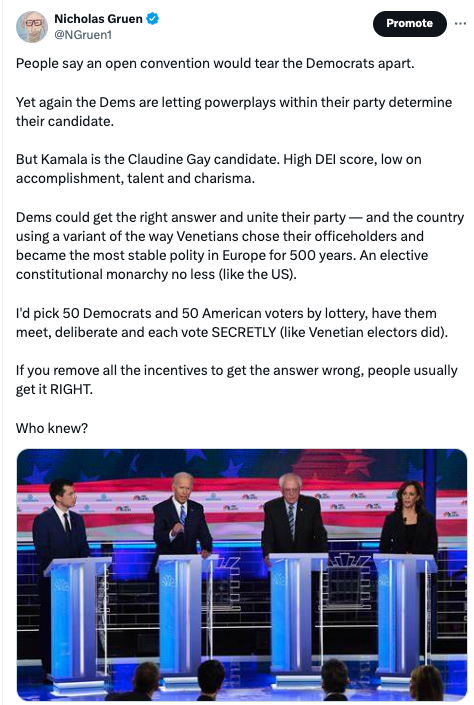
Accordingly here’s something tweeted today —with the full text reproduced below the tweet.
People say an open convention would tear the Democrats apart.Yet again, the Dems are letting powerplays within their party determine their candidate. But Kamala is the Claudine Gay candidate. High DEI score, low on accomplishment, talent and charisma. Dems could get the right answer and unite their party — and the country using a variant of the way Venetians chose their officeholders and became the most stable polity in Europe for 500 years. An elective constitutional monarchy no less (like the US). I’d pick 50 Democrats and 50 American voters by lottery, have them meet, deliberate and each vote SECRETLY (like Venetian electors did). If you remove all the incentives to get the answer wrong, people usually get it RIGHT. Who knew?
The first step toward the application of sortition for the democratization of society is not to convince elites that sortition would be a good tool for them to use, as many academics seem to believe, but to disseminate the idea widely among the population, so that it becomes a live political possibility. For this to happen, the few who are aware of this idea need to tirelessly take advantage of every opportunity to advocate for sortition.
Chandre Dharmawardana and Phil Wilson are advocates for sortition (each in their own country and situation), whose writings have been citedhere before. Each of those has recently written again, demonstrating the spirit of consistent dedication to the cause of democracy.
In my opinion, a way around [the practical and theoretical problems with elections] is to abandon electoral methods and return to the method of SORTITION advocated by Aristotle and used in several Hellenic cities during the time of Pericles. Continue reading →
Followers of this site will be intrigued to know what I think is a really first-rate radio documentary from Rory Stewart, which reframes knowledge in a Socratic or Confucian way, which is to say, starting from our vast ignorance both before and after we learn all we can. There are six episodes with the fourth on politics where Rory bangs the sortition drum pretty loud. You can click through to the whole series on this link or to the sortition episode by clicking the image below or the mp3 file which I’ve also appended below.
The Guardian has an obituary of Mogens Herman Hansen.
Danish historian who transformed our understanding of the way Athenian democracy functioned
The term democracy emerged in the classical city-state of Athens to denote power exercised by common people, at that point men who were not slaves. From around the sixth century BC, officials were chosen by lot and were subordinate to a citizens’ assembly that made decisions. Writers on this process tended to describe it in theoretical terms. But the Danish historian Mogens Herman Hansen, who has died aged 83 after a short illness, transformed understanding of how Athenian democracy functioned by approaching it empirically, through a series of simple questions.
Hansen established the actual practices of the direct democratic assembly, the nature of the leadership exercised by the distinct classes of orators and generals in the absence of any form of partisan political structures, and the importance of mood and rhetoric on the opinions of the mass assembly.
His second insight was based on the fact that previous interpretations of Athenian democracy had ignored how it had changed as a result of Athens’ defeat in the Peloponnesian war with Sparta and the constitutional reforms that began in 403 BC.
The system had moved from the assembly being sovereign to one that was ruled by the distinction between laws (nomoi) that were permanent, and decisions (psephismata) that had to be made in conformity with the laws, and could be challenged in the courts if they were not. Continue reading →
Already weakened by the vast impersonal forces at work in the modern world, democratic institutions are now being undermined from within by politicians and their propagandists. The methods now being used to merchandise the political candidate as if he were a deodorant positively guarantee the electorate against ever learning the truth about anything. —Aldous Huxley, Brave New World Revisited, 1958, VI.
We vote, indeed we perceive political reality, through the people with whom we are in contact. Most of us are reached by the mass media only in a two-step process, by way of other people’s perceptions and reactions to them. —Hanna F. Pitkin, The Concept of Representation, 1967, p. 223.
… it has also become evident that if one acts ruthlessly …, cleverly organized propaganda can accomplish swift and drastic changes in opinions and attitudes, especially in difficult and critical situations; it can … also instill patently false ideas about actual conditions. — Daniel Boorstin, The Image, 1961.
Regarding one of those Pernicious P’s, Wikipedia says the following [2024-07-01] about the influential author Edward Bernays and his book, Propaganda (1928):
[Bernays] outlined how skilled practitioners could use crowd psychology and psychoanalysis to control them [the masses] in desired ways. Bernays later synthesized many of these ideas in his postwar book, Public Relations (1945), which outlines the science of managing information released to the public by an organization, in a manner most advantageous to the organization.
Among the major handicaps a reformer can encounter is the opposition of the indignant virtuous …. —E.S. Turner, Roads to Ruin: The shocking history of social reform, 1960.
Cristina Lafont’s 2020 book, Democracy Without Shortcuts, unfairly attacks lottocracy as invidiously exclusionary. A false equivalence is asserted between lottocrats’ current “existential” criticism of the political capability of mass publics and misogynists’ past “essentialist” criticism of the political capability of women (and sometimes of other marginalized groups). Lafont writes, for instance:
… The empirical evidence provided to supposedly ‘prove’ women’s ignorance, irrationality, apathy, and irresponsibility, and the arguments put forth to perpetuate their subjection to others in the not too distant past, are remarkably similar to the arguments and evidence currently provided by the ‘voter ignorance’ literature. Continue reading →
The imbecility of men is always inviting the impudence of power. —Emerson, Representative Men, ch. 1.
The incompetence of the masses … furnishes the leaders with a practical and to some extent a moral justification. —Robert Michels, Political Parties, 1915, 111.
The weaker the interest and knowledge of the electorate, the more decisive become the efforts of organized groups in molding opinion. This situation alone implies a tendency toward oligarchy within democracy …. —Herbert Tingsten, The Problem of Democracy, 1965, p. 102.
Democracy is the most difficult of all forms of government, since it requires the widest spread of intelligence, and we forgot to make ourselves intelligent when we made ourselves sovereign. —Will and Ariel Durant, The Lessons of History, 1968, p. 273.
Proxy Electors will be better informed than effectively “imbecilic” mass-voters, because they will be focused on a single responsibility. They will not have a dozen other political issues competing for their attention. They will instead be exposed to opportunities to delve deeply into their sole topical area, such as online lectures by experts, testimony by insiders and whistleblowers, audiobooks by investigative reporters, etc. Much of it should soak in.
The Jury Trust Model: Nationalised Industries Without the Corruption
Presented by Oliver Milne, PhD. – Independent scholar and game designer based in Galway, Ireland. PhD in Philosophy from the University of Galway in 2024.
The control of capital is among the most potent of powers: the power to make or break people’s livelihoods, landscapes, and governments. There are limitless ways this power can be abused, and vast amounts of it can be amassed by its abuser. In this talk, Oliver will propose a novel model of capital ownership, the jury trust, in which allotted juries are entrusted with the stewardship of large firms, and make the case that this model can address the problems inherent to state and private ownership.
Date: Thursday, 27 June · (Friday, 28 June in Asia & Australia)
INSA is a volunteer organisation aimed at connecting pro-sortition academics, advocates, and activists around the world, to share resources and tactics and advance the theoretical understanding of sortition. Join the conversation!
Dr. Camila Vergara is a critical legal theorist, historian, and journalist from Chile writing on the relation between inequality and the law, and on alternative institutional solutions to systemic corruption. She is Senior Lecturer at University of Essex Business School, Editor of Theoria: A Journal of Social and Political Theory, Associate Editor of Critical Sociology, and author of Systemic Corruption: Constitutional Ideas for an Anti-Oligarchic Republic (Princeton University Press 2020). In her work on constitutional theory, republicanism, and corruption, she advocates for council democracy and sortition-based plebeian institutions as part of a counterpower structure against oligarchy. In addition to her scholarly work, Dr. Vergara is a global public intellectual and an activist advising and collaborating with grassroots organisations on rights, deliberative democracy, and community-based forms of governance.
INSA is a volunteer organisation aimed at connecting pro-sortition academics, advocates, and activists around the world, to share resources and tactics and advance the theoretical understanding of sortition. http://www.INSA.site
Back in 2017, after a minor campaign of harassment, Guardian columnist George Monbiot weighed in on sortition. At the time his verdict was that the idea was nothing short of “a formula for disaster” and instead he offered his readers the usual electoral fixes such as campaign finance reforms, voter education and proportional representation. Well, seven years later, Monbiot has had a significant change of heart:
General elections are a travesty of democracy – let’s give the people a real voice
Our system is designed for the powerful to retain control. Participatory democracy and a lottery vote are just two ways to gain real representation
[G]eneral elections such as the one we now face could be seen as the opposite of democracy. But, as with so many aspects of public life, entirely different concepts have been hopelessly confused. Elections are not democracy and democracy is not elections. Continue reading →










 Adam Cronkright
 Ali
Ali Ahmed R. Teleb
 avanderven
 avergne
 Alex Kovner
 azakaras
 Brett Hennig
 campbellwallace
 Simon Threlkeld
 Nick Coccoma
 codyhipskind
 Common Lot Sortitionist
 Conall Boyle
 constitutionalism
 davidschecter
 graytmatter
 gtridimas
 H.J. Hofkirchner
 Hanspeter Rosenlechner
 John Burnheim
 jgarry20151
 Jochen Krattenmacher
 johnedwardtaylor
 johnhuang865
 Jonathan Crock
 keithsutherland
 Jacob Richter
 kkoreilly
 lukewhito
 SimonPek
 Nathan El
 Nicholas Gruen
 Owen Shaffer
 Patrick Chalmers
 Paul Gölz
 peterstone
 Pierre-Etienne Vandamme
 pronfeld
 Emil
Emil rcaze
rcaze richwbrown
 Roger Knights
 roslynfuller
 Pierre-Etienne Vandamme
 shaharavin
 tbouricius
 Ted Wachtel
 Joshua Laferriere
 theodorestathis
 towardsautonomyblog
 Wayne Liebman
 Yoram Gat
 Oliver Milne
 Equality by lot