More sortition in the Guardian

In October, the Guardian published an excerpt from Tim Dunlop’s sortition-advocating book “The Future of Everything”. Today, James Bridle offers the readers of the Guardian to apply sortition to the Brexit issue. (Of course, he is not the first with this idea.)

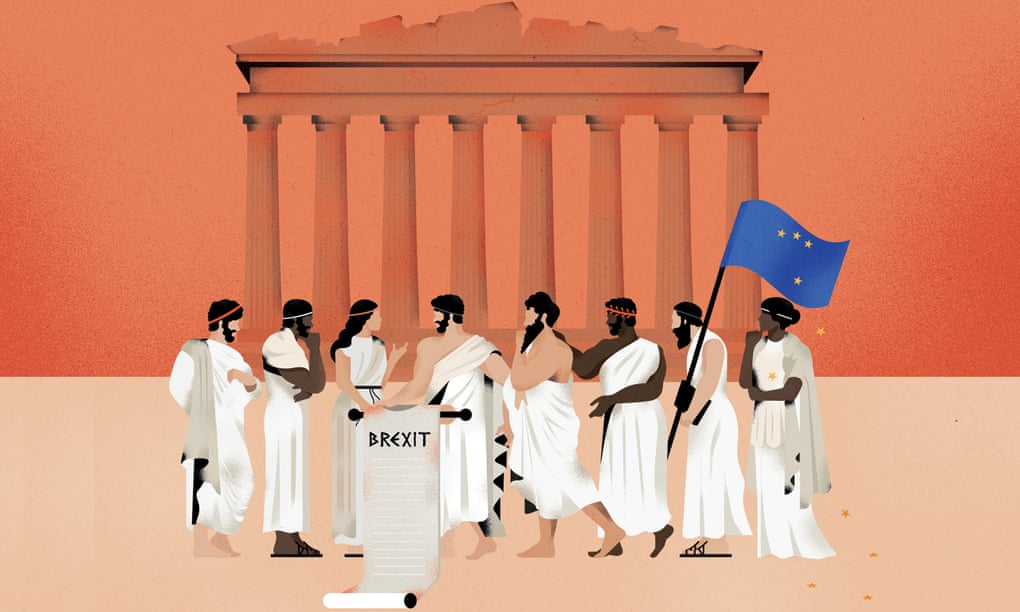
How can we break the Brexit deadlock? Ask ancient Athens
James Bridle

Citizens’ assemblies have their roots in sortition – selecting citizens at random to fill public posts – which was once central to democracy

In the central marketplace of ancient Athens, around 350BC, there stood a machine called the kleroterion. This was a six-foot-high slab of stone that had a series of slots on the front, and a long tube bored down from the top to the base. Those up for selection for the various offices of state would insert metal ID tags, called pinakia, into the slots, and a functionary would pour a bucket of coloured balls, suitably shaken, into the top of the tube. The order in which the balls emerged would determine who took which role, some for the day, some for a year.

2018 review – statistics

Below are some statistics about the ninth year of Equality-by-Lot. Comparable numbers for last year can be found here.

2018 Page views Posts Comments
Jan 2,655 2 65
Feb 3,165 12 211
Mar 2,216 9 163
Apr 2,038 5 30
May 2,570 13 118
June 2,421 11 178
July 2,095 2 64
Aug 1,961 6 43
Sept 2,490 6 109
Oct 7,746 15 80
Nov 3,286 8 106
Dec (to 25th) 2,423 6 25
Total 35,066 95 1,192

Note that page views do not include visits by logged-in contributors – the wordpress system does not count those visits.

Posts were made by 16 authors during 2018. (There were, of course, many other authors quoted and linked to.)

There are currently 377 email and WordPress followers of this blog. In addition there are 347 Twitter followers (@Klerotarian) and 67 Facebook followers.

Searching for “distribution by lot” (with quotes) using Google returns Equality-by-Lot as the 3rd result (out of “about 30,200 results”). Searching for “sortition” returns Equality-by-Lot as the 6th result (out of “about 140,000 results”) – preceded by the sortition entry at Wikipedia, links to Brett Hennig’s Sortition Foundation, and a link to Tim Dunlop’s article in the Guardian.

Happy holidays and a happy new year to Equality-by-Lot readers, commenters and posters. Keep up the good fight for democracy!

Chalmers: The nakedness of elections

Patrick Chalmers writes:

TOULOUSE, France — In the Danish fable “The Emperor’s New Clothes,” it was a little boy who pointed out what no adult dared expose: The king was naked; his court, a cast of pompous fools beguiled by tricksters.

It’s time to do the same with our own reified system of government — representative democracy and its so-called free and fair elections.

Shocking? Of course it is. We’ve been taught to hold our voting rights as sacred — that despite our political system’s many flaws, representative democracy is, to paraphrase Winston Churchill, “the worst form of government, except for all the others.”

But what if there were, after all, a real alternative? What if there were something less corruptible than pure democracy by election? That something needn’t replace periodic elections, or at least not at once, but it could certainly guard us against their worst failings. Not least of those is the grossly outsized influence of narrow interests at the expense of everyone else’s.

2018 review – sortition-related events

This is the end-of-year summary of notable sortition related events for 2018.

Sortition received some increasing attention in the English-speaking world in 2018. The Hannah Arendt Center for Politics and Humanities at Bard College has announced the creation of the Bard Institute for the Revival of Democracy through Sortition. Richard Askwith and Tim Dunlop published books advocating for sortition. Selina Thompson put on a sortition-themed play and organized a sortition-themed workshop. Van Reybrouck’s Against Elections was (dismissively) reviewed in the New York Times. Sortition was featured in the Left-leaning magazine Jacobin as well as on BBC radio, and was mentioned in the Washington Post. Canadian scientist and environmentalist expressed interest in drawing politicians from a hat.

Brett Hennig’s TED talk about sortition was featured by TED on their main page, generating a spike of interest in the idea, including by Beppe Grillo, co-founder of the Italian electorally successful Five Star movement. Another spike of interest in sortition followed media reports about the arrest of a sortition advocate who allegedly planned to blow himself up in an attempt to draw attention to the idea.

Late in the year, sortition was on the agenda of two mass-action movements: UK’s Extinction Rebellion and France’s Gilets Jaunes.

Earlier in the year elites continued to express their dissatisfaction with the way elections are turning out. A proposal was made to use sortition to improve citizen behavior. Former UK prime minister Gordon Brown made a similar suggestion in the context of Brexit. The Ireland abortion referendum that approved the recommendations of an allotted chamber was held as an example to emulate.

Reports about sortition being used or advocated at local government appeared in the press. An initiative for appointing judges by lot is under way in Switzerland. Charlie Pache, a Swiss sortition activist, promotes single issue allotted citizen panels. Academic conferences about sortition were held in Belgium and in the US.

In France, the discussion has moved beyond the initial stage of unfamiliarity into some substantive discussion of the details of applications of sortition. A member of La France insoumise who was allotted to its electoral committee expressed disillusionment with the process. Other FI activists claim that “so far, the allotted have had no real power”. Michel Quatrevalet, a power industry professional in France, complains that the so-called participatory democracy process that was part of the process for the creation of a French multi-year energy plan was a sham.

Hennig: Citizens’ Assemblies and the next democratic revolution

Brett Hennig writes in the New Internationalist magazine:

Is this the beginning of another winter of discontent? The Extinction Rebellion that hit London in the weeks around 17 November might be the spark that lights the tinder box of our democratic malaise. Thousands of people blockaded bridges, disrupted traffic, and engaged in non-violent acts of civil disobedience to demand the UK government truthfully address climate change, and convene a national citizens’ assembly to create ‘a democracy fit for purpose’.

Meanwhile, across the channel, the ‘Gilets Jaunes’ (Yellow Vests) protestors have grabbed enough attention – perhaps by causing enough havoc – to get an invitation to meet the French Prime Minister. Their demands? Initially that the government address the rising cost of living (specifically a rise in fuel tax), but the protest has morphed into a broad movement that has, according to several reports, also demanded ‘the creation of a citizens’ assembly to replace the [French] Senate’ or ‘the creation of a citizens assembly to put forward demands that would then be submitted to referendum’, among many other disparate propositions.

Whatever the diverse causes of, and messages from, these two very different protests, it appears that the demand for a citizens’ assembly is crossing cultural barriers and being promoted as the preferred democratic tool of a new generation of activists.

Call for 2018 review input

This is the yearly call for input for the year’s end review. As in previous years, I would like to have a post or two summarizing the ongoings here at Equality-by-Lot and notable sortition-related events over the passing year. Any input about what should be included is welcome – either through comments below or via email. You are invited to refresh your memory about the events of the passing year by browsing Equality-by-Lot’s archives.

For previous years’ summaries see: 2017, 2016, 2015, 2014, 2013, 2012, 2011, 2010.

Democracy For Young People: a provocative podcast

Democracy For Young People is, in my opinion a very compelling analysis of the ills of our democracy. It’s a very simple idea – which is that electoral democracy massively underrepresents three classes of people whose influence on democracy the great anti-democrats of the ancient world (i.e. all the thinkers whose work has come down to us in any substantial form) were most hostile to. The young, the poorly educated and the poor.

I thought the ‘solutions’ section would end up at selection by lot, but it moved right along from that to lowering the voting age (dramatically!). But then the conclusion on what to do was an afterthought, and not really the focus of the podcast. The analysis was compelling. It’s good points are that the ideas are very simple, clearly important. They’re also clearly right to some extent, though of course there could be very wide reasonable disagreement on that extent.

So I recommend it.

EPSA

The 2019 Annual Meeting of the European Political Science Association (EPSA) will be held on 20-22 June in Belfast next year. I’m organizing the Political Theory panels for this meeting. I know there are plans afoot to organize one on sortition and related democratic institutions, as well as another democratic theory panel (on epistemology and democracy). Unfortunately, the deadline is a bit tight–17 December. (I meant to post about this earlier, but was distracted by other matters. Apologies.)

If you might be interested in joining one of these panels, please drop me a line ASAP. (Or just go ahead and propose a paper–I can add you to a panel later.) The website for the meeting is at

http://www.epsanet.org/conference-2019/

Thanks!

Citizens’ chambers: towards an activism of selection by lot

In a paper, previously linked to on this blog, James Fishkin identifies some potential shortcomings of citizen’s chambers which justify his own preference for ad hoc, and temporary citizens’ panels. I think he makes some good points. I think his arguments need further exploration which I do in the first half of this post before articulating a more general unease at where Fishkin and many protagonists of sortition are coming from.

His central concerns with a citizen’s chamber are that it might:

  • have insufficient technical expertise
  • be susceptible to corruption and
  • not maintain the high quality “conditions for deliberation” that have been achieved in more ad hoc citizens’ juries.

These are legitimate concerns. But they have a ‘theoretical’ ring to me. Firstly Fishkin doesn’t provide much evidence that these problems would arise or if they did how bad they’d be. Secondly, he also fails to compare the likely problems with existing similar problems in the existing chambers. I’ll go through these arguments regarding each of the claims in a little more detail below before proceeding to my more general concern.

Technical expertise

If someone can suggest a means by which one or two hundred people can represent the polity and not lack expertise in all the functions of government, I’ll be interested to hear it. Perhaps a random selection from the great unwashed will be less technically expert than elected representatives. For instance, in wealthy countries today, over 90 percent of elected political representatives are university educated compared with around half the population. But that greater level of education comes with its own blind spots as we’re discovering. Moreover, a university graduate in law or psychology won’t be much help in steering fiscal policy and in that regard, the people’s elected representatives often rely in such matters on delegation to independent experts and being advised by experts. But this comes with the territory.
Continue reading

Gordon Brown embraces citizens’ assemblies

In a thoughtful contribution to considering the governance of Britain in the context of the still running Brexit fiasco, Gordon Brown offers this suggestion:

We must renounce the unsatisfactory, inward-looking, partisan and inevitably piecemeal decision-making process of the past 30 months.

In the old days, political parties saw their role as aggregating and then articulating grassroots views. But to the British people the parties seem – like social media – to be dominated by those with the loudest voice.

[…]

I envisage bringing together in each region a representative panel of a few hundred citizens, engaging them in a day’s dialogue to deliberate on arguments presented by informed opinion leaders and advocates from both sides — and testing whether pro and anti-Brexit voters can find any common ground.