


A version of this article was first published in the run-up to the 2020 general election in Aotearoa/New Zealand by the public interest journalism platform The Dig as part of a series on Transitional Democracy. You can find the original article here.
By Alison McCulloch
Aren’t we lucky, we’re constantly told, that we live in a democracy, a government by and of and for the people. Except our system of government is none of those things. It’s certainly not by the people, it’s barely of the people and we’ve surely gathered more than enough social and economic data to show it’s not for the people.
But how could it be otherwise when it’s based on elections, given that elections are incompatible with democracy. No, that wasn’t a typo: elections are incompatible with democracy. It might seem a surprising statement on its face, given we are raised to equate the two. But one need only scratch the surface of how electoral systems like ours actually work to see the truth of the claim.
What elections actually do is elevate elites to power — those with greater than ordinary wealth, influence, connections, education, charisma, celebrity, privilege… And rule by elites is in fact the antithesis of ‘Democracy’ which properly applies only to governments where power is exercised by the people, the vast majority of whom are ordinary. Electoral systems do not do this; they cannot do this.

The Westminster-based system we live under serves us very badly. Not only is it undemocratic, it is unresponsive to ordinary people, it is cruel and divisive, and yet virtually from the cradle we are taught that it is sacrosanct, an article of religious faith, untouchable, and that while we might tinker around its edges, there is and can be no better, more democratic system of government.
But this system is a cultural product like any other, something Māori (see glossary at end for discussion of Māori terms) know only too well, having had it imposed on them as if prior to the arrival of British colonists, this land were a kind of political terra nullius. It simply wasn’t so. It’s a point the report of Matike Mai Aotearoa (the independent Māori working group on constitutional transformation) makes in setting out both a Māori critique of the current system, and proposals for a way forward.
Continue readingFiled under: Elections, Sortition, Theory | 14 Comments »
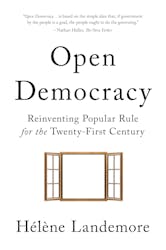 I have recently started reading Hélène Landemore’s book Open Democracy (2020, Princeton University Press). Having gone through the first two chapters, I find the book very useful and I highly recommend it. Despite its somewhat clichéd title, and despite the occasional bow toward the self-serving traditional Western theory of democracy, Landemore is in fact offering (it seems so far, I should say) a rather radical critique of the status quo and does not shy away from throwing some heavy punches at theorists who in one way or another defend oligarchical ideologies. In fact, Landemore presents – even if intermittently and obliquely – a thoroughgoing critique of the elections-based system that is not only better argued than, say, that of Van Reybrouck, but also more radical than his. I can’t think of a comparable book from a mainstream US political scientist. (Maybe Dahl’s A Preface to Political Theory?) The fact that Landemore, now at Yale, is originally French, may be playing a significant role.


 Part
Part  The concept of the “benevolent dictator” occasionally plays a role in political discussion of democracy. The general thrust of the “benevolent dictator” argument is that democracy cannot be defined in terms of its outcomes because “a benevolent dictatorship” can produce any given outcomes, while still, by assumption, being anti-democratic.
 Adam Cronkright
 Ali
Ali Ahmed R. Teleb
 avanderven
 avergne
 Alex Kovner
 azakaras
 Brett Hennig
 campbellwallace
 Simon Threlkeld
 Nick Coccoma
 codyhipskind
 Common Lot Sortitionist
 Conall Boyle
 constitutionalism
 davidschecter
 graytmatter
 gtridimas
 H.J. Hofkirchner
 Hanspeter Rosenlechner
 James Kierstead
 John Burnheim
 jgarry20151
 Jochen Krattenmacher
 johnedwardtaylor
 johnhuang865
 Jonathan Crock
 keithsutherland
 Jacob Richter
 kkoreilly
 lukewhito
 SimonPek
 Nathan El
 Nicholas Gruen
 Owen Shaffer
 Patrick Chalmers
 Paul Gölz
 peterstone
 Pierre-Etienne Vandamme
 pronfeld
 Emil
Emil rcaze
rcaze richwbrown
 Roger Knights
 roslynfuller
 Pierre-Etienne Vandamme
 shaharavin
 tbouricius
 Ted Wachtel
 Joshua Laferriere
 theodorestathis
 towardsautonomyblog
 Wayne Liebman
 Yoram Gat
 Oliver Milne
 Equality by lot