


Part one is here.

A useful part of Wang Shaoguang’s article “Representative and Representational Democracy” (2014) is his critique of the arguments for elections as a democratic mechanism (and in fact as the most fundamental component of democracy). The whole matter of the justification for elections in terms of their expected outcomes is usually avoided by electoralist dogma. Instead the discussion is framed using formalisms: elections are judged as being “legitimate” because they follow some supposed principles of “representativity”. The issue of how those principles themselves can be justified other than in terms of system outcomes is not addressed.
On the rare occasions when the expected outcomes of elections are addressed, two mechanisms are offered as connecting elections with desirable outcomes – Wang refers to these as the “authorization theory” and the “accountability theory”. These arguments go at least as far back as the Federalist papers. Wang first presents and critiques the authorization theory:
According to authorization theory, during elections each political party puts forth its policy positions and promotes its candidates, while the people have the right to choose to support whichever party or candidate they want, and they will vote for the party and candidates of their choice. In the sense that those who are elected start governing only after they have been invested with the authority of the people, this system is of course democratic.
Continue reading
Filed under: Academia, Elections, Theory | 9 Comments »

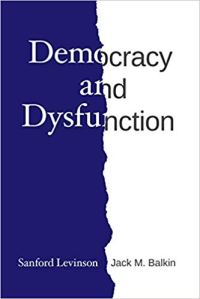 Noted American Constitutional scholar Sanford Levinson seems to have recently read David Van Reybrouck’s Against Elections.
  “Republic” means, more or less literally, “a government serving the public interest”. According to Thucydides, Pericles thought that this is also what democracy means:
 This is the first post in a series dealing with the book Justice by Lottery by Barbara Goodwin, University of Chicago Press, Chicago, 1992.
 Background about this essay and its table of contents can be found
  Adam Cronkright
 Ali
Ali Ahmed R. Teleb
 avanderven
 avergne
 Alex Kovner
 azakaras
 Brett Hennig
 campbellwallace
 Simon Threlkeld
 Nick Coccoma
 codyhipskind
 Common Lot Sortitionist
 Conall Boyle
 constitutionalism
 davidschecter
 Ethan McCutchen
 graytmatter
 gtridimas
 H.J. Hofkirchner
 HpR
HpR James Kierstead
 John Burnheim
 jgarry20151
 Jochen Krattenmacher
 johnedwardtaylor
 johnhuang865
 Jonathan Crock
 keithsutherland
 Jacob Richter
 kkoreilly
 lukewhito
 SimonPek
 Nathan El
 Nicholas Gruen
 Owen Shaffer
 Patrick Chalmers
 Paul Gölz
 peterstone
 Pierre-Etienne Vandamme
 pronfeld
 Emil
Emil rcaze
rcaze richwbrown
 Roger Knights
 roslynfuller
 Pierre-Etienne Vandamme
 shaharavin
 tbouricius
 Ted Wachtel
 Joshua Laferriere
 theodorestathis
 towardsautonomyblog
 Wayne Liebman
 Yoram Gat
 Oliver Milne
 Equality by lot