Aspects of decision-making

1. Public affairs and rational ignorance.

The argument: It is rarely rational for anybody to vote or engage in some other political activities because the chance of influencing the outcome is so infinitesimal that it does not merit the slightest effort.

Reply. That is one consideration, but it is not only a false picture of the thinking of most people, but not the only rational consideration. Many, I think most, voters also recognise two other dimensions to their role as voters.

One is that they see voting as an expressive act and feel it is important to them to express themselves in this way. That is why opposition voters still turn out to vote in what is a safe seat for the incumbent party. Moreover, voters are concerned that in expressing their support for a candidate or a party they are ding something that reflects credit on them. So they are concerned to exercise what influence they can on that candidate or party to adopt policies that they find admirable.

Another reason why the selfish approach is not rational is that people quite rightly do not take an entirely selfish attitude to public goods. Their identity as members of a particular community is closely bound up with the quality of the public goods in which they can share as members of the community. So they do have an interest in the quality of the community’s educational institutions, even though they do not expect any particular pay-off to them from those institutions. Moreover, they are usually well aware that the sort of cost-benefit analyses that reduce benefits to measurable benefits to individuals leads to a penny-pinching approach to funding policy decisions that is often destructive and counterproductive in its effects. It is not rational.

That is not to say that it is improper in choosing to support one rather than another of competing proposals about, say, an educational program, to do so because it suits one’s own interests better. Practical decisions are rarely one-dimensional. They involve diverse, often competing, considerations in varying degrees in different contexts.
Continue reading →

Demarchy and the ways of the world

1. Demarchy assumes that enough people will engage in the complex of serious activities it is supposed to work on to convince people that the outcome of those activities can claim to represent public opinion.

Looking at the way in which public opinion is in fact formed in our society that seems an absurd assumption.

Even if we go back to Habermas’s beloved 18th century coffee house it is utterly unrealistic. Public opinion emerges from a host of conversations in which what is going on or what is proposed is talked about in terms of familiar images. What is prized in conversation in all sorts of social contexts, from groups of labourers on lunch break to elite dinner parties is wit, the remark that encapsulates a way of looking at a subject in a new light that is at least in some respect plausible.

The cardinal sin in conversation is to insist on spelling out in detail just where that slant on the subject is misrepresented. People are not expected to take casual remarks seriously. That is utterly boring and destructive of conversation. Nevertheless there is overwhelming evidence that people are very strongly influenced by the cumulative effects of the caricatures that prevail in representations of ideas and states of affairs and come to be seen as expressing public opinion.

Even very sophisticated people succumb to this sort of conversation, because they are very aware that political affairs are usually so complicated that there is little chance of arriving at a rationally justified analysis and verdict on them. One just despairs or hopes that the obscure processes of social change will tend towards decisions one can live with. But there is no prospect of getting reliable decisions about political matters by discussion. So Demarchy is nonsense.

Reply: I concede there is a great deal of truth in this picture, but as a generalisation it is too sweeping. At the risk of being boring I shall try to explain why. There are several aspects to it.
Continue reading →

Choice

No one party

The practicalities of demarchy

1. In order to be THE voice of public opinion the council advancing that claim would need to be unique and unchallenged. But if anybody can set up a rival council, that is impossible. If anybody takes it seriously, it will be challenged and rivals set up.

Answer. There are two stages in the proposal: a fully open public discussion and the council attempting to draw a practical policy from that discussion.

The public discussion will be unique if the Foundation sponsoring it has adequate resources to publish and render accessible on line every word that anybody thinks relevant to the problem under discussion. If anybody sets up a rival forum, all of its content will be posted on the original site, where it could have been posted at no cost. So if somebody refuses to allow certain material to be posted, they are refusing to offer it for public scrutiny.

How might they justify that refusal?

Perhaps it is copyright, and they demand to be paid for it. In a genuine case, the foundation might agree to pay whatever any other user would pay for it. In some cases a reference to sites on which it has been published might suffice.

In other cases the appeal might be to confidentiality, for example, in the case of survey documents. That sort of confidence protects the identity of contributors to the survey, not its content. When it comes to privacy about the actions of individuals and organisations, such privacy can never be invoked in a way that favours a competing open forum. It has to remain private.

Some may argue that the way in which the problem is described by the foundation in initiating discussion is subtly biased to exclude certain viewpoints. In that case they need to state their case and argue it publicly.

A completely open forum, including full documentation on the proceedings of the foundation, can be reduplicated, but the only point that could have was to try to exclude certain contributions. And that cannot be done with impunity.
Continue reading →

A review of Landemore’s Democratic Reason

A review of Landemore’s Democratic Reason by Alfred Moore published in Contemporary Political Theory:

Landemore argues that rule by the many is better than rule by the few or the one because it can harness ‘democratic reason’. Democratic Reason refers to the collective political intelligence of the many, which in turn is a function of individual epistemic competence and the cognitive diversity of the group. [S]he claims that a group containing diverse perspectives, interpretations, heuristics and predictive models, will be better at making decisions than a less diverse group of people, even if they are individually smarter. As the key feature of democracy is that it is an inclusive decision procedure, and inclusion tends to increase cognitive diversity, democracies are likely to outperform rival regime types.

Talking Democracy on Talking History

I recently appeared on the Irish Radio show “Talking History.” I was part of a discussion of democracy with Paul Cartledge, the esteemed classicist; Roslyn Fuller, whose work has been discussed on this blog; and Iain Walker, from New Democracy in Australia. Much discussion of Athens and sortition. The show can be heard here:

https://www.newstalk.com/Is-democracy-the-best-we-have

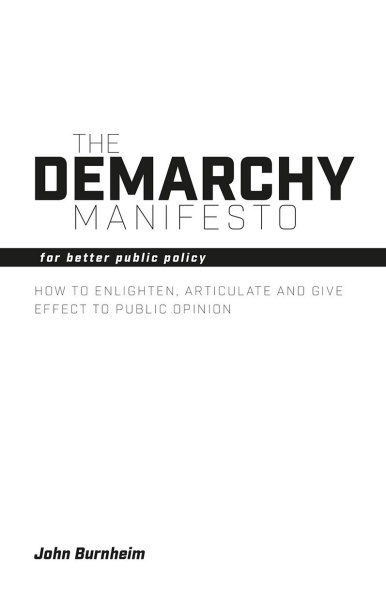
The Demarchy Manifesto

71157100257740l

Many kleroterians are bound to be disappointed in my new book The Demarchy Manifesto, due to be release from Imprint Academic on March 1, because it makes no proposals for replacing voting in favour of sortition in existing institutions, but only in the new voluntary institutions I propose. I believe it is necessary to start this way, since it is extremely difficult to persuade people to give up their vote, but they are prepared to consider sortition where it gives them access to a chance of participating that they do not at present have. This is just an instance of a general pattern in the way that the presentation of options makes a great difference to the evaluations people make of alternatives. You might like to look at this article in the US edition of The Conversation for February 6.

The book suggests that we can snatch the initiative in discussing and formulating public policy from the political parties and produce proposals that they have to accept on pain of voter backlash. I think that there is just a chance that my proposals would consolidate the middle ground whereas the existing procedures encourage the extremes. More fundamentally I aim to move attention from “who gets what” to the sort of public goods that we all can take pride in.

An excerpt from the Introduction to the book:

What I call ‘demarchy’ is primarily a process of transferring the initiative in formulating policy options from political parties to councils representative of the people most directly affected by those policies. The task of those councils would be to distil from public discussion the most acceptable policy in a particular matter. It would be up to voters to insist that the politicians heed them. There is no question of constitutional change, no new parties or new laws, no call for a mass conversion of opinion, but a suggestion about how to initiate a change in accepted practice, starting with actions that may seem of little significance in the big picture, but are still justified by their specific purposes. My focus is on how policy is produced and adopted. I am not concerned with questions about the philosophical basis of state power, or human rights, or crime and punishment. The precise forms these things take in practice are a matter of conventions, which I do not propose to challenge. There is already much debate about these matters. I am concerned about what I see as a more important, but neglected, question.

I begin by concentrating on how to establish some new practices and initiatives in policy formation, empowering those most affected to take the initiative in formulating what they want. It is no advantage to have a choice of products if none of those on offer meets your requirements. The best situation is to be able to say exactly what you want and commission specialists to supply it. Or is that analogy anachronistic and inappropriate in the era of mass production and distribution? I try to analyse our unique problems. My ultimate aim is to transform our political culture. I intend to show how different practices of policy formation are appropriate to different problems at every level from the local to the global and how they might come to be accepted.
Continue reading →

Democratising Deliberation: Parliamentarism, Deliberative Democracy and Lotteries

This article [PDF], by Anthoula Malkopoulou, is a commentary on the work of political theorist Kari Palonen on parliamentarianism. In response to recent scepticism, Palonen’s support for the ‘classical paradigm of elected Members of Parliament looks outdated and insufficiently responsive to the challenge of rising inequalities’:

On one hand, sceptics point to the inherent aristocratic or elitist character of elections, embodied in the perceived superiority of representatives compared to the represented (Manin 1997, 134–149). This is sustained not only by century-long anarchist polemics against bourgeois parliamentary democracy, or populist shaming of political corruption, but also by legitimate i.e. republican concerns about election engineering or illegitimate political lobbying. On the other hand, many scholars are worried by the growing social inequalities enabled by the predominance of economic liberalism since the 1980s (Rosanvallon 2013). These are often exacerbated by corresponding inequalities in political influence that further benefit the wealthy and socially advantaged classes (Hill 2013; Malkopoulou 2014). In this respect, legitimising the current system of parliamentary government and providing its apology sounds far too elitist and self-defeating.
In response to such scepticism, Kari has showed some interest in opening his parliamentary model of deliberation to new modes of inclusion . . . his ideal-typical democratic innovations include the practice of rotation, election of singular representatives who are not linked to political parties, and recently, support for the random choice of representatives (Palonen 2014, 345). This turn is linked to the dissociation of random selection from Habermasian consensus and its support by klerotarians as a device that is independent of the process of deliberation (Stone, Delannoi and Dowlen 2013).

Continue reading →

Charlie Douglass: Guaranteeing gender equality

A post by Charlie Douglass.

Democracy we are told is government by the people. What if many of the people aren’t involved? What if some have a much stronger voice than others?

If a government is to act on behalf of people of every colour, gender, age, and wealth status, then we must either rely on politicians ignoring self-interest completely, or find a way in which a house of parliament can have its members chosen very differently to today. Bias matters because today our parliaments under-represent many groups. Women are under-represented and although some change is happening, the change is slow. Why should the men who are already there be the ones who decide how fast the change is? Why is there so little effort to represent people from below the poverty line?

If you could draw equal representation from across society into a house of parliament, then self-interest matters much less. If a parliament was half female, half male, and contained people from every type of wealth status, then many really important issues would see quick and effective change. Poverty has the attention of many of us, but without power not much is changing. When there is a vote which gives voice to all, then the bias of media barons and political donations can be put in the trash-can where it belongs.

In many countries politics has two houses of government, and the proposal here is to replace the one is which the nation’s leader does not stand. In the USA, France and Australia this is the Senate. In the UK this is the House of Lords, and in Germany it is The Bundesrat. After two terms perhaps this new senate could replace both houses, or the second house could be replaced by sortition also – forming two houses.
Continue reading →

#LordsReform – Let the People Decide

From the Sortition Foundation blog: http://www.sortitionfoundation.org/lords_reform_let_the_people_decide

Sortition certainly sounds good to us – but how do we get from here to there?

#LordsReform Let the People Decide

The Sortition Foundation has released a Draft Strategy Document outlining some ideas. The first campaign proposal is a call for a Citizens’ Parliament on House of Lords Reform (http://www.citizensparliament.uk/). The campaign, to be officially launched later this year, will call on the UK government to constitute and empower a 650-member, random though representative sample of ordinary citizens to consider, research, deliberate on, and then make a House of Lords Reform proposal, to then be put to a national referendum. You can already sign the open letter calling for a Citizens’ Parliament on Lords Reform.

Continue reading →