


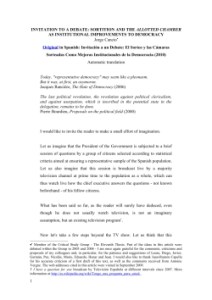
 Here [PDF] is an automated translation (with a few touch-ups) of Jorge Cancio’s 2010 paper “Invitación a un Debate: El Sorteo y las Cámaras Sorteadas Como Mejoras Institucionales de la Democracia”.
Abstract:
I start off inviting my readers to exercise their imagination and then explaining a proposal of creating new “sortition chambers” on all administrative levels – from a chamber at the same level as the present-day Spanish Congress and Senate down to sortition chambers for each municipality. They essentially would be an addition to present-day institutions and would partake in the powers which are held today by elected representatives and officials, although the proposal envisages that in the short run they could be out-voted by the elective institutions. They would exercise their powers according to deliberative procedures.
After that introduction I offer a short account of present-day theoretical and practical proposals and implementations of sortition-based systems in the political field – highlighting the fact (following Manin) that mainstream discussions on democracy tend to ignore sortition altogether (including those made by the political left), but also making the point that since Dahl and others (inter alia, Burnheim, Goodwin, Barber; and the more recent works now appearing in Imprint Academic) there seems to be an increasing renaissance of this subject. I also point to the practical experiences of the Planungszelle and the voters’ and citizens’ juries.
Thereafter I try to explain why sortition is mainly ignored nowadays – here I follow again Bernard Manin – identifiying the contractualist bias of the XVII and XVIII century revolutions (which sought to establish a rule of consent for being governed) as the main reason for opting for elections instead of sortition as mechanism for the selection of political office-holders. Afterwards, the emergence of the political parties as oligopolical forces in the political market (here I refer to the work of C.B. Macpherson) and their growing distance from society and increasing autonomy vis-à-vis societal needs have led to a “party democracy” or “cartel party” system (Katz and Mair). The facade of autonomous decision in electing public officials covers, therefore, a system where political offers are very limited, allowing me to speak about an “election-fetish”. Contrasting to this evolution I then underline the paradox of identifiyng democracy with elections (and political parties) when we consider that democracy was linked in Athens with sortition whereas elections were considered aristocratic.
Continue reading
Filed under: Academia, Proposals, Sortition, Theory | 2 Comments »



 On the website Gerwin
 Adam Cronkright
 Ali
Ali Ahmed R. Teleb
 avanderven
 avergne
 Alex Kovner
 azakaras
 Brett Hennig
 campbellwallace
 Simon Threlkeld
 Nick Coccoma
 codyhipskind
 Common Lot Sortitionist
 Conall Boyle
 constitutionalism
 davidschecter
 Ethan McCutchen
 graytmatter
 gtridimas
 Henry Tuttle
 H.J. Hofkirchner
 HpR
HpR James Kierstead
 John Burnheim
 jgarry20151
 Jochen Krattenmacher
 johnedwardtaylor
 johnhuang865
 Jonathan Crock
 keithsutherland
 Jacob Richter
 kkoreilly
 lukewhito
 SimonPek
 Nathan El
 Nicholas Gruen
 Owen Shaffer
 Patrick Chalmers
 Paul Gölz
 peterstone
 Pierre-Etienne Vandamme
 pronfeld
 Emil
Emil rcaze
rcaze richwbrown
 Roger Knights
 roslynfuller
 Pierre-Etienne Vandamme
 shaharavin
 tbouricius
 Ted Wachtel
 Joshua Laferriere
 theodorestathis
 towardsautonomyblog
 Wayne Liebman
 Yoram Gat
 Oliver Milne
