It’s the Economy, (not) stupid!

I’ve never met Paul Wyatt – who describes himself as a self-producing filmmaker and media consultant. I’ve admired his work from a distance though, both as an inspiration for my own efforts to transform myself into a multi-media journalist and also for the subject matter he’s currently focused on.

I’m highlighting his work to Equality by Lot readers as you may be able to help him – right now – to raise some money to promote the cause of random selection and deliberation as it relates to economic policy. The challenge he’s facing is directly relevant to EbL readers. You are people, I assume, who are intent on spreading awareness and best practice of sortition in its different forms.

If Paul gets the money, and completes his film, we’ll all have a tool to help us argue the case for citizens to get a stronger voice in directing economic policy.

That’s why I’m spending some of my time writing this blog post.

Paul is crowdfunding for the money to complete a film on the RSA’s Citizens’ Economic Council.

The RSA programme gave randomly selected British citizens a non-binding say on national economic policy, and influence over the future of the UK economy.

So far, so so, you demanding EbL readers would say. You’d be right, of course, the Council conclusions didn’t oblige any policy maker to do anything with those findings, regardless of how good they might have been. Not at all best practice in sortition land but not catastrophically bad either.

The RSA initiative has had some heavyweight endorsement from the likes of Andrew Haldane, Chief Economist at the Bank of England. Who knows how far its recommendations will make it through the mechanisms of government and public policy? Perhaps its best legacy will be to move the debate and practices forward for others to then pick them up in turn.

Paul secured an RSA commission to document this event – something he did with skill and style in the short film shown below. You can access the kickstarter campaign via this link, and share it far and wide to your networks.
 

Kialo discussion on lottery

Kialo.com is a website featuring a form of debate that is unlike most discussion platforms on the internet. Instead of the usual bulletin format – where debates are often repeated, trolls derail discussions and things can get rather emotional – Kialo focuses on a tree structure. Each argument has pros and cons hanging beneath it. This has the benefit of being concise, the argument following a logical pattern and things tend to stay more focused.

Here’s a short video on how it functions.


The reason for bringing this up, is that a new debate has started on lottery: Lottery should be an integral component of democratic political systems. Bring in arguments of your own! Let’s debate the issue.

Criteria and two proposals for the use of sortition in politics

The Dutch organization Democratie.nu has published a document (Dutch, German, Français, English) with criteria for the application of sortition in a political system and with two proposals for the use of sortition in the European political system.

The criteria deal with how the agenda is set, the sampling system, the size of the allotted chamber, its service term, its powers – advisory or binding and the potential for manipulation.

The two proposals are:

  • a “transitional” system in which the size of an allotted chamber is determined by the number of voters indicating support for this chamber during elections, and
  • a ‘European Citizens Jury’ – an allotted chamber set up as a review chamber next to the European parliament.

From the introduction:

According to historical sources, our political system was developed to protect the elite AGAINST democracy (sovereignty of the people). An “Electoral Aristocracy” was installed (18th century). Nevertheless, this can be seen as a positive evolution compared with monarchy.

Later on, some “democratic” elements were introduced, for instance “free”, or so called “democratic”, elections with universal suffrage, the equality principle, freedom of speech, freedom of organization, free press etc. However, some of those elements were moderated or abolished afterwards.

But a “democratic element” is not yet a “democracy”. Freedom of organization may be a “democratic element” without which a democracy cannot exist, but on its own it is no democracy. Hence “free elections”, to appoint a governor for instance, may be a democratic element, but on their own they are by no means a democracy. Furthermore, our political system of representation by elected representatives originates from the Roman Republican system and not from the Athenian Democracy. Calling our political system a “democracy” is deliberately misleading propaganda.
Continue reading →

Saillans

Let’s do some sightseeing and go to Saillans. A small village in a South of France tried something unusual, and I belong to a collective in Paris wanting to reproduce their experiment. A member sent a bunch of links to videos about Saillans.

Two images to help locating Saillans. Romain Cazé CC-BY

Saillans’ town hall uses sortition massively. 12 randomly selected citizen control the elected official (check 5:00 of this video). They also use random selection to build action groups on specific topics, like designing the city’s urban plan. The experiment demonstrates how we can use chance to enhance citizen involvement. They demonstrate at least two points: (1) Citizens can perform executive functions, and (2) Citizens can be used to control the executive power.

Of course, some locals speak against this method and for them things were better before. And some mayors around look on Saillans with a judgemental eye. They argue that people should not decide on topics unknown to them. We can answer this argument in two ways: people can become experts through action, and certain mayors didn’t have any prior training before their elections.

But the easiest criticism of this experiment is about its scale (Saillans’ population is around 1,200 inhabitants). Hey, we need to start somewhere and better start at the smallest scale possible. I like the bottom-up approach and believe that a revolution should be done one step at a time. The town hall has worked this way for four years now. A story to be continued…

Thank you for reading! Write below, if you want to add information about Saillans or why you agree or disagree.

This post was originally published on http://www.stochocratie.org.

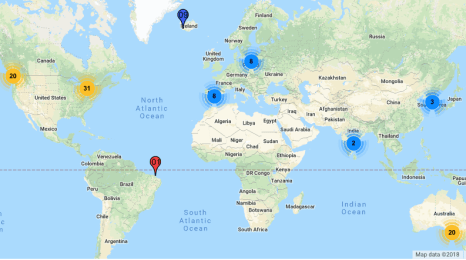
New “sortition around the globe” map

The Sortition Foundation has launched its new “sortition around the globe” map – we know there are many examples missing (those that we do know about will slowly be added). If you want to help just get in touch!sortition_around_the_globe_map

And a reminder about Sortition Foundation events happening in London this weekend:

  1. Sortition Foundation AGM, 8pm Saturday 10th March: contact us for details.
  2. “Back to the Future for a Real Democracy” discussion at Conway Hall, 11am Sunday 11th March. Tickets now available.

Democracy between sortition and elections

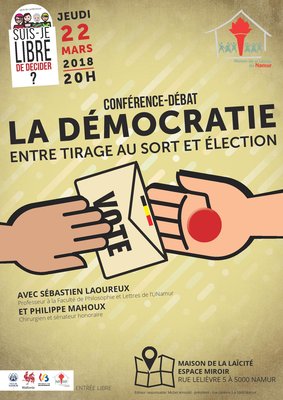
A debate titled “Democracy between sortition and elections” is planned to take place in Namur, Belgium later this month.

In a context where dissatisfaction with the political system is widely shared, the selection of members of legislative assemblies via sortition seems promising in the sense that it allows exchange of citizens’ opinions outside of any framework of careerist political interest. Presentations by Sébastien Laoureux (professor at the Philosophy and Letters department of the University of Namur) and by Philippe Mahoux (surgeon and honorary senator) will be the opportunity to evaluate the link between democracy and elections before exploring new avenues which current democracy can take.

Back to the Future for a Real Democracy – London sortition talk

20180311-Democracy-SortitionHow can we fix our broken democracies? What lessons can we learn from the past and what bold new democratic experiments are happening right now? At Thinking on Sunday on March 11 at Conway Hall, and together with London Futurists and GlobalNet21, Brett Hennig, author of The End of Politicians: Time for a Real Democracy, will take you back in time through history before jumping back to the future to show how a real democracy of, by and for the people could work. Tickets are now available at http://buytickets.at/conwayhallethicalsociety/138492
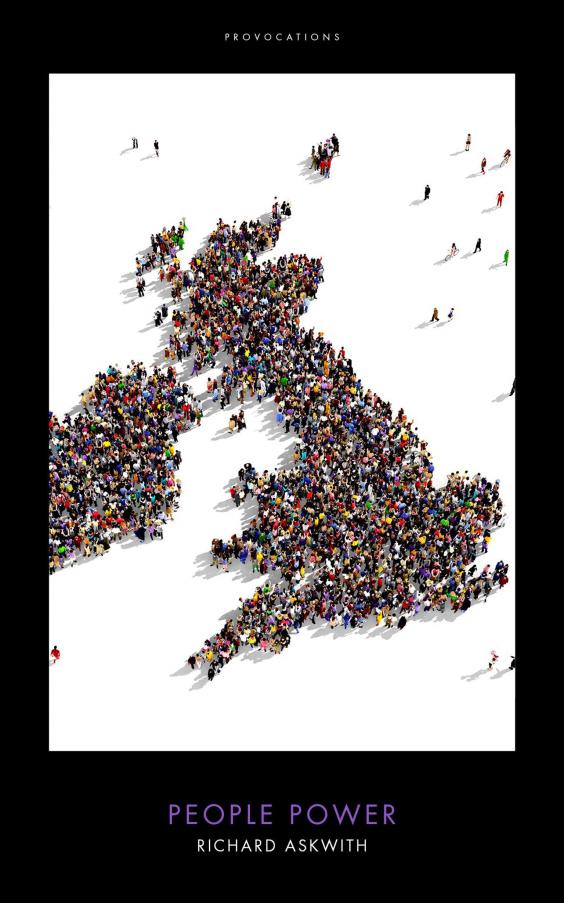
Richard Askwith: People Power

Richard Askwith, a former executive editor of The Independent, has a new book out:

People Power: If we want to defend our democracy we must expel the Lords and replace them with the people

In his new book, ‘People Power’, Richard Askwith makes the case for abolishing the House of Lords and replacing it with a citizens chamber of 400 people to bridge the gap between ‘us’ and ‘them’

[…]

Here’s how [to reform Parliament]. We start in the obvious place, at the least democratic, southern end of the Palace of Westminster. We expel the occupants. And we give the House of Lords to the people.

We cannot put everyone in the chamber; nor can we sensibly put everything to referendum. What we could do, though, is create a People’s Chamber, whose 400 members, randomly conscripted from the electoral roll as jurors, would be a small, representative sample of the population as a whole.

The details are negotiable. Here’s one hypothetical version. Everyone eligible to vote is also eligible for selection by lot to serve in the chamber for a fixed term of, say, four years. Service is compulsory, well-paid and prestigious. The People’s Peers can wear ermine and, if they want, use titles; the financial rewards are comparable to a sizeable lottery win.
Continue reading →

Bouniol: The idea of a Citizens Chamber gains ground

Béatrice Bouniol has been showing some interest in sortition in her stories at La Croix. Last November, on the occasion of the publishing of a new book on the subject of “The Citizens Assembly of the Future”, Bouniol had the following story.

The idea of a Citizens Chamber gains ground

During COP 23, the Foundation for Nature and Man calls on France to make a democratic innovation by establishing a Citizen Assembly for the Future. Facing a crisis of representation, a citizens’ third chamber, an idea which has been discussed for about twenty years, gains ground.

On July 3rd, 2017, speaking in front of Congress, Emmanuel Macron proposed the transformation of the Social and Environmental Economy Council (CESE) into a Chamber of the Future, “a forum of our Republic” aimed at becoming “the crossroad of public deliberation”. Dominique Bourg, president of the scientific council of the Foundation for Nature and Man – created by Nicolas Hulot – having advocated the creation of such a chamber since 2011, was thus pleased at the proposal, but expressed his worry on the pages of La Croix that it could be a mere “rebranding – certainly necessary but far below what is desired.” The programmatic essay that appears today under his direction (Inventing the 21st Century Democracy: The Citizen Assembly of the Future. [Inventer la démocratie du XXIe siècle. L’Assemblée citoyenne du futur, Les Liens qui libèrent/Fondation pour la Nature et l’homme, 2017]) aims therefore to remind the President of the Republic of the conditions required for creating a Citizen Assembly for the Future.


The hall of the Social and Environmental Economy Council, at Iena Square, Paris.

In order to go beyond a feel-good formula, the establishment of a third parliament chamber must rest on an effort of democratic creativity, required by an unprecedented situation. At the age of the anthropocene (a new geological period defined by the impact of humans on their environment), reported by a group of researchers, it is necessary to systematically take into consideration of the impact of laws on the long term, that is, of their influence on the large scale physical and biological evolution of the planet.
Continue reading →

Official records lacking in EMA location allotment

Corriere dela Sera writes:

Doubts emerge over EMA ballot and “burnt” voting slips

Various aspects of assignment to Netherlands of EMA headquarters still unclear, also due to lack of official records regarding draw by lot

The assignment of the European Medicines Agency (EMA) to Amsterdam by lot – to the detriment of Milan – was made official at the EU General Affairs Council on 20 November. But it has now emerged that there is no documentary evidence to reassure European citizens everything was done correctly and according to the rules; the procedure displayed unprecedented anomalies and levels of secrecy, culminating in selection by lot. The representatives of Italy and the Netherlands were not even called to supervise the proceedings at close hand. “Even in children’s tournaments the referee allows the two team captains to watch the toss of the coin …”, commented one ambassador present on the day.

No checks
The ballot papers of the three rounds of voting by the ministers were immediately burned, and the speed with which the draw was performed made any checks either before or after impossible. Above all, on 20 November there was an attempt to shroud everything in the utmost secrecy, with not even the draw method made public. Moreover, since last week the EU Council has continued to refuse to give the Corriere any information on how the voting and count took place, let alone on the lot drawing procedure. We have been able to reconstruct what happened thanks to informal interviews with ministers and ambassadors present, who set greater importance on the value of transparency than on being sworn to secrecy.