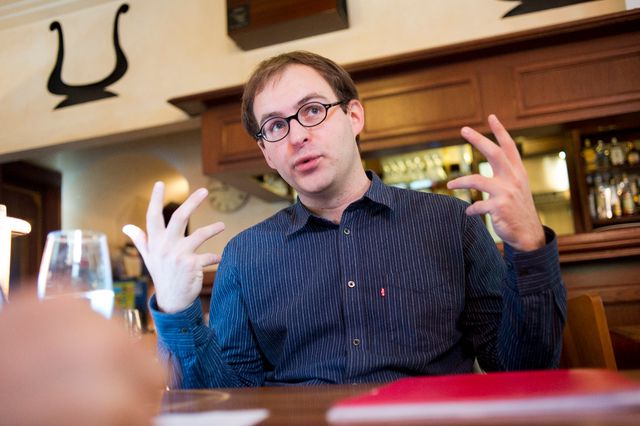
Wariboko: Election by lottery: A new approach to Nigerian democracy

Nimi Wariboko, Walter G. Muelder Professor of Social Ethics at the School of Theology at Boston University, writes:

Electioneering is warfare in Nigeria. Billions of naira are invested in campaigns and conducting elections. War and money have not yielded wise leaders for the country. Is it not time for us to generate creative ideas on how we can peacefully and cheaply select citizens for offices? I suggest that we complement our system of election with lottery. We reserve one-third of all seats in the state Houses of Assembly, House of Representatives, and the Senate for delegates to be filled by lot. Every four years, we put the names of all eligible citizens in a given constituency in a computerised urn or other mechanism and pick out a winner to represent his or her constituency at one level.
Continue reading

Ranciere: What times are we living in?, part 2

What to save from the drifting French political system? The philosopher Jacques Ranciere was the guest of Aude Lancelin in “The war of ideas” of June 20th, 2017. Here is the transcript of this interview. Part 1 of the translation is here. [My translation, corrections welcome. -YG]

03. It is paradoxical to work through institutions in order to demolish them.

Aude Lancelin: Let’s remain with France insoumise and the phenomenon of Mélenchon during the presidential elections. You are very sceptical regarding the figure of a tribune (Mélenchon) who is going to speak in the name of the suffering of the people and champion their cause. This posture is suspect in your view. What is the basis of your criticism?

Jacques Ranciere: There are several things. First, adopting this posture means also adopting the posture that the system imposes, namely the posture that there is an official political game and that there are the people of the depths who are not represented, or are represented by the extreme right from which they must be separated. It is this idea that the people exist, that there are those who represent the people, that is what de Gaulle pretended to do. I don’t think that this is a democratic idea that makes it possible to mobilize and advance. That is the first point. The second point is that I find it paradoxical to become a candidate of the supreme office of the system saying: if you elect me, here is my program. And at the same time to say: but pay attention, this system is bad and therefore everything is going change. I think there is a fundamental contradiction. You are saying to me that my anti-presidential stance is somewhat paradoxical or difficult to follow. But I think it is still more difficult to follow a stance which on the one hand asks to be vested with the powers of the president of the 5th republic and at the same time says I want to 6th republic and i am going to throw all of this up in the air. It is either one or the other. If we say: it is necessary to throw the 5th republic up in the air, we say: I am here to throw the 5th republic up in the air. Period.
Continue reading

Legislature by Lot

[Note: this has been adapted from an orginial blog post here: http://www.bretthennig.com/legislature_by_lot]

legislature

From Friday to Sunday this weekend (September 15-17) the co-founder and director of the Sortition Foundation, Brett Hennig, will be joining a group of academics, researchers and activists gathering at the University of Wisconsin-Madison to discuss the pros and cons of a “Legislature by Lot” – a parliament, senate or congress selected by sortition.

The workshop is being organised by Professor John Gastil (Penn State) and Professor Erik Olin Wright (University of Wisconsin-Madison) who have drafted the principal proposal that attendees are responding to. Their proposal is for a bicameral legislature where one chamber is elected and one is selected using sortition.

Deepening Democracy CoverThe intended outcome of the workshop will be a book whose prospective title is “Legislature by Lot: An Alternative Design for Deliberative Governance”, to be published by Verso as part of of the Real Utopias series.

The workshop will be attended by many well know academics and practitioners in the field of deliberative and participatory democracy, including Lyn CarsonNed CrosbyJim FishkinArchon FungJane MansbridgeYves SintomerGraham Smith and many others.

Workshop session titles include “Legislatures by lot in the context of major democratic reforms”, “From deliberative to radical democracy? Sortition and politics in the 21st century”, “On democratic representation and accountability” and “Random assemblies for law-making? Prospects and limits”.

It promises to be an interesting and stimulating weekend of discussion about if and how sortition should be introduced into the legislative branch of government – and the resulting book (probably appearing in late 2018) should make a major contribution to the debate about radical but achievable changes that could be made to better our democracies.

Athens as a democratic precedent

Athens of the fifth and fourth centuries BC is often brought up in discussions and polemics about sortition, both in support of the idea and against it. However, since this is often done in rote or knee-jerk manner rather than as reasoned argument the results provide more insight about modern conventional views than about the mechanism of sortition. It is therefore of interest to make an orderly account of the properties of the Athenian system as they are relevant to the question of using sortition in a modern political system and then use this account to evaluate the relevance of the system to the modern debate: the lessons that can be drawn from the historical record, if any, and whether in fact Athens should be a prominent part of the discussion of sortition today.

The historical facts

The institutional arrangements in Athens are pretty well known. My understanding is that the main source for the details is Aristotle’s The Athenian Constitution, but the general institutional picture and the conventional political theory behind them is clear from multiple sources. In addition some background facts about the Athenian society can be established including both facts about the demography of Athens and about the conventional ideology of the Athenians. For our purposes, the following points (“stylized facts”) are the relevant ones:

  1. Athenian citizenship was very restrictive. Of a population of about 300,000 people, only 30,000 were fully enfranchised citizens (adult males of Athenian ancestry). The rest were women, children, foreigners and slaves.
  2. Despite some vestiges of formal political stratification among the citizens, conventional Athenian ideology saw citizens as deserving equal political rights and in practice no formal distinctions were enforced.
  3. The set of Athenian citizens was largely made of two groups – small farmers and city-resident workers. There were two elite groups: landed Aristocracy, and the wealthy city bourgeoisie.
  4. The rich were taxed by the city and money was given in various ways to the poorer citizens, but significant economic inequality persisted in Athens.
  5. The day-to-day governing of the Athenian city was carried out by the Council – a body of 500 citizens allotted yearly. The council oversaw a large number of magistrate boards, each made of ten 10 citizens allotted yearly. There were also a few specialized offices (military generals and high financial officers) that were elected.
  6. Continue reading

Ranciere: What times are we living in?, part 1

What to save from the drifting French political system? The philosopher Jacques Ranciere was the guest of Aude Lancelin in “The war of ideas” of June 20th, 2017. Here is the transcript of this interview. [My translation, corrections welcome. -YG]

01. There is always this confusion between democracy as the power of all and a representative system.

Aude Lancelin: Jacques Rancière, welcome. I thank you, a great political philosopher, for coming to help us understand what is happening in a democratic country where full power is obtained with the support of less than 11% of the electorate. One of the very cruel lessons of your new book “In what times are we living?”, which is a dialog with the editor Eric Hazan, is that despite the mass abstention, despite the dysfunction of the representative system, someone holds power. Moreover, power becomes more and more oligarchical in our societies, without meeting any serious obstacle. It is not enough to turn our backs on the electoral system for it to collapse by itself. It continues to function without the popular classes, without the left… until when?

Jacques Ranciere: As I see things, the representative system is made to function with the support of a minority. There is always this confusion between democracy as the power of all and a representative system. The electoral system is made as a conflation of the two but fundamentally the representative system is in its essence an oligarchical system. In the 17th century the representative system was therefore made for a small part of the population that was supposed to be “enlightened”, representative and conscious of the general interests of society, to be able to govern with as few obstacles as possible. At the time of the revolutions of the 19th and 20th centuries a belief in the power of people emerged, which could express itself through the electoral system and representation. Today we realize again that in different ways power is always with a small minority. In the past it was a social class, now it is difficult to say what social class can really govern the country, even if we know what interests the system serves. In consequence, we professionalization occurred which produced an interaction between a left and a right which fundamentally thought and did the same thing. And at the same time, they saw themselves as representatives and called for a non-establishment system or an “anti-system”. That is, the system itself produced its anti-system. What we see with Macron, with En Marche [Macron’s party], is a new and unexpected way in which the system produces its “anti-system”. I mean that the representative system carries within it the potential for several possibilities. There is the Le Pen style alternative, that is the people of the depths who are going to sweep away all the people of the system, and then there is of course the Macron alternative, which is a more subtle form because it replaces the system by the system itself. Fundamentally, what is the great novelty about under the banner of En Marche? These are alliances which are already known in other European countries (Germany, for example), with the difference that the parties keep their autonomy, while keeping the same politics, sometimes as adversaries and sometimes as allies.
Continue reading

‘We spent almost two years sitting on a jury’

There has been some debate on this site regarding the optimal length of service for a political jury.  On the one hand most of those chosen by lot to participate will have had very little political experience, and will need a period of induction and this has led to suggestions for a service period of up to 2 years with overlapping tenure, so that at all times there will be jurors who will have served for at least a year to help guide new inductees. On the other hand others (including myself) argue for short ad hoc juries, allotted for each legislative bill, in order to ensure ongoing representativity (i.e. to combat the risk of jurors ‘going native’).

However the discussion has always been from the perspective of the system rather than the participants who, it is assumed, will go back to their normal lives once their service period has ended. But evidence from a recent fraud trial suggests this may be difficult if the service period is for a year or more. Jurors rarely talk about their court-room experience but four out of the twelve participants in this case have revealed how difficult the transition back to civilian life has been (three of the original 15-strong allotment dropped out, suggesting negative outcomes for nearly one half of the original sequestration). One of the jurors, ‘Julie’

returned to her job in a travel agency when the case finished, but quickly found herself struggling. Julie says: “I went back and did two days training and then I went two days into the shop. I’ve never been back since. I’ve not given it up yet. “I am going through the doctor and trying to get back into it. I’m still struggling. I just felt like I could not even hold a conversation.”

Continue reading

Greece: School flag-bearers will be chosen by lot, rather than achievement

ekathimerini.com reports:

The government has scrapped a long tradition of honoring top pupils by selecting them to carry the national flag in school parades. From now on flag-bearers will be chosen by lot. Opposition parties criticized this as part of the SYRIZA party’s assault on excellence.

A presidential decree published in the Government Gazette on Tuesday sets out the new procedure for selecting flag-bearers, and those flanking them, in primary school parades. Two pupils in sixth grade (the final year of primary school) will be chosen by lot each year, with one serving from the start of the academic year until January 31 and the other from February 1 to the end of the school year.

This means different pupils will carry the flag in parades to mark Independence Day on March 25 and Oxi Day on October 28, which commemorates Greece’s response to an Italian ultimatum in 1940 and the country’s entry into World War II.
Continue reading

Public opinion in crisis

A stable democracy depends on a sound public opinion. It is the essential basis of agreement about what is legitimate behaviour on the part of both public institutions and many of the relations of citizens to each other. It is the central common good or communities of most sorts.

The traditional notion of public opinion

Until the advent of continuous polling what was invoked by the phrase “public opinion” was a set of beliefs and attitudes that were assumed to be shared by nearly everybody in the nation concerning the grounds on which choices of public policies were to be judged and the performances of public activities to be assessed. As contexts change, depending on the degree to which different groups approve of those changes, differences emerge in many fringe situations. As long as there is a sense of community people deal with these differences mainly by agreeing to small verbal changes that accommodate certain important new demands without abandoning traditional formulae “I’m not a feminist, but…”

Public opinion in this sense was traditionally invoked by prominent public figures, politicians, journalists and intellectuals often with such phrases as “will not tolerate” or “demands” that a government do this or that. Such public protagonists assumed that their attempts to articulate the tacit understandings on which the society operated would be endorsed by the “general public” if they thought seriously about the matter. So churchmen would assume that as Christians their followers were committed to certain views, labour leaders that justice required a certain treatment of workers and business leaders that the rights of investors be respected. They would each attempt to represent such claims as reflecting a more fundamental agreement on the way the community needed to work of it was to flourish and command loyalty.
Continue reading

Sortition within cooperatives

I am conducting a research project on sortition in cooperatives, and am wondering whether anybody in this community has come across any research or practice in this domain. The only work I am aware of is Terry Bouricius’s article titled “A Better Co-op Democracy Without Elections?” Thanks in advance!

G!LT Party in Austria to use sortition

This sortition community may be pleased to hear that a new party employing principles of sortition was recently founded by Austrian Comedian Roland Düringer. The new party is called “Meine Stimme GILT” (translates as: “My Vote Counts”) and is now highly likely to get sufficient popular support to run at Austria’s national parliamentary elections in October.

Roland Düringer has puzzled media and pundits by declaring himself not eligible for election, which of course sounds absurd for party system adherents. In fact, however, he is not a candidate and will not accept a mandate. Also, the party has declared that it has absolutely no political program which adds to journalists’ head scratching but is a logical consequence of a commitment to crowdsourcing all future policy proposals and decisions with full neutrality.

Once sufficient supporting signatures have come in from all Austrian federal states, expected to happen at the end of next week, G!LT will allot 50 parliamentary candidates for its election lists from a group of 1,000 vetted volunteers. These volunteers committed to donate most of their salary (anything above 2017 Euros) to social or democratic causes and to represent the General Will in parliament. This will be determined by “Open Democracy“, a multi-stage process mixing elements of several democratic approaches:

  1. Participative democracy — broad public participation during initial opinion and prediction gathering, open for all citizens
  2. Sortition democracy — stratified random sampling for demarchic committees from volunteers vetted by prediction success
  3. Deliberative democracy — demarchic committees will vote after a multi-phase hearing of innovators, the pro and the con side, and deliberation
  4. Anticipatory democracy — all committee decisions will be backed and tracked by falsifiable impact predictions

(Here are the principles of this process in English.)

The party decided to adopt this model for the upcoming elections, over two other competing ones (Liquid Democracy and Sociocracy), after research by a combination of questionnaire and prediction market forecasts drawing on a representative sample of 1,000 Austrians.

Democratic legitimisation will be effected by vote share in general election. Or not, as a 4% hurdle applies.

If there is sufficient interest, I can keep this community posted on new developments and of course on actual election results.