Demiocracy, Chapter 21: “Wide” mass electorates attract and empower Propaganda

Already weakened by the vast impersonal forces at work in the modern world, democratic institutions are now being undermined from within by politicians and their propagandists. The methods now being used to merchandise the political candidate as if he were a deodorant positively guarantee the electorate against ever learning the truth about anything. —Aldous Huxley, Brave New World Revisited, 1958, VI.

We vote, indeed we perceive political reality, through the people with whom we are in contact. Most of us are reached by the mass media only in a two-step process, by way of other people’s perceptions and reactions to them. —Hanna F. Pitkin, The Concept of Representation, 1967, p. 223.

… it has also become evident that if one acts ruthlessly …, cleverly organized propaganda can accomplish swift and drastic changes in opinions and attitudes, especially in difficult and critical situations; it can … also instill patently false ideas about actual conditions. — Daniel Boorstin, The Image, 1961.

Regarding one of those Pernicious P’s, Wikipedia says the following [2024-07-01] about the influential author Edward Bernays and his book, Propaganda (1928):

[Bernays] outlined how skilled practitioners could use crowd psychology and psychoanalysis to control them [the masses] in desired ways. Bernays later synthesized many of these ideas in his postwar book, Public Relations (1945), which outlines the science of managing information released to the public by an organization, in a manner most advantageous to the organization.

Continue reading

Democracy Without Shortcuts, A Critique. #1: A false equivalency is drawn between electoral misanthropy and electoral misogyny 

Among the major handicaps a reformer can encounter is the opposition of the indignant virtuous …. —E.S. Turner, Roads to Ruin: The shocking history of social reform, 1960.

Cristina Lafont’s 2020 book, Democracy Without Shortcuts, unfairly attacks lottocracy as invidiously exclusionary. A false equivalence is asserted between lottocrats’ current “existential” criticism of the political capability of mass publics and misogynists’ past “essentialist” criticism of the political capability of women (and sometimes of other marginalized groups). Lafont writes, for instance:

… The empirical evidence provided to supposedly ‘prove’ women’s ignorance, irrationality, apathy, and irresponsibility, and the arguments put forth to perpetuate their subjection to others in the not too distant past, are remarkably similar to the arguments and evidence currently provided by the ‘voter ignorance’ literature.
Continue reading

Martin Wolf on Democratic Capitalism (and me as it turns out!)

Martin Wolf is talking up a storm on the crisis of democratic capitalism, and he’s supporting sortition as you can hear from around 11 minutes in where I’ve set it up to begin.

In case you’re interested, here’s the presentation he gave before the panel session recorded above.

The Case for Abolishing Elections

Just in advance of Election Day here in the USA, Boston Review has published my article on why getting a real democracy requires that we replace elections with lotteries, career politicians with everyday citizens. Grateful to Terry Bouricius, Brett Hennig, and Adam Cronkright for allowing me to interview them for this piece.

In the ancient world, lot meant “destiny.” The Athenians believed that it was the fate of selected citizens to serve. Views on providence have changed, but whether we channel the will of the gods or merely our own earthly dreams, democracy by lottery would empower us to combat oligarchy, give voice to the multitude, and put ordinary citizens in the room where decisions are made. The question is not whether American democracy will die, but whether it will be instituted for the first time.

Invitation to The Similitude

Hello, Kleroterians! Nick Coccoma here from Boston, USA. I’ve been a follower of the blog and member of the sortition movement for several years now, after I discovered the theory and practice in the wake of the 2016 Presidential Election. In the years since, I’ve been a part of The Sortition Foundation and Democracy Without Elections, and published an article on sortition a couple of years ago for the journal New Politics.

Last February I launched my own Substack newsletter, The Similitude, where I cover politics, culture, and religion. I’ve written several posts on sortition, including a recent one entitled “Real Democracy Now: How Americans Can Win Self-Government.” It makes the case for sortition and features original interviews with our own Brett Hennig, Terry Bouricius, and Adam Cronkright. In your kindness, consider subscribing to the newsletter and sharing it in your circles as I seek more readers. I’d love to have the Kleroterians join the conversation. Many thanks for your ongoing work to bring about real democracy in our time!

The Jury of the Whole

In my latest post on the legislative branch, I look at what happens after a set of concrete proposals are made and published. This is the most transformative aspect of the proposal-jury model. It engages every aspect of a polity, from intellectual and business elites, to the news media, to ordinary citizens. And it is the closest that any large, modern society can come to experiencing direct democracy.

Kill The Assembly

In the first post of my series on the legislative, I discuss what is wrong with the general assembly (spoiler alert: everything). Nevertheless, in the history of the assembly there are the seeds of new growth. We can get back to a more honest, more productive assembly if we take it apart, honor its historical motivation, and rebuild it with some modern innovations.

Sortition Foundation: a new campaign for government by sortition

Last week a new campaign was launched to demand government by sortition.

sortition-definition2

Its aim is to promote sortition and build a movement demanding the replacement of elections with sortition.

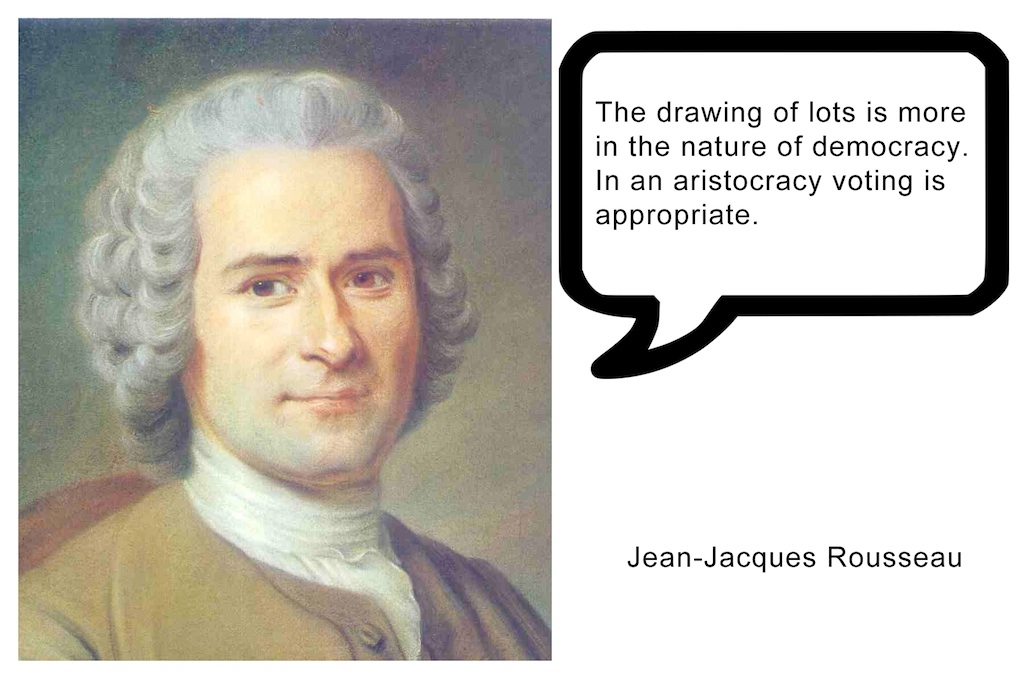
rousseau-1024

To support or promote it, visit http://www.sortitionfoundation.org/, like it on Facebook: https://www.facebook.com/SortitionFoundation or follow it on Twitter @SortitionNow

For more information, or to give feedback or offer to help, please use
the contact page: http://www.sortitionfoundation.org/contact

[Editor’s note: this post was modified after posting as the group changed its name]

The Blind Break, the Invisible Hand and the Wisdom of Crowds: The political potential of sortition

[Update: Commenting was accidentally initially off, enabled now.]

Draft paper:

Abstract: Following (Waldron, 2013), this paper draws a distinction between ‘social’ and ‘political’ variants of sortition, focusing principally on the latter. The two leading theories – the ‘blind break’ and the ‘invisible hand’ of descriptive representation – rely on different principles, focus on different levels of analysis (individual and collective) and have little in common. The attempt by epistemic democrats to bridge the gap via small-group face-to-face deliberation fails on account of the lack of concern for statistical representativity and the lack of distinction between the different roles of advocacy and judgment (proposing and disposing) in political decision-making, sortition only being relevant to the latter function.

This is derived from the paper that I presented at the recent IPSA Montreal conference, where I was encouraged to write it up and submit to a journal. I’d really appreciate comments and criticisms via this forum. Here’s the full draft (click the download button on the right).

Discussions of sortition in German?

Does anyone know of organizations, publications or websites that discuss sortitional selection of legislatures in German?