Choosing by lot and the politics without titles

Yavor Tarinski

The man who wears the shoe knows best that it pinches and where it pinches. ~John Dewey [1]

One of the main pillars of contemporary oligarchies worldwide is the institution of elections. Every leader and government, regardless of how liberal or authoritarian, claims its ascendance to power through some kind of electoral process. Elections are considered as “the democratic means” per se – if a system is based on elections, then it supposedly is a “democracy”.

The supporters of this view see in electoral processes a means of sustaining popular sovereignty, while avoiding what they see as a danger of popular self-rule – i.e., rule by the incompetent. But as philosopher Jacques Rancière underlines, there is an “evil at once much more serious and much more probable than a government full of incompetents: government comprised of a certain competence, that of individuals skilled at taking power through cunning.”[2]

Electoral processes tend to nurture antagonism and competitiveness, rather than cooperation and dialogue. They give way to a certain anthropological type – the power-hungry political demagogue. Rather than concerned with resolving public issues and problems, it focuses on “winning” elections. The very essence of politics is radically altered in elections-based systems – with their content being emptied of any substantial deliberatory essence and replaced with a lifestylish approach that focuses on candidates – their ways of life, the tricks they pull on each other, etc.

Ultimately, the main agenda that drives the action of the electoral anthropological type is that of opinion polls. Candidates must learn what and when to say things that will be liked by the largest amount of people, so that they can get ahead in the race. The result is a type of craft where electoral competitors outbid each other, play dirty, and resort to all sort of tricks in order to win. This becomes the main occupation of people involved in electoral competitions for office. Because of this political scientist James S. Fishkin suggests:

Candidates do not wish to win the argument on the merits as much as they wish to win the election. If they can do so by distorting or manipulating the argument successfully, many of them are likely to do so. Representatives elected through such processes are looking ahead to the next election while in office.[3]

Continue reading

Elections and Sortition: two systems, two destinies, two ways to do politics

In the pretty likely event of a hung parliament after the next Australian election, the cross-bench becomes kingmaker. I’m hoping — and expecting — the crossbench to seek greater use of citizen assemblies in governing Australia. But what comes next is crucial.

Some think it would be great if a citizen assembly was held on an important issue — or two or three. Allegra Spender proposes one on tax. Others want one on housing. It would be nice to see them go ahead. But I’m sceptical they can achieve a lot.

First, on their own, citizen assemblies can be useful in lots of circumstances, but I’d say they’re most successful where they solve problems for politicians.

Ireland has become the pin-up boy for citizen assemblies

They’ve probably acquired a higher visibility in Ireland than anywhere else. And two of them have gone very well — allowing same-sex marriage and the repeal of anti-abortion provisions of the constitution. That’s because both solved problems for the politicians.

Irish citizen assemblies haven’t done noticeably better than elsewhere on the other occasions where they typically created problems for the politicians. In these circumstances, if politicians can’t ignore the citizen assembly on account of the profile it’s acquired, they cherry-pick its recommendations.

More importantly, whether or not the politicians accept their recommendations, the citizen assemblies usually contemplated are temporary and, as such, don’t aspire to leave any institutional trace. They also rehearse existing relationships in which we the people propose and the Government disposes.

I’ve gone to some lengths to propose an alternative, A standing citizen assembly effectively operating as a third house. (There’s something similar in the German-speaking part of Belgium). It is not more ‘radical’ than existing suggestions. It establishes an institution with exactly as much formal power as the other citizen assemblies just discussed. None.

The idea that it is more radical comes from what I call its greater ‘imaginative vigour’. Without proposing any change in formal power structures, it follows through on the idea that a different logic needs to enter the system.

I don’t see a citizen assembly as a tricky new ‘hack’. Nor is it that important to me that it seems more democratic. That’s a good thing, but, as we’ve seen in Iraq and Afghanistan and as the ancient Athenians discovered during the Peloponnesian War, more democratic structures don’t always arrive at better decisions.

The more I’ve thought about representation by sampling as opposed to representation by election, the more deeply I’ve appreciated their differences.

By their nature, elections separate the governed from those who govern. That’s why Aristotle called selection by lot ‘democratic’ and elections aristocratic or oligarchic. Montesquieu and America’s founding fathers agreed.

Electoral systems are also intrinsically competitive. And the competition for votes rewards performativity, manipulation and dissimulation.

That plunges electoral democracy into deep pathologies.

Continue reading

Sortition on Novara Media

Novara Media is British media organization which publishes videos on YouTube. On August 31st it published a video in which the presenters mocked a certain UK MP. In the context of lamenting the supposed stupidity of that MP, one of the presenters, Aaron Bastani, suggested appointing the entire House of Commons by lot. Bastani seemed fairly well informed about the topic, mentioning the term sortition and the use of the mechanism in Athens.

The argument about sortition generating a more competent body is somewhat unusual since it is conventionally claimed that sortition generates a more representative but less competent body.

The video had over 17,000 views and over 200 comments, but none of the comments as far as I could see picked up on the topic.

I mean you’d be better off, you’d honestly be better off, just the first person you see on the street or in the pub and saying “Look, you’re going to be an MP for a constituency”, they will be better than Esther McVey.

By the way, that’s something I really believe. If you randomly chose individuals and you made them MPs and then they had to form parties and alliances over a period of time, I genuinely believe they would do a better job than than the House of Commons. I know people are going to get upset with me. That’s not anti-politics left populism. It’s called sortition. It used to be the basis of Athenian democracy. I’m saying that it would be superior, with women involved and no slave class. I do genuinely believe it would give us better MPs than the caliber we have right now.

Monbiot has a change of heart on sortition

Back in 2017, after a minor campaign of harassment, Guardian columnist George Monbiot weighed in on sortition. At the time his verdict was that the idea was nothing short of “a formula for disaster” and instead he offered his readers the usual electoral fixes such as campaign finance reforms, voter education and proportional representation. Well, seven years later, Monbiot has had a significant change of heart:

General elections are a travesty of democracy – let’s give the people a real voice

Our system is designed for the powerful to retain control. Participatory democracy and a lottery vote are just two ways to gain real representation

[G]eneral elections such as the one we now face could be seen as the opposite of democracy. But, as with so many aspects of public life, entirely different concepts have been hopelessly confused. Elections are not democracy and democracy is not elections.
Continue reading

Malkin and Blok: Drawing Lots

Drawing Lots: From Egalitarianism to Democracy in Ancient Greece, a new book by Irad Malkin and Josine Blok, has just been published by Oxford University Press. The book is a major landmark in the study of sortition and its association with democracy. The book aims to show, via a review of the history of the application of allotment in the ancient Greek world, that Greek democracy grew out of an egalitarian mindset, a mindset that was expressed, as well as presumably reinforced, by the widespread application of allotment in different contexts over a centuries-long period.1
Before the lot became political, drawing lots and establishing a mindset of equal chances and portions were already ubiquitous during the centuries before Cleisthenes laid the foundations for democracy in 508. They touched upon a whole spectrum of life and death, both private and public. They expressed values of individuality, fairness, and equality.

Malkin considers his new book as the first comprehensive treatment of classical allotment. He points out a rather astounding fact – allotment, “a significant institution that permeated the lives of Greeks during the archaic period and impacted how they saw human society and structured their expectations and behaviors”, has received very little attention by classicists.
Continue reading

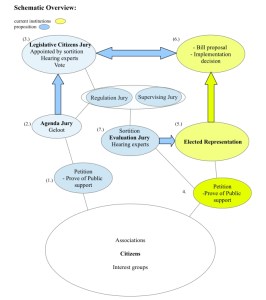
Sortition as a direct democratic system to appoint a real citizens representation, also called “citizen jury“

INTRODUCTION

According to historical sources our political system was developed AGAINST democracy (sovereignty of the people). An “Electoral Aristocracy” was installed (18 century). Nevertheless, this can be seen as a positive evolution compared with ruling by inheritance.

Later on some “democratic” elements were installed, for instance “free” or so called “democratic” elections with universal suffrage, the equality principle, freedom of speech, freedom of organisation, free press, … but some of them were weakened or eliminated afterwards.

But a “democratic element” is not yet a “democracy”. Freedom of organisation may be a “democratic element”, without it a democracy can not exists, on his own it is no democracy. This way “free elections”, to appoint a governor for instance, can be a democratic element but on his own it is by no means a democracy.
Continue reading

Sortition Foundation: a new campaign for government by sortition

Last week a new campaign was launched to demand government by sortition.

sortition-definition2

Its aim is to promote sortition and build a movement demanding the replacement of elections with sortition.

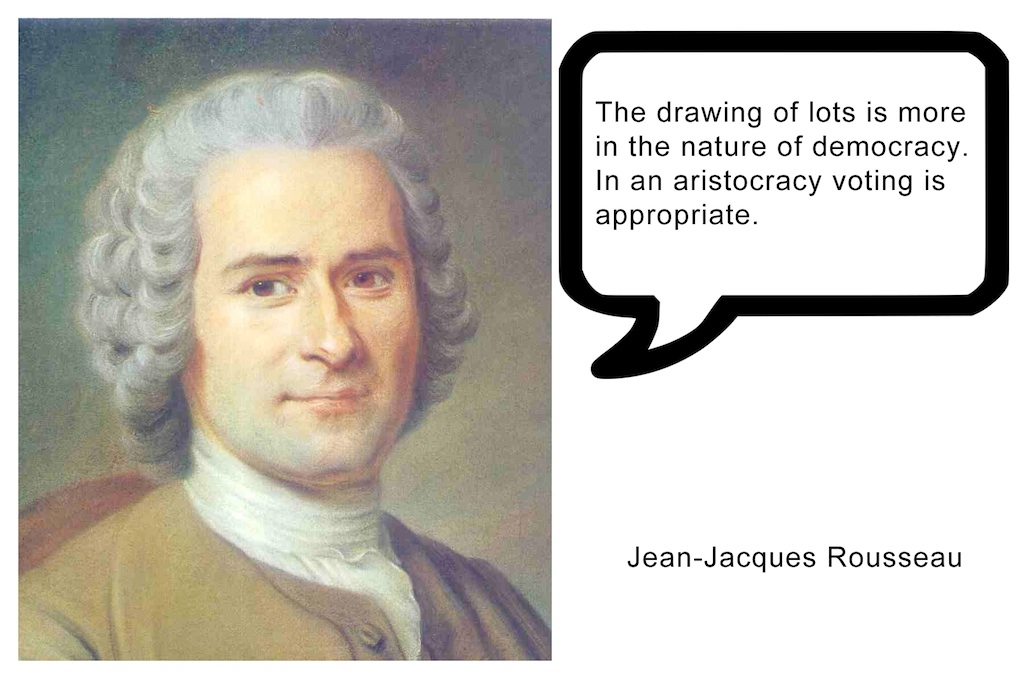
rousseau-1024

To support or promote it, visit http://www.sortitionfoundation.org/, like it on Facebook: https://www.facebook.com/SortitionFoundation or follow it on Twitter @SortitionNow

For more information, or to give feedback or offer to help, please use
the contact page: http://www.sortitionfoundation.org/contact

[Editor’s note: this post was modified after posting as the group changed its name]

Discussions of sortition in German?

Does anyone know of organizations, publications or websites that discuss sortitional selection of legislatures in German?

Is the word government a problem?

This is a change of pace from the previous posts, and an issue not yet discussed on EbyL as far as I know. To express a new dynamic between citizen and political institutions, through selection by lot and possibly other reforms, would we need a word besides “gov’t”?

The full article is here. I suggest we comment on that site (DaftBlogger), especially explaining sortition or Equality by Lot, as a way to develop some cross traffic and build awareness.

“A ship is safe in harbor, but that’s not what ships are for.”
William Shedd

Finally, uncannily, a philosophical-linguistic dimension leaves us astounded and open-mouthed.

The word “govern” means to rule over, originating from the Greek kybernân = to steer and kybernḗt = helmsman, tillerman! The word “cybernetics,” by the way, shares this root.

Mr. Tillerman is no appraisal of contemporary government, or American isolationism, or American imperialism. Mr. Tillerman stands for 2500 years of a conception of government as controlling, disciplining machine. To some, it means controlling the masses or keeping their hands off the property of elites. For others, it means checking the abuse of the weak by the strong. For some, it means limiting the influence of social organizations like the church. Again for others, it means curbing the economic power of moneyed elites.

Continue reading

Plutonomy — how the 1% has hijacked democracy

An excellent paper on the tricks the richest 1% have played to turn our political democracy of ‘one person one vote’ into financial despotism:

http://www.paecon.net/PAEReview/issue59/Fullbrook59.pdf

It’s a gripping read. So is Sortition the answer? If so, why?