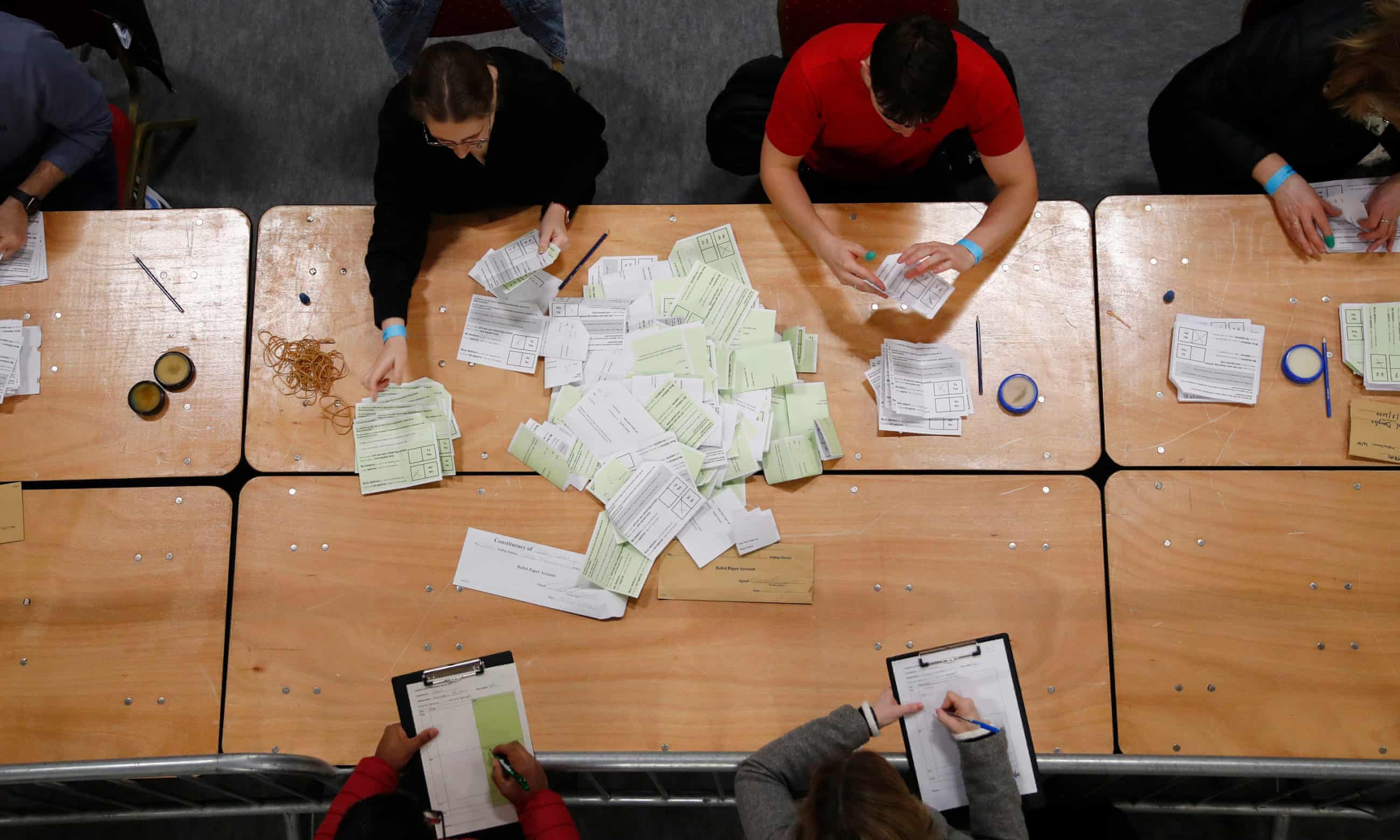
A referendum in Ireland on March 8 resulted in a “no” vote for constitutional changes. The rejected proposals were the product of a process involving an allotted citizen assembly. An article by Rory Carroll in the The Guardian offers an illuminating review of the aftermath of the failure of the proposed changes at the polls.
Irish referendum fiasco puts future of lauded citizens’ assemblies in doubt
Debates involving 99 randomly selected people were hailed as a model for the world, but some say faith has been eroded
When Ireland shattered its history of social conservatism by passing a 2015 referendum on same-sex marriage and a 2018 referendum on abortion, progressives credited its citizens’ assembly.
Ninety-nine randomly selected people, who are brought together to debate a specific issue, had weighed evidence from experts and issued policy recommendations that emboldened the political establishment, and voters, to make audacious leaps.
Governments and campaigners around the world hailed Ireland as a model for how to tackle divisive issues and a modern incarnation of the concept of deliberative democracy that dated back to ancient Athens. Continue reading →
Fortune tells the story of Marlene Engelhorn who is busy dispensing with €25 million which she inherited.
Engelhorn settled on an idea: Let 50 strangers decide how to give it away.
Those strangers, all of whom live in Engelhorn’s native Austria, will meet for the first time this weekend at a hotel in Salzburg. Dubbed the Guter Rat, or Good Council, they were chosen through a statistical process run by research group Foresight and range in location, age, race, socioeconomic background and other demographic factors chosen in an effort to be representative of the overall Austrian population.
Engelhorn’s goal is not only to give away €25 million, but also to spark conversations on wealth inequality. She’s frustrated that her windfall wasn’t taxed — Austria eliminated its inheritance tax in 2008 — and doesn’t see traditional philanthropy as a good solution because it still gives her too much power.
“I’m just one brain, I’m just one person and so to me, this is a huge relief knowing that the process of redistribution is much more legitimate and thorough and democratic than I could ever do it,” she said in an interview. “Nobody needs another foundation.”
Continuing what is a bit of a tradition, Evan Tao, a Brown University student, proposes employing sortition to select student government at Brown.
Over the past decade, many countries have held citizens’ assemblies in which citizens are randomly selected to deliberate and make policy recommendations to legislators. Hundreds of these assemblies have been held around the world with great success. An Irish citizens’ assembly’s proposal to legalize abortion was sent to a national referendum; in France, an assembly submitted recommendations on combating climate change to the incumbent government. Citizens’ assemblies can be effective pilot programs, proving to the public that sortition works. Ideally, they will become regularized and eventually hold direct legislative power in local government.
If I’ve convinced you that lotteries are preferable to elections, and you’re wondering what to do about it, we can start right here at Brown. Our student government election process has room for improvement. I don’t know about you, but I only voted for the people who asked me to or who had cute posters, neither of which seem like a good indication of the best future leader. Voter turnout in the class of 2026 first-year elections was only 33.5 percent. And, as we saw with the recent Undergraduate Finance Board budget surplus fiasco, who our student government representatives are matters. Let’s make it an opt-in lottery at Brown—and then take it to the rest of the country.
Iain Walker, executive director of The newDemocracy Foundation, has an opinion piece in The Jerusalem Post. Walker offers Israel and its allies advice about what government they should set up in Gaza (once they tire of killing tens of thousands of its inhabitants).
Gaza needs democracy without elections
Instead of elections, Athenian democracy used a simple random draw among citizens (known as “sortition”).
Prime Minister Benjamin Netanyahu receives regular criticism for failing to share the plan for Gaza after the military role concludes. The lack of an official position on this subject could stem from the fact that all over options are unattractive, and so a new approach is required.
Israel as an occupying force is undesirable, it would draw global criticism and simply push off the problem to a later date.
Equally, traditional electoral democracy is an unworkable option.
With polls reflecting up to 80% support for Hamas among Gaza residents, elections would only allow for some incarnation of Hamas to emerge newly empowered – an untenable situation following its acts of terror targeting civilians. Continue reading →
George Galloway’s recent landslide win the UK was certainly a rejection of the British duopoly by the Rochdale voters. Despite his obvious loathing of the people put into power by the UK electoral system, and the policies they pursue, Galloway seems to still adhere to Van Reybrouk’s rule – “we despise elected officials, we venerate the elections” – and avoid offering a systemic change that would be more likely to promote different people and different policies.
CEPS is “a think tank and forum for debate on EU affairs”, founded in Brussels in 1983. CEPS has a project it calls Ideas Lab whose aim is “to provide a high-level intellectual forum for exchanges concerning the wide range of current and pressing issues faced by the EU”. In this forum, Kalypso Nicolaidis, chair of global Affairs at the New Florence School of transnational governance at the European University Institute in Florence, is proposing to set up a permanent allotted EU citizen assembly.
Eurobarometer data shows that the trust European citizens have for their governments has recovered significantly from the depths of distrust felt in the wake of the 2008 financial crisis. At the bottom, in 2013, only a quarter of European expressed trust in their governments and parliaments. Now the average EU government and parliament enjoy a level of trust of 36% and 39% respectively. These numbers have been fairly steady over the last 5 years and are comparable to the numbers before the crisis.
It seems then this is the European “normal”: those who distrust their government outnumber those who do by a 3 to 2 margin or more. Currently, of the 27 EU countries, there are only 6 countries in which a plurality of citizens trust their governments.
how individuals, communities, the public and private sector and others can become more energy efficient in a way that makes the most impact on the climate, economy, jobs, health – and energy bills.
This event, which is billed as “putting citizens at the heart of European policymaking”, is an archetype for how citizen assemblies are being used as an exercise in public relations and a driver for meaningless governance process that serves to generate employment and status for a self-serving political, professional and academic elite. The notion that a body of 150 people can meaningfully generate independent ideas about energy management over 3 weekends is transparently absurd. This is even before questions about whether the purview of energy efficiency even makes sense and how any recommendations produced would be handled by the vast professional political apparatus.
No doubt, though, that events like this would then serve as grist for the citizen assemblies industry and would feed a self-congratulating rhetoric about how “increased involvement of citizen assemblies in our democracies” is leading to a renewal of democracy and is a way to address citizen alienation and cynicism. It is indeed a useful contribution to the money-raising operation of this fledgling industry and to the careers of the experts and academics associated with it.
Senegal, which “is considered one of West Africa’s more stable democracies and is the only country in the region never to have had a military coup”, has recently been in the news, as its electoralist system is being shaken by the government’s attempt to postpone the upcoming elections.
Back in 2012, the Senegalese economist Ndongo Samba Sylla wrote the following assessment of the situation in Senegal (and elsewhere).
By praising the Senegalese “democratic” model, we are in fact glorifying an oligarchic system based on a legitimacy which, for its effectiveness, is no less artificial. This artificial character derives from the fact that the label “democratic” is conferred more by the certification of established political rating agencies than by an ability to really address the needs of the population. At a time when demagogic flights of fancy regarding the “Senegalese exception” are all the rage on the web, the most needy are quietly suffering in structural poverty which “democracy” will probably never pull them out of. Continue reading →
Carlos Acuña an attorney from El Centro, California, writes in the Calexico Chronicle:
The upcoming national elections later this fall, not to mention the upcoming recall in … gulp, Calexico, bring to mind the legend of Faust. For those unfamiliar with the name a Medieval legend revolves around a man, Faust, who made a deal with the devil. Faust, in exchange for knowledge and the hedonistic life, offered his soul to the devil. The devil gladly agreed. The devil had vacancies to fill, that sort of thing; hell has no homeless; all are welcome.
Faust was not alone. Your garden-variety political candidate pretty much brings Faust to mind. Political office seekers tend to be a self-selecting lot; unlike the ancient Greek system of sortition — reflected in our modern jury system — where citizens got selected at random to represent the population at large in the halls of leadership and political decision-making. Those hungry for power jockey for position; sadly, those who want it most, deserve it least. The Greeks knew it, 2,300 years ago … Hence, their citizen lottery for leadership, real democracy. A side effect from that: the Greeks not knowing who among them would be picked, made sure everyone got a first-rate education, including ethics … Continue reading →


 Continuing what is




 Carlos Acuña an attorney from El Centro, California, writes in the Calexico Chronicle:
 Adam Cronkright
 Ali
Ali Ahmed R. Teleb
 avanderven
 avergne
 Alex Kovner
 azakaras
 Brett Hennig
 campbellwallace
 Simon Threlkeld
 Nick Coccoma
 codyhipskind
 Common Lot Sortitionist
 Conall Boyle
 constitutionalism
 davidschecter
 Ethan McCutchen
 graytmatter
 gtridimas
 Henry Tuttle
 H.J. Hofkirchner
 HpR
HpR Carl Lundgren
 James Kierstead
 John Burnheim
 jgarry20151
 Jochen Krattenmacher
 johnedwardtaylor
 johnhuang865
 Jonathan Crock
 keithsutherland
 Jacob Richter
 kkoreilly
 lukewhito
 SimonPek
 Nathan El
 Nicholas Gruen
 Owen Shaffer
 Patrick Chalmers
 Paul Gölz
 peterstone
 Pierre-Etienne Vandamme
 pronfeld
 Emil
Emil rcaze
rcaze richwbrown
 Roger Knights
 roslynfuller
 Pierre-Etienne Vandamme
 shaharavin
 tbouricius
 Ted Wachtel
 Joshua Laferriere
 theodorestathis
 towardsautonomyblog
 Wayne Liebman
 Yoram Gat
 Oliver Milne
