Representation as Embodiment

‘May you live in interesting times’ is both an ancient Chinese curse and an accurate description of current politics. Despite often being at opposite ends of the policy scale, lottocrats and charismatic populists share the same perspective on ‘representation as embodiment’, as illustrated in this crude mash-up of the frontispiece to Hobbes’s Leviathan (1651 m/s drawing). Both camps (while often disagreeing on policy matters) claim that the Mortall God is an emergent property of popular sovereignty. Lafont and Urbinati (2024) equate lottocracy with populism: populism has an unaccountable leader who is supposed to ‘embody’ the nation; lottocracy has an unaccountable assembly that is supposed to ‘embody’ the nation.
Continue reading

Summer Anwer: The Need for Ireland’s Citizens’ Assemblies in a Post Roe America

A post by Summer Anwer, an undergraduate student at American University.

The intention of Dobbs v. Jackson’s Women Health Organization Supreme Court ruling was to give the authority to regulate abortion back to the people and their elected representatives. To uphold this intention and thus validate the ruling, the people’s voices of each state must be prioritized in decision making. States should adopt a form of Ireland’s citizens’ assembly to navigate abortion laws while putting citizens at the forefront of decision-making like the Supreme Court ruling intended.

Ireland’s 35-year battle for abortion rights

In 1983, the Eighth Amendment was introduced to the Constitution and established a constitutional ban against abortion. Following this strict prohibition of abortion was a 35-year battle for safe abortion access.

Several international human rights organizations called on Ireland to repeal the Eighth Amendment. The UN Committee on Economic, Social, and Cultural Rights was “particularly concerned at the criminalization of abortion, including in the cases of rape and incest and of risk to the health of a pregnant woman; the lack of legal and procedural clarity on what constitutes a real substantive risk to the life, as opposed to the health, of the pregnant woman; and the discriminatory impact on women who cannot afford to obtain an abortion abroad or access to the necessary information.”

The Citizens’ Assembly of Ireland

In 2012, Ireland created an assembly of majority citizens to discuss important topics and influence the Oireachtas, the Irish parliament. 66 citizens were randomly selected from the electorate. They require no prior knowledge, as they are given time and background information. The result is a truly representative opinion of what Ireland’s future should be. The assembly merely makes recommendations, which parliament is not required to accept. The other 33 people are politicians and the 100th person is Tom Arnold, a prominent economist.

In 2017, the citizens’ assembly voted that the Eighth Amendment also known as Article 40.3.3º should be repealed. They were given four ballots to shape the referendum, which gradually became more specific about the parameters of the potential referendum.. In 2018, the Irish government sent out a referendum for Irish citizens to vote on which asked if they wished to approve the 36th Amendment which would repeal the Eighth Amendment. 66.4% voted yes which allowed the government to introduce legislation permitting abortion in the first 12 weeks of gestation and up to 24 weeks in some circumstances. Within one year of being presented with this topic, the citizens’ assembly was able to completely change abortion policies to allow for safer abortion access. This proves that allowing the people to choose their nation’s policies and giving them a larger voice in decision-making is more efficient and leads to a happier, healthier society.
Continue reading

True Representation Sketchbook—Sketches #1 and #2

Free Webinar: Lottocracy Versus House of Citizens: Contradictory or Compatible?

The Building a New Reality Foundation is featuring Brett Hennig and Alex Guerrero on April 1 at noon EDT (UTC-4) to present and discuss their ideas, and to respond to audience questions. An optional half hour small group discussion will follow the one-hour webinar. If the time is not good for you, register anyway because we will send all registrants a link to the recording.

Register Now!

The following written “sketches” about the work of BANR’s webinar guests supplement my True Representation (2020) book and illustrate examples of how True Representation might be used in practice.

Sketch 1: House of Citizens for the UK

I first saw a video of Brett Hennig delivering a brilliant 9-minute TEDx Talk entitled, “What if we replaced politicians with randomly selected people,” in which he talked about “sortition” replacing elections and bringing about the end of politicians.

There is a growing global interest in citizens’ assemblies, with members chosen randomly like a jury, who collectively study issues and provide recommendations to government.

Hennig helps organize single-issue citizens’ assemblies as a way of demonstrating the “wisdom of crowds” but his end goal is to replace elected legislators with citizens chosen by lottery, free from party politics.

He is co-director of the UK-based Sortition Foundation that in 2024 launched Project 858 — a campaign and petition drive calling for the replacement of the utterly undemocratic House of Lords with a randomly selected House of Citizens.

The 858.org.uk website explains:

858 years ago King Henry II shook things up by introducing juries. After eight centuries they’ve more than proven their worth as the backbone of the legal system and now it’s time to put ordinary people at the helm in politics too.
Continue reading

Should a Citizens’ Assembly Complement the European Parliament?

A new book with the title “Should a Citizens’ Assembly Complement the European Parliament?” has been published by the European University Institute. The book is made of a 30-page proposal by Kalypso Nicolaidis for setting up a permanent allotted citizen assembly as part of the EU governance structure followed by about 20 short responses from different authors including many who are known names in the sortition milieu.

From a cursory look, the for and against arguments are predictable and well-worn, but someone possessing a strong character and an iron discipline may be able to go through the whole thing and find some new ideas.

Shareholder democracy using investor assemblies

Luigi Zingales (University of Chicago), Oliver Hart (Harvard University), and Helene E. Landemore (Yale University) write on the Harvard Law School Forum on Corporate Governance.

It is interesting to note how in this context the authors are able to enunciate proposals and arguments that are more systematic and thorough than sortition advocates usually manage to achieve in the context of national or local government.

How should asset managers make decisions in today’s world?

Large asset managers, like Blackrock, Vanguard, and State Street, have been quick to recognize the catch-22 they are in: good old value-maximization in the name of a restrictively understood “fiduciary interest” is no longer cutting it. But in turn any explicitly moralized or political use of their concentrated power puts a political target on their backs and subjects them to public opprobrium. Further, while asset manangers can provide expertise on how many dollars will be lost by pursuing an ethical or environment-friendly strategy, they cannot provide any insights, nor do they have any legitimacy, concerning whether the trade-off is worth it, i.e., whether the moral gains exceed the monetary losses, or whether the moral dimension trumps the financial one altogether.

One obvious way out is to offload the moral and political responsibility for value-values tradeoffs to investors themselves. In 2022, BlackRock launched Voting Choice, a program to transfer the right to cast corporate ballots from asset managers back to investors.

Continue reading

Ariely advocates for allotted citizen assemblies

Dan Ariely is a fairly prominent Israeli-American behavioral economist who authored some best-selling popular books (and was also involved in dubious research).

Ynet, the website of the popular Israeli newspaper Yediot Aharonot, has now published an opinion piece by Ariely [Hebrew] in which Ariely proposes allotted citizen assemblies as a way for overcoming divisions in the Israeli public.

Excerpts from the piece [Google translation]:

My proposal for a new Israeli democracy

It already works in the world, why not here? Imagine a situation where one day you receive a letter from the State of Israel. The letter informs you that you have been selected, along with 299 other citizens, to participate in a deep thinking process on one of the biggest problems facing the country. Then, the experts arrive – a variety of voices from all ends of the spectrum

Why is this so important now?

In Israel, the political, social, and values ​​crisis has reached a boiling point. Each side seems convinced that the other is endangering the country. Dialogue has become toxic, and the ability to listen has almost disappeared.

But research shows that if you put people from all groups in a room, give them time to learn about each other and understand the data, they will be able to reach compromises – and, no less importantly, begin to see each other as human beings.

If all you know about your political opponents comes from social media and the belligerent headlines in the media, it’s very easy to think they’re enemies. But when people sit together, really listen, and study the data before forming an opinion – the magic happens. This doesn’t mean that the gaps will disappear, but a process will be created in which people can cooperate and seek common solutions.

Are we ready to think differently about democracy?

I recently met with a German expert who studies citizens’ committees. He told me that there is a widespread perception in representative democracy that once every four years we go to the polls, and that this is what is considered taking civic responsibility. But according to him, the truth is exactly the opposite – going to vote once every four years is not taking responsibility, but giving it up.

A true democracy, he explained, is a situation in which citizens actively participate in public life, frequently and in depth. Not just on social media, not just in protests, but in orderly processes where they can learn, understand and influence. And what’s more – citizen committees are one of the best ways to do this.
Continue reading

The French School of Athens builds a kleroterion

Kathimerini reports about a project of the French School of Athens involving building a full size marble reconstruction of an Athenian kleroterion:

It is made of marble and weighs about 300 kilos. It is 1.20 meters tall, but on its wooden base it’s the height of a tall adult. And while it looks like an inscribed column, if you get close up, you’ll find that it has many rows of slots in a vertical and horizontal arrangement. What are they for? To receive wooden tiles with the names of citizens who, through a special process, will be selected for public office, or not, at least until their luck is tested again.

It is a faithful copy of an ancient kleroterion, a randomization device similar to the one that the Athenians of the 5th and especially the 4th century BC used to select citizens to be lawmakers, state officials and jury members.

“The best method of democratic selection was to draw lots,” archaeologist and historian Veronique Chankowski, director of the French School of Athens, who coordinated the construction and study of the ancient lottery device, tells Kathimerini. “A person was selected not because they belonged to a specific family or social network, nor because they were rich. This machine chose them.”

Sortition Advocated in the Windsor Star

The Windsor Star just published an editorial by James Winter, a professor emeritus at the University of Windsor, advocating the replacement of federal elections with sortition. The reasons given are diverse, from the cost of elections to the disproportionity resulting from “first-past-the-post” elections to the self-serving nature of politicians. I am unaware of anything previously written by James Winter on this subject, but perhaps others know more.

Sortition in 2024

Equality-by-Lot’s traditional yearly review post.

2024 continued the trend of the last few years of cooling interest in the idea of sortition among the elites. This happened despite the re-emergence of Donald Trump as a viable candidate and his subsequent election to the presidency of the United States. The same Trump who was hysterically portrayed as a menace to democracy in 2016, and triggered (together with Brexit) a wave of elite interest in sortition, was accepted this time without nearly as much alarm. Presumably, Trump’s first term indicated that he is not the threat to the electoralist establishment that he was feared to be. This time the electoralist establishment seems confident enough with the existing structures that it has no need to consider introducing allotment into the system in order to shore it up.

Indeed, the most prominent application of sortition in 2024, a third constitutional assembly in Ireland, ended in what was described as “a fiasco”, as the proposals derived from the assembly’s work (there is some controversy about how close those proposals were to the those issued by the body itself) were rejected by two thirds of the Irish in a ratification referendum. This led to the inevitable hand-wringing and acrimony among those who have been promoting sortition based on the supposed success of such bodies.

Of course, the underlying issues with electoralism are not abating. The electoralist system maintains its record of generating low approval ratings and gestures of rejection by the public.

The academic world continued to churn out the familiar arguments for and against sortition, with a side of AI. In this ongoing discussion, two notable contributions this year are Malkin and Blok’s book Drawing Lots, which sets the Greek use of sortition in a longue durée context of an egalitarian ideology, and Alex Guerrero’s tome Lottocracy which, as it argues for replacing electoralism with a sortition-based system, provides a broad overview of the literature. Also worthy of note is the impending launch of the Journal of Sortition.

A few more mentionable sortition-related developments in 2024: Students continued to write positively about the idea. Sortition was mentioned in popular social media outlets and mass media. Of particular interest is an exchange on the pages of The Conservative Woman, in which an opinion writer bashed citizen assemblies, only to be corrected by a reader who actually took part in one. A new appointee to the House of Lords in the UK advocates for selecting this chamber using sortition. A kleroterion-inspired statue is on display at the Storm King art center in New York state.

Finally, three figures who played important early roles in the modern discussion of sortition have died over the last 14 months:

Late last year John Burnheim, an Australian researcher with a seminal contribution to igniting interest in sortition, passed away. Burnheim’s 1985 book Demarchy was a radical proposal for replacing the existing electoralist system with a very different system which relied heavily on sortition.

Mogens Herman Hansen, a prominent historian of Ancient Greece, died in June this year. Hansen’s book, The Athenian Democracy in the Age of Demosthenes, has become the go-to book on many questions regarding the functioning of democratic Athens, including specifically the application of sortition.

Most recently, Bernard Manin, a French researcher who wrote the seminal book The principles of representative government, died in November. Manin set out to problematize elections in the 1990’s, a time when following the collapse of the Soviet bloc electoralism was considered by a triumpalist West as the political holy grail at the end of history. Manin’s “pure theory of elections” is, in my opinion, the most incisive critique of electoralism ever written. Interestingly, Manin was not an advocate of sortition but his scholarship on this subject is unmatched.

A review of Lottocracy in the Journal of Sortition

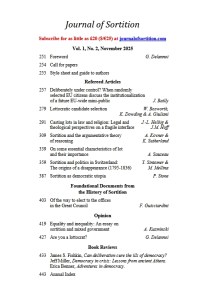
The first issue of the new Journal of Sortition is going to be published in 2025.

Keith Sutherland, the publisher, wants to emphasize that all those who register on the webpage of Imprint Academic’s sortition hub will get a free printed copy of the first issue of JoS. Please visit https://www.imprint.co.uk/sortition-hub/.

A review of mine of Alex Guerrero’s book Lottocracy will be appearing in this first issue.

The discussion around sortition and the possibility of applying it in modern political systems has been intensifying in academia over the last two decades. A debate between sortition-optimists and sortition-pessimists (as well as intermediate positions) has been taking shape. Alex Guerrero’s Lottocracy, with its over 450 pages, recaps this debate with considerable breadth while arguing for what may be perceived as the sortition-optimist position par excellence, namely, for replacing the elections-based system with one which is sortition-based.

Among some other points, I discuss how Lottocracy, like the academic discussion of sortition as a whole, adopts a Socratic viewpoint, according to which the experts are those who should shape and authorize (or choose not to do so) the use of sortition as a tool of politics.