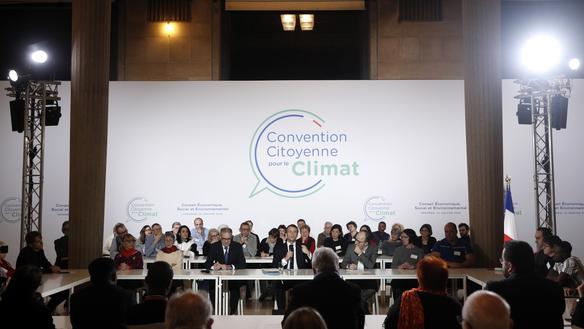
Feertchak: The Citizen Convention for the Climate does not meet with unanimity

With the Citizen Convention on the Climate publishing its report, Alexis Feertchak writes in the Le Figaro about early reactions.

The Citizen Convention for the Climate does not meet with unanimity
June 20th, 2020

The 150 allotted citizens are voting this weekend for as many environmental proposals. But since its introduction, reactions to this body have been mixed.

“Involve citizens in the governance of transportation at the local level as well as at the national level.” The “technical” tone of this proposal makes it sound more like a recommendation in report of the state bureaucracy than a conclusion of a citizen assembly chosen by lot. It is one of the points that are regularly made on the social networks: if we involve citizens directly in democratic deliberation, we should have been able to get more original results than that one.

Rather than being original, the 150 proposals or so, showing a leftist slant economically, seem quite familiar. Responding to the proposal of reducing the work week to 28 hours (a proposal that was eventually not presented), increasing the minimum wage, taxing dividends, etc., Philippe Bas, senator for [the center-right party] Les Républicains and head of the laws committee, twitted: “The results of the so-called citizen convention are a disappointment: a rehashing of the hymn book of the environmental lobby, (…) economic ignorance, total lack of legitimacy. Sortition exposed as a democratic deception!”
Continue reading →

Massol: Participative democracy: a job for professionals

Nicolas Massol writes in Liberation.

Participative democracy: a job for professionals

The growth of citizen participation initiatives, such as the Climate Convention, has been made possible thanks to a lot of organizational work by specialized businesses.

Participative democracy is not a business for amateurs. To be convinced of that, it is enough to have a look at the sophisticated organization of the Climate Convention. All this beautiful engineering was designed and put together by professionals of citizen participation. For them this unprecedented experience is going to usher in a profession of a future. It is a future which has been in the making for 20 years in which, from participative budgeting to a Grand national debate, initiatives for directly involving citizens in political decision-making have been growing, with the support of the authorities. “Municipalities account for 80% of the initiatives”, estimates Alice Mazeaud, co-author of “The market of participative democracy” (2018). The Convention, on the other hand, was financed directly by the Prime Minister’s office, to the tune of over 4 million Euros. Not enough to speak of a real “participation business”, but still enough to create a small ecosystem.

And so, the organization of the Convention was handed to a consortium of businesses: The Harris Interactive polling institute carried out the allotment, Eurogroup Consulting set up the database available to the citizens, and for moderating the discussions, Res Publica and Missions publiques – two consulting firms for participative democracy – were hired. “My profession is to make sure the collective discussion advances”, says Gilles-Laurent Rayssac, the president of the first of those. A technical role, according to Judith Ferrando, the co-director of the second one: “Our moderation techniques promote the success of deliberation, but we stay in the wings, a little like in the theater.”
Continue reading →

Allotted body to advise the German SPD

The German SPD party announced that an allotted body advising party leadership has met for the first time. The body has 20 people, randomly drawn for one year of service among party members. The newspaper Die Welt has interviews with four of the members.

The Bundestag gives sortition a spin

Ahmed Teleb wrote to point to the following Tweet thread.

Continue reading →

The French citizen convention on the climate: the endgame


Florent Gougou and Simon Persico write in La Vie des idées about the approaching culmination of the French citizen convention on the climate and how its work should be translated into policy. They find the use of a referendum particularly appealing. Also included in the article is the useful chart above comparing along several dimensions the makeup of the French National Assembly to that of members of the convention (which were selected to reflect the makeup of the French population).

Deciding together: The citizen convention on the climate and the democratic challenge

Now that the citizen convention on the climate is drawing to a close, how should the proposals of the allotted citizen be made into policy within the framework of the a democratic process? What place and shape should a referendum take within the political decision-making?

In the weekend of June 19 to 21, the 150 citizens allotted to the citizen convention on the climate will meet for the last time in order to conclude their work. Two essential points will be on their schedule. The first is finalizing the list of proposals that they will hand to the executive, and more broadly to the French people. The second is choosing the legal mechanisms by which a decision would be made regarding those proposals: executive orders, legislation or through a referendum.
Continue reading →

Dutch sortition website

Tegen Verkiezingen (Against Elections) is a dutch website informing and advocating for sortition. In addition to content in Dutch, the website has occasional news about sortition in the Netherlands in English.

A recent item, for example, describes an interview of David Van Reybrouck on Dutch TV on the topic of citizens’ assemblies on climate change – the one in France and a potential one in the Netherlands. In the interview, we learn, Van Reybrouck tells the story of how he met President Macron and how that led to the creation of the French convention citoyenne pour le climat:

Then the interviewer wants to know more on how Van Reybrouck managed to sell the concept of sortition to the French president, Mr. Macron. Van Reybrouck already told about this in the interview on BNR Newsradio a year ago, but now we get to hear some additional details. When one of the guests at the lunch table points out to Macron that Van Reybrouck is working on ‘a revolutionary model for democracy’, Macron immediately gets very interested, forgets about the food on his plate, and concludes after a thirty-minute converstation with Van Reybrouck on sortition: “C’est formidable! C’est formidable!” (That’s wonderful! That’s wonderful!) and expresses “Merci, merci infiniment!” (Thank you so much!) at the end of the conversation. Two weeks later, his prime minister started talking about sortition-based citizens’ assemblies on tv, resulting in the Convention Citoyenne pour le Climat, the French Citizens’ Assmembly (CA) on Climate Change.

Kerlouan: Macron treats the allotted citizens like children

Philippe Kerlouan writes in Boulevard Voltaire.

Citizen Climate Convention: Macron treats the 150 allotted citizens like children…

One may ask oneself how can 150 citizens, selected by lot in order to create proposals for addressing global warming, be “France in miniature” and represent “all the significant sections of French society”, as the co-president of the governance committee of the Climate Convention asserted they are. One must believe that the allotment was balanced according to some statistical measurements. But nevermind! The Athenian democracy at the time of Pericles designated numerous officials using a lottery. Chance is maybe the most effective way to turn equality for all and social-professional diversity into a democratic system.

We should also have confidence in the people so selected and not consider them second class citizens. As they met on Friday, January 10th for another weekend of work, they were able to pose questions to Emmanuel Macron, who attend in person for the occasion. No doubt he had nothing better to do in these troubled times. One of the participants, quoted by the Le HuffPost, observed that it is “scandalous that he chose this date in order to clown around in front of the Convention whereas he would have done better to take care of the pensions”. But our president must have had his reasons.
Continue reading →

An interview with a member of the French Citizen Climate Convention

In January, Le Télégramme interviewed Denis Boucher, a member of the French Citizen Climate Convention:

How is the convention organized?

We are 150 citizens of all ages and walks of life, including some who are younger than 18 and others who live in overseas France. There is great diversity and I believe that we represent French society quite well. We gather one weekend each month for a session of three days. We work around five themes dealing with the objective of reaching a 40% reduction in greenhouse gas emissions by 2030: food, transportation, housing, consumption, and production. I am part of the housing theme. The allocation to themes was by sortition – that is the principle of the convention. We reject expertise from the outset and it is normal citizens who express themselves, whoever they may be. It is an altogether original organization which really embodies direct democracy. It is a little like the citizens of Ancient Greece would discuss the issues of the city in the agora.

Where are you now in the process?

We are in the fourth session and we just finished the latest weekend of work. After 4 months during which we heard numerous speakers and understood the climate and the objectives we are now entering into the thick of it. We are going to propose measures that will become bills of legislature, decrees or constitutional amendments. That is not going to be easy!
Continue reading →

Comments by members of the French Citizen Climate Convention

Thomas Baïetto of Franceinfo has talked to 9 members of the French Citizen Climate Convention and reports their comments about their work.

Sylvain, a 45 year old Parisian marketing manager, says that before he was allotted he used to be “a cynical Parisian” rahter than an environmental activist. He does not hide his enthusiasm about this assembly of “citizen superheros, somewhere between Jaurès and Léon Blum” and about its complex mission.

“I was skeptical at first. I was thinking that these 150 people, if there were as ignorant as I am , that is going to be difficult,” says Grégoire, 31 year old from Caen. The first months of work, spread over a several weekend sessions in Paris, have convinced him that there is a possibility of formulating proposals that are “strong, powerful and acceptable by the population.”

Continue reading →

Mellier-Wilson: More on the Convention Citoyenne pour le Climat

Claire Mellier-Wilson, “Systems Change and Participation Practitioner”, has a lengthy and informative article about the French Citizen Climate Convention, with details about its origins, its organization, proceedings and schedule and the people and bodies involved.

One rather interesting detail is as follows:

Themes and group work

Alongside plenary discussions where all 150 citizens stay together, the Convention members are also working in groups.

The 150 citizens have been split into five groups of 30 people covering five themes: ‘Se deplacer’ transport, ‘Se nourir’ food, ‘Consommer’ consumption, ‘Travailler et produire’ work and production, ‘Se loger’ housing. The selection of the citizens in each group was done by lot in order to prevent people from choosing their preferred subjects and this introducing an element of bias into the process.

A cross-cutting group, called ‘escouade’ was created after the second session in November 2019, at the request of the citizens, in order to look at overarching topics relevant to all five themes such as: the financing of measures, communication, engagement, education and training, constitutional reform, energy production and consumption, protection of the natural environment and biodiversity. An overview of the transverse topics can be found in the summary of session 3. However, it emerged that this cross-cutting group, based on the self-selection principle (rather than selection by lot) presented issues of legitimacy and had process implications, as it did run in parallel with the other five groups, and in effect was preventing people from being fully engaged with their original topic. Also, due to the subjects covered in the escouade (i.e. constitutional reform, finances etc.), it created tensions around the perceived more strategic nature of that group. As a result, the Governance Committee decided to suspend the escouade. Going forward, the topics from the escouade will be dealt with via different mechanisms as announced by Thierry Pech, Co-chair of the Convention, at the end of Session 4.