Cirone: Lotteries in Political Selection

A 2019 paper by Alexandra Cirone, Assistant Professor of Government at Cornell University, is titled “When democracy is broken roll the dice: Lotteries in political selection”.

There is a long tradition in political science and law that analyzes the benefits of lotteries in political selection (Manin 1997; Elster 1989; Engelstad 1989; Dowlen 2009; Duxbury 1999; Ober 1993 among many others). Most readers will be familiar with selection by lottery – also called sortition – where individuals are randomly chosen for political office.

The element of chance in a lottery has always captured our imaginations. Yet from a policy perspective, lotteries are now being proposed in various forms to address democratic deficits. Lottery-based selection of high-ranking politicians have been suggested for the national parliaments of the UK and France, as well as for the supranational institutions of the European Union. Citizens assemblies have been implemented in a wide range of countries, at both the local and national levels (Fishkin 2011).

However, lottery-based political selection is no panacea. There are a number of shortcomings to these processes. First, no matter which selection rule, it is likely that elites can still be disproportionately involved in politics, and lotteries don’t insulate all democratic institutions from partisan or corrupt pressures. Second, politics benefits from investment in expertise and career politicians; the uncertainty inherent in random selection of permanent institutions could disincentivize potential candidates from acquiring skills or experience. Alternatively, problems with recruitment and attrition from selected citizens will always be an issue with lottery-based selection; and randomly chosen officials might lack democratic legitimacy, which could impair their ability to do their job well. Third, even implementing lotteries in the form of temporary citizens assemblies require time, resources, and careful design of the process. Lotteries are also difficult to endogenously implement, particularly at top levels of governance — political parties and other groups are too invested in current systems of selection, so it is unlikely we will see a return to the pure sortition of ancient times.

Still, there is distinct promise to the use of lotteries in political selection, to help include more citizens in the democratic process. By examining unique institutional experimentation in the past, and by adapting democratic initiatives based on more recent instances of lottery-based selection, it may be possible to alleviate current democratic shortcomings.

Citizens allotted for drawing electoral districts in Michigan

Back in January it was reported that Michigan has sent out invitations to voters to apply to serve on the Independent Citizens Redistricting Commission. 13 citizens have now been selected to serve on the commission “charged with drawing new district lines for members of the state House and Senate”.

The commission is being assembled as a result of a November 2018 ballot proposal, Proposal 2 which passed with support from 61% of voters. Redistricting was previously handled by the Michigan legislature and approved by the governor, which, Proposal 2 supporters pointed out, allowed politicians to set their own district lines.

Despite the rather limited purview of the commission, it has two important characteristics that set it as an independent source of political power and thus lend it importance. First, the body was constituted through a ballot measure. Thus it was legitimated and mandated directly by the citizens. Second, the body’s function is to supervise, and indeed to limit the power of, the elected officials.

Information about the allotment is available on the state government website. Some of the skews in the applications demographics are quite interesting.

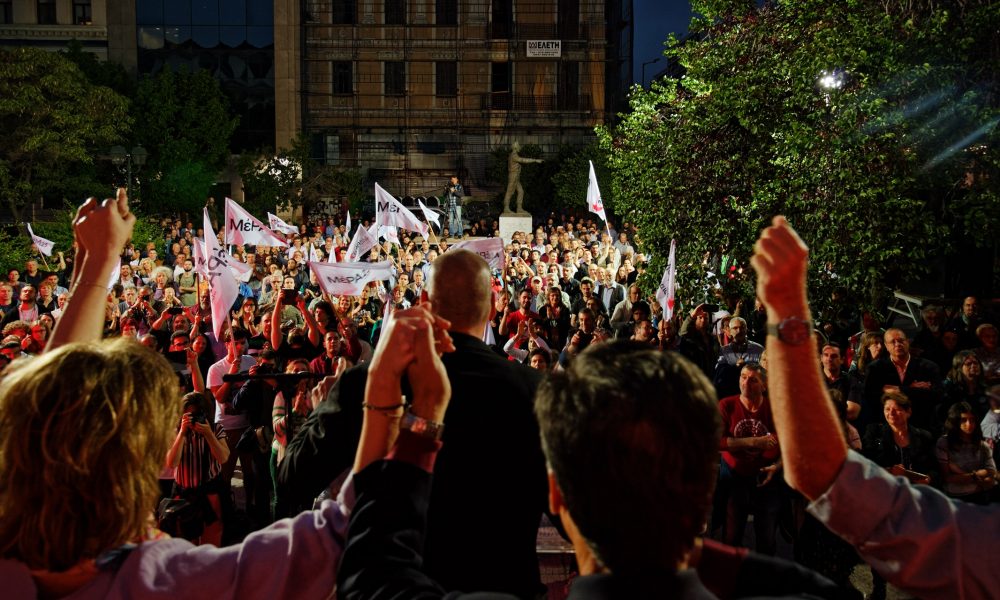
MeRA25 and sortition

MeRA25 is a Greek party headed by former Syriza finance minister Yanis Varoufakis. MeRA25 has recently made two moves pushing sortition forward in the Greek political agenda.

First, in July MeRA25 tabled a bill proposing that senior public servants would be elected by an allotted committee. The bill calls for

Establishment of a new, autonomous General Secretariat for Public Revenue, whose General Secretary will be selected by neither the government nor the lenders. Instead, they will be elected by a Social Committe for Selection of Senior Personnel, 1/3 of which is comprised of parliamentarians, 1/3 by judges selected by sortition and 1/3 by tax professionals – accountants selected by sortition.

Secondly, MeRA25 is selecting its own central committee members with some of them selected by election, some by appointment and some by sortition:

The 1st Central Committee is comprised of the members of the current Extended Political Secretariat, 15 members chosen by sortition amongst all MeRA25 members (who are also DiEM25 members), 2 members from every Administrative Region (excluding Attica) put forward by the Secretary in concert with the Committee for the Organisation of the Congress and Movement Outreach, and 1 member from every electoral district, selected by the members of that district through e-voting.

60% of the French perceive the Citizen Climate Convention as legitimate

Soon after the release of the proposals of the French Citizen Climate Convention, the Elabe polling institute conducted a poll regarding the attitudes of the French population to the Convention. Like the Odoxa poll, the Elabe poll finds [PDF] that large majorities among the French see the convention’s work as useful and support most of the proposals. Notably, the proposal for a 4% tax on big businesses in order to invest in environmental transition – a proposal that was rejected by Macron – enjoys the support of 83% of those polled.

Most interestingly, the Elabe poll goes farther than the Odoxa poll in asking about the legitimacy of the Convention process itself rather than merely about its outcomes. By a margin of 60% to 39%, the French see the Convention as having legitimacy to make proposals in the name of all the citizens. Support is even higher among the young: 70% in the 25-34 age group and 78% in the 18-24 age group.

The French overwhelmingly support the proposals of the Climate Convention

An opinion poll conducted by the Odoxa polling institute after the release of the proposals of the French Citizen Climate Convention reveal that large majorities support the proposals made by the convention.

Among the top billed proposals, amending the constitution to include preservation of the environment was supported by 82% of those polled. 74% supported mandatory environmental retrofitting of buildings, and 52% supported the creation of “ecocide” as a new form of crime. On the other hand, the proposal to lower the speed limit on the freeway to 110 km/h was met with disapproval by 74% of those polled.

Generally, 62% of those who have heard of the proposals made by the Convention supported them, and majorities felt they were realistic and effective. While 81% of those polled supported putting the proposals to a referendum 73% believed that only a small part of them would be put into effect.

Malcolm Gladwell on sortition

Malcolm Gladwell is a well-known popular science author. Gladwell has a podcast called “Revisionist History”. A recent episode of the podcast is devoted to sortition, with much of it being about Adam Cronkright’s work in applying sortition to student bodies in schools in Bolivia. Gladwell himself visits a school in the US and finds that the students are receptive to the idea. He also mentions the idea of using a lottery to allocate research funds.

Bellon: The sortition pandemic

A column by André Bellon, July 7th, 2020.

This is not the first time that I opine on sortition, but addressing this matter seems to me more and more necessary in view of the avalanche of commentary which has accompanied the celebrated “Citizen Convention for the Climate”.

If the advocates of sortition were able to appear for a while like dreamers, they are now showing their toxicity. They are now are now no longer merely asking us for a convention aimed to enlighten public decision making. They are now demanding an allotted parliament. Considering, with much justice, that the elected do not represent the voters any more, they are not trying to redefine the mandate of the elected. They are proposing to suppress the voters.

An so, Jacques Testart conjures up an allotted constitutional assembly. Just that! The legal expert Dominique Rousseau, who constantly criticizes universal suffrage – which he falsely associates with abbé Sieyès – asks for a new deliberative assembly formed by sortition. To justify his request, he declares: “The nation has its chamber, then national assembly. The territories have theirs, the senate. The citizens, who are everything in society but nothing in its institutions, should have their chamber as well”. Beyond this far-fetched argument, Rousseau feels that in order to be truly represented, the citizens should no longer be voters. To be consistent, he opposes the popular initiative process (référendum d’initiative citoyenne) because it could “ask about the reestablishment of the death penalty, citizen preference or the preventative detention of sexual deviants?”.
Continue reading →

Macron “accepts all but three” of the CCC’s 149 recommendations

RFI reports:

A day after a powerful push by the Greens in French municipal elections, President Emmanuel Macron on Monday vowed to speed up environmental policies – promising an extra €15 billion to fight global warming over the next two years, and throwing his support behind two referendums on major climate policy.

Macron was responding to proposals put forward by the 150-member Citizens Climate Convention (CCC), a lottery of French people chosen to debate and respond to the climate challenges facing society.

During a meeting in the gardens of the Elysée Palace, Macron told convention members that he accepted all but three of their 149 recommendations which would, he promised, be delivered to parliament “unfiltered”.
Continue reading →

Feertchak: The Citizen Convention for the Climate does not meet with unanimity

With the Citizen Convention on the Climate publishing its report, Alexis Feertchak writes in the Le Figaro about early reactions.

The Citizen Convention for the Climate does not meet with unanimity
June 20th, 2020

The 150 allotted citizens are voting this weekend for as many environmental proposals. But since its introduction, reactions to this body have been mixed.

“Involve citizens in the governance of transportation at the local level as well as at the national level.” The “technical” tone of this proposal makes it sound more like a recommendation in report of the state bureaucracy than a conclusion of a citizen assembly chosen by lot. It is one of the points that are regularly made on the social networks: if we involve citizens directly in democratic deliberation, we should have been able to get more original results than that one.

Rather than being original, the 150 proposals or so, showing a leftist slant economically, seem quite familiar. Responding to the proposal of reducing the work week to 28 hours (a proposal that was eventually not presented), increasing the minimum wage, taxing dividends, etc., Philippe Bas, senator for [the center-right party] Les Républicains and head of the laws committee, twitted: “The results of the so-called citizen convention are a disappointment: a rehashing of the hymn book of the environmental lobby, (…) economic ignorance, total lack of legitimacy. Sortition exposed as a democratic deception!”
Continue reading →

Massol: Participative democracy: a job for professionals

Nicolas Massol writes in Liberation.

Participative democracy: a job for professionals

The growth of citizen participation initiatives, such as the Climate Convention, has been made possible thanks to a lot of organizational work by specialized businesses.

Participative democracy is not a business for amateurs. To be convinced of that, it is enough to have a look at the sophisticated organization of the Climate Convention. All this beautiful engineering was designed and put together by professionals of citizen participation. For them this unprecedented experience is going to usher in a profession of a future. It is a future which has been in the making for 20 years in which, from participative budgeting to a Grand national debate, initiatives for directly involving citizens in political decision-making have been growing, with the support of the authorities. “Municipalities account for 80% of the initiatives”, estimates Alice Mazeaud, co-author of “The market of participative democracy” (2018). The Convention, on the other hand, was financed directly by the Prime Minister’s office, to the tune of over 4 million Euros. Not enough to speak of a real “participation business”, but still enough to create a small ecosystem.

And so, the organization of the Convention was handed to a consortium of businesses: The Harris Interactive polling institute carried out the allotment, Eurogroup Consulting set up the database available to the citizens, and for moderating the discussions, Res Publica and Missions publiques – two consulting firms for participative democracy – were hired. “My profession is to make sure the collective discussion advances”, says Gilles-Laurent Rayssac, the president of the first of those. A technical role, according to Judith Ferrando, the co-director of the second one: “Our moderation techniques promote the success of deliberation, but we stay in the wings, a little like in the theater.”
Continue reading →