Josine Blok reviews Pope’s The Keys to Democracy

Josine Blok, a historian from Utrecht University, has a review of Maurice Pope’s The Keys to Democracy in H-Soz-Kult. In the last two paragraphs of the review, Blok gives her opinion about the substance of the book:

The quality of the argument is in my view quite uneven. Some of the political analyses and in particular the historical sections suffer from oversimplification, generalisation, and special pleading. For instance: “The political ideals and most of the political practices of Western civilisation go back through Venice and ancient Rome to classical Greece.” (p. 115). No, they don’t, this is simply not true, nor is Pope’s account of how sortition got “lost” in the course of history. On p. 123, Pope contends: “It would be possible […] to define history itself as the story of how experts have been proved wrong. For otherwise […] it would not be history at all, but current practice. […examples in] the history of science. Being history, it is possible to tell which side was wrong.” This view of history is simply bizarre. If Pope resorted to such sweeping statements to help easy reading, I don’t think they are the proper means to that end.

But, making up for such drawbacks, Pope offers excellent observations on deliberation as a crucial ingredient of democracy and on the potential of sortition to prevent oligarchisation (the “law of Michels”), meritocracy and other problematic forms of hierarchy. Sortition enables implementing the equality of citizens and bringing their engagement in policy making about. Importantly, Pope points out that sortition, whenever it is employed, must be rigorous and compulsory to be effective, and allotted bodies must be selected from the whole population (p. 167; complemented by the outstanding comment by Potter in the appendix). He underlines that allotted panels of citizens must have moral authority and real responsibility (to which should be added a transparent system of accountability). Written with an open, engaging style, The Keys to Democracy is set to win a wider audience for its important and pressing message.

Quality of representation through sortition is assured using appropriate prerequisites

In my article Democracy through sortition I mentioned that sortition is a tool and not an end in itself. That means for sortition to work it needs to be subject to certain constrains. This condition is neglected by many followers of sortition and that creates a problem, at least in when trying to make a political system to operate democratically. One such problem is created, concerning quality of representation in a legislative body, like a parliament, when sortition neglects to take into consideration the use of prerequisites.

Sortition was used in the first democracy in ancient Athens, in order to select, from teams of volunteers, 500 parliamentarians for a term of one year, 50 from each of the 10 districts with equal population. The prerequisites for one to be selected through sortition as a member of parliament in a district were: He had to be a Greek, a member of a district, 30 years of age and older among others. The question may arise as to whether these prerequisites were sufficient in order for the representation to be, concerning its quality, sufficiently appropriate. The operation of that parliament started around 509 B.C. and for more than half a century the parliamentarians, while working all year around, were not paid for their services. So the members of a district that were working for a living, even if they wanted to be among those in the teams of volunteers, it was, objectively, not possible and there were many of them. Another difficulty for the citizens to participate was the distance to Athens from the place they lived, which to many of them was a major obstacle. In any case the fact is that, even in the first democracy, prerequisites were used!

Continue reading

Under sortition, no matter what your cause is, you have no lever to force the government to act

Adam Lee writes a polemic for sortition in OnlySky, a website billing itself as being “dedicated to protecting America’s secular democracy through reality-based journalism, storytelling, and commentary”. Lee covers standard ground – Athens using sortition and rejecting elections, the statistical representativity of allotted bodies, the unrepresentativity of elected bodies, Ireland’s use of sortition. (One thing that I have not heard before is that Ireland will soon have another constitutional referendum for adopting or rejecting a proposal by the allotted constitutional convention, this time for deleting Article 41.2 of the Irish constitution which is concerned with making sure mothers do not neglect “their duties at the home”.)

Lee offers two potential problems with a sortition-based system. The first is the statistical possibility of unrepresentative samples:

What if we choose 100 representatives by lot and get 75 QAnon-believing evangelicals? A legislature that’s far out of the mainstream could wreak tremendous harm or radically reshape society in disastrous ways.

The other is problem is that

even if [the system is] representative, it wouldn’t necessarily be responsive. People mounting a campaign on issues that matter to them is one of the safety valves of democracy. If there’s a problem that the government is ignoring—anything from potholed streets to rampant gun violence to unpopular wars—someone can, and probably will, run for office on a platform of fixing it.

Under sortition, that’s impossible. No matter what your cause is, you have no lever to force the government to act. You have to sit back and hope that someone who shares your views gets chosen on the next go-round.

Lee concludes:

Despite these problems, I can see real potential for sortition—if not as the sole basis for government, then maybe as a component of it. What if, instead of a House and a Senate, we had one democratically elected chamber and one made up of citizens chosen by lot?

Rancière: The scandal of sortition

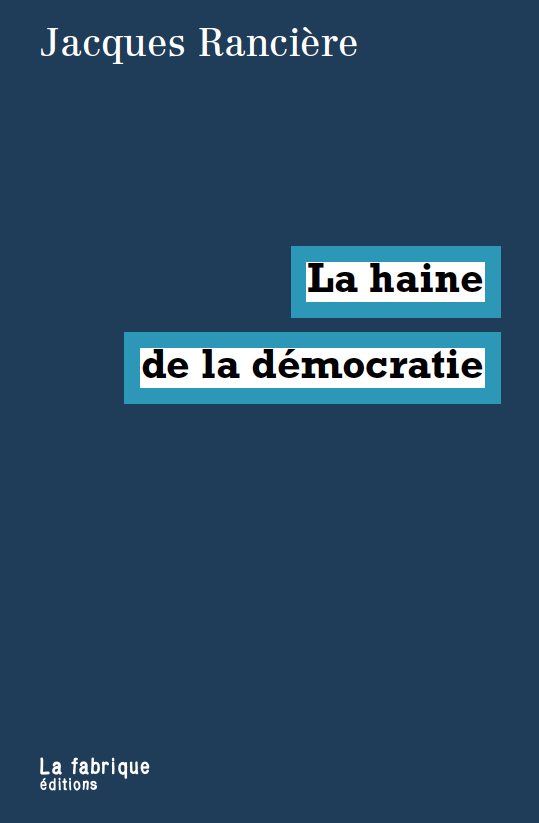
The second chapter of Jacques Rancière’s Hatred of Democracy (2005), “Politics, or the Lost Shepherd”, contains a fairly long discussion of sortition and its relation to democracy. The following paragraph is from page 41 of the English translation:

The scandal [of sortition] is simply the following: among the titles for governing there is one that breaks the chain, a title that refutes itself: the [Plato’s] seventh title is the absence of title. Such is the most profound trouble signified by the word democracy. It’s not a question here of a great howling animal, a proud ass, or an individual pursuing pleasure for his or her own sake. Rather is it clearly apparent that these images are ways of concealing the heart of the problem. Democracy is not the whim of children, slaves, or animals. It is the whim of a god, that of chance, which is of such a nature that it is ruined as a principle of legitimacy. Democratic excess does not have anything to do with a supposed consumptive madness. It is simply the dissolving of any standard by which nature could give its law to communitarian artifice via the relations of authority that structure the social body. The scandal lies in the disjoining of entitlements to govern from any analogy to those that order social relations, from any analogy between human convention and the order of nature. It is the scandal of a superiority based on no other title than the very absence of superiority.

This is somewhat reminiscent of the “blind break” argument for sortition (by eliminating all reasons for selection, bad reasons are eliminated as well). Later on, for example, Rancière emphasizes the fact that when using sortition seeking power is not a prerequisite to attaining it. But the tone here is quite different. The emphasis is on rejecting traditional or “natural” reasons, reasons that dominate social relations throughout, reasons that justify the elevated status of established elites. It is the rejection of those traditional reasons that scandalizes those elites, as well as many among the masses who have internalized the justness or naturalness of those “distinctions”.

The puppet show of modern accountability: How allotment could help

The more I’ve thought about sortition or as I call it “representation by sampling” the more profound I find the ways it differs from representation by election. The latter is inherently competitive and performative and both these things tend to undermine the bona fides of people’s contribution to discussion. They minimise rewards for listening and maximise the rewards for assertive speech.

Performance, especially performance before those with greater power saturates our daily lives. Hence the following passage from an anonymous local government bureaucrat.

I spent 10 years of my life writing. I wrote neighbourhood plans, partnership strategies, the Local Area Agreement, stretch targets, the Sustainable Community Strategy, sub-regional infrastructure plans, funding bids, monitoring documents, the Council Plan and service plans.

I have a confession to make. Much of it was made up. It was fudged, spun, copied and pasted, cobbled together and attractively formatted. I told lies in themes, lies in groups, lies in pairs, strategic lies, operational lies, cross-cutting lies. I wrote hundreds of pages of nonsense. Some of it was my own, but most of it was collated from my colleagues across the organisation and brought together into a single document.

Why did I do it? …[B]ecause it was my job.

The Greek political principle of parrhēsia is directed specifically against this kind of tendency — in our language it is the taking of risk to speak truth to power. But it is a distinctly modern form of speech — in which the warrant for its truthfulness (whether scientific or political) is not its persuasiveness to others, but it’s truthfulness to the speaker — it is the speaking of one’s own truth, and that truth is demonstrated by the speaker’s heedlessness of the consequences of his truth-telling.

In any event, in the discussion recorded above I argue the scope for sortition to help us escape from this trap. The audio file is also available here.

Psychologizing the electoralist phenomenon

Steve Taylor, a Senior Lecturer in Psychology at Leeds Beckett University wrote a piece in The Conversation offering his explanation for trouble with the electorlist system. Taylor writes:

The ancient Greeks practised direct democracy. It literally was “people power”. And they took measures specifically to ensure that ruthless, narcissistic people were unable to dominate politics.

Recent political events show that we have a great deal to learn from the Athenians. Arguably, a key problem in modern times is that we aren’t stringent enough about the people we allow to become politicians.

There’s a great deal of research showing that people with negative personality traits, such as narcissism, ruthlessness, amorality or a lack of empathy and conscience, are attracted to high-status roles, including politics.

In a representative democracy, therefore, the people who put themselves forward as representatives include a sizeable proportion of people with disordered personalities – people who crave power because of their malevolent traits.
Continue reading

Peter Jones: The lost art of persuasion

In his column “Ancient and Modern” published in the Spectator Australia, Peter Jones warns his readers against the “Maoist re-education” of the young, generated by the “cancellation” tactics wielded by those “urging gender changes on children who rather feel like it”. In the process, Jones gives his readers a sketch of the Athenian system, including its reliance on sortition, presenting it as a model of good government, where policy was decided based on debate, persuasion and “peaceful agreement”, rather than the outrageous tactics he decries.

Despite mentioning selection by lot, Jones ignores the role of the allotted Council in Athenian politics. When talking about “the all-powerful Assembly” Jones does not consider the question of whether this Assembly in reality provided an arena where isegoria was more than a formality. It also remains unclear whether Jones advocates for the radical change that would be required in order to turn the Western political system into something that is more akin to the Athenian system and providing “more political control over tyrants and oligarchs”. His focus on activists causing an “uproar and silently glueing [themselves] to tarmac” may indicate that leaving those aside we are already living in a system which embodies the ideals of democracy. An off-handed comment about the “rights” of free speech being “rescindable” may also provide a hint regarding Jones’s mindset.

What would ancient Greeks have made of the current protests relating to the oil industry and identity reassignment? Very little indeed.

The Greek invention of democracy (‘people power’) emerged in the late 6th century bc after strong popular demand for more political control over tyrants and oligarchs. The result was a system in which all male citizens over 18 debated and determined all political questions in the regular Assemblies. Most official posts were held, usually for one year, by citizens who presented themselves for selection by lot (voting was considered meritocratic, not democratic), with serious consequences for failure.
Continue reading

Bertrand Russell on Athenian democracy

In his 1945 book History of Western Philosophy Betrand Russell writes the following (p. 74):

Athenian democracy, though it had the grave limitation of not including slaves or women, was in some respects more democratic than any modern system. Judges and most executive officers were chosen by lot, and served for short periods; they were thus average citizens like our jurymen, with the prejudices and lack of professionalism characteristic of average citizens.

It is remarkable that the reason given for the Athenian system being more democratic than modern systems is not the standard superficial argument about the Assembly voting directly on laws. Russell’s appeal to the fact that Athenian judges and officers had, as a result of being chosen by lot, the same outlook as the average citizen is an adumbration of Manin’s pure theory of elections (“the principle of distinction”).

Sintomer: The Government of Chance

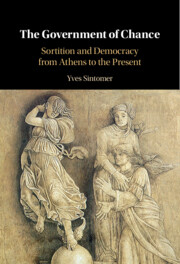
French political scientist Yves Sintomer has published a new book dealing with sortition called The Government of Chance: Sortition and Democracy from Athens to the Present.

The publisher, Cambridge University Press, provides a(n apparently auto-translated) book description:

Electoral democracies are struggling. Sintomer, in this instructive book, argues for democratic innovations. One such innovation is using random selection to create citizen bodies with advisory or decisional political power. ‘Sortition’ has a long political history. Coupled with elections, it has represented an important yet often neglected dimension of Republican and democratic government, and has been reintroduced in the Global North, China and Mexico. The Government of Chance explores why sortation is returning, how it is coupled with deliberation, and why randomly selected ‘minipublics’ and citizens’ assemblies are flourishing. Relying on a growing international and interdisciplinary literature, Sintomer provides the first systematic and theoretical reconstruction of the government of chance from Athens to the present. At what conditions can it be rational? What lessons can be drawn from history? The Government of Chance therefore clarifies the democratic imaginaries at stake: deliberative, antipolitical, and radical, making a plaidoyer for the latter.

Continue reading

“A Random Group of People” editorial in Seattle and town hall on Citizens’ Assemblies

the Stranger, perhaps Seattle’s most widely read newspaper, has recently published an editorial by Ansel Herz, a former Congressional staffer in DC, now serving as communications director for Democracy Next, recently founded by Claudia Chwalisz (of OECD & Parisian Citizens’ Assembly fame).

In fact, this is what “democracy” actually is. In the 5th century B.C., the Greeks of ancient Athens coined demokratia to describe their carefully designed lottery system, under which any citizen was able to serve in parliamentary, administrative, and judicial bodies. Demokratia is not politicians, elections, and parties; the Greeks would have abhorred those, as many ordinary people—perhaps even you—do to this day.

“Their greatest gift was their passion for democracy,” observed the Trinidadian writer C.L.R. James in his 1956 essay, “Every Cook Can Govern”. The Athenians believed that elections were undemocratic; Aristotle called them “oligarchic.” It’s common sense that when only a handful of people can hold power, corruption is likely.

The Greeks recognized that whoever runs for elected office in the first place usually projects a peculiar power-seeking personality type. Having spent a lot of time around candidates who’ve won and lost, let me tell you: the Greeks were right.

After introducing sortition, Herz mentioned America in One Room, the Irish Citizens’ Assembly, and Brussels’s recent introduction of its own permanent CA.

In 2019’s “America In One Room”, for example, Stanford researchers organized an assembly of 526 Americans to deliberate for a long weekend. The group did not combust from anger and tension, nor did the participants retreat to their bubbles and cling to their beliefs. They found common ground around issues of trade, wages, immigration, and more. Democrats reported a 13-point increase in positive feelings toward Republicans; Republicans felt 14 points more favorably toward Democrats. Ninety-five percent of participants said they “learned a lot about people very different from me,” and 98 percent said they found the experience “valuable.”

Continue reading