The “classical” justification for democracy was that it is, or should be, rule by an informed public opinion acting, after deliberation, in the public interest.
Investigations, especially by post-war political science, discovered that the democracy we have actually got is not the classical model the Founders had in mind, but in fact mostly the rule of factions and partisans, which the Founders dreaded.
Factions include organized pressure groups and other “players.” They are only fitfully concerned—truly and wisely concerned—with the public interest.
Some political scientists have called this system “pluralism” or “polyarchy” (the rule of many); others have called it “interest group liberalism.” Both have concluded that elections are a mostly ceremonial affair and that it is unrealistic to expect (width-first) democracy to function in any very different way. They have also mostly concluded that polyarchy’s scramble isn’t so bad, especially compared to totalitarianism.
They hope that they may persuade you, that since it is impossible to do any good, you may as well have your share in the profits of doing ill. —Edmund Burke, The Philosophy of Edmund Burke, p. 148.
Chris Forman, PhD, an Author, and Fellow of the Royal Society of the Arts was interviewed on the Unity Now podcast and discussed his advocacy for Deliberative Democracy and how it relates to his work in physics. Forman discusses how he inadvertently created a deliberation process, how this process can be adopted in the West, and how we can protect it from power-hungry individuals.
Josine Blok, a historian from Utrecht University, has a review of Maurice Pope’s The Keys to Democracy in H-Soz-Kult. In the last two paragraphs of the review, Blok gives her opinion about the substance of the book:
The quality of the argument is in my view quite uneven. Some of the political analyses and in particular the historical sections suffer from oversimplification, generalisation, and special pleading. For instance: “The political ideals and most of the political practices of Western civilisation go back through Venice and ancient Rome to classical Greece.” (p. 115). No, they don’t, this is simply not true, nor is Pope’s account of how sortition got “lost” in the course of history. On p. 123, Pope contends: “It would be possible […] to define history itself as the story of how experts have been proved wrong. For otherwise […] it would not be history at all, but current practice. […examples in] the history of science. Being history, it is possible to tell which side was wrong.” This view of history is simply bizarre. If Pope resorted to such sweeping statements to help easy reading, I don’t think they are the proper means to that end.
But, making up for such drawbacks, Pope offers excellent observations on deliberation as a crucial ingredient of democracy and on the potential of sortition to prevent oligarchisation (the “law of Michels”), meritocracy and other problematic forms of hierarchy. Sortition enables implementing the equality of citizens and bringing their engagement in policy making about. Importantly, Pope points out that sortition, whenever it is employed, must be rigorous and compulsory to be effective, and allotted bodies must be selected from the whole population (p. 167; complemented by the outstanding comment by Potter in the appendix). He underlines that allotted panels of citizens must have moral authority and real responsibility (to which should be added a transparent system of accountability). Written with an open, engaging style, The Keys to Democracy is set to win a wider audience for its important and pressing message.
In an article in The Boston Globe, James Fishkin and Larry Diamond recount the story, a rather familiar and standard one, of how the participants in a deliberative body became “depolarized” and more democratic.
When our nationally representative sample of 600 (selected by NORC at the University of Chicago) deliberated for a weekend about these issues, Republicans often moved significantly toward initially Democrat positions and Democrats sometimes moved just as substantially toward initially Republican positions. The changes were all consonant with basic democratic values, such as that everyone’s vote should count and that our elections need to be administered in a nonpartisan way.
The novelty of Fishkin and Diamond’s latest deliberative workshop is that it was done on the cheap. The participants met online, saving travel and real-estate costs as well as reducing the commitment required of the participants, and where previously moderators had to be hired, moderation was now taken care of by AI magic: Continue reading →
Thierry Beaudet is the President of the French Economic, Social and Environmental Council (CESE), the body which organized the French allotted bodies which discussed environmental policy and end-of-life policy. He has now published a book in which he advocates the use of sortition as a tool of democracy. The book is described by the publisher as follows:
The trappings of our democracy are falling apart: elections are no longer adequate for the task, and there is general distrust toward every authority and every power. Facing this crisis, new political practices assert themselves, practices which engage and refer to the citizen body. Citizen participation, still in its beginning in our country, must develop, through sortition, the exercising of collective deliberation, the systematic collaborative construction of public policy. Thierry Beaudet, the President of the Economic, Social and Environmental Council, proposes that we learn how to remake democracy and to discuss together substantive issues rather than keep rehashing divisions in a vacuum.
French political scientist Yves Sintomer has published a new book dealing with sortition called The Government of Chance: Sortition and Democracy from Athens to the Present.
The publisher, Cambridge University Press, provides a(n apparently auto-translated) book description:
Electoral democracies are struggling. Sintomer, in this instructive book, argues for democratic innovations. One such innovation is using random selection to create citizen bodies with advisory or decisional political power. ‘Sortition’ has a long political history. Coupled with elections, it has represented an important yet often neglected dimension of Republican and democratic government, and has been reintroduced in the Global North, China and Mexico. The Government of Chance explores why sortation is returning, how it is coupled with deliberation, and why randomly selected ‘minipublics’ and citizens’ assemblies are flourishing. Relying on a growing international and interdisciplinary literature, Sintomer provides the first systematic and theoretical reconstruction of the government of chance from Athens to the present. At what conditions can it be rational? What lessons can be drawn from history? The Government of Chance therefore clarifies the democratic imaginaries at stake: deliberative, antipolitical, and radical, making a plaidoyer for the latter.
Antoine Vergne (of Mission Publique) and I were invited guests on the American cultural center Hamburg’s podcast for two episodes over the last two weeks.
The discussion was much too short to be anything new to regular readers of EbL, but I wanted to post it as another sign of the mainstream acceptance of the idea of sortition. Another disclaimer, the Amerikazentrum is a propaganda outfit for the US & German foreign ministries. So, as expected, the framing of the show starts with cliched talking points about Brexit, Ukraine, autocracy v. democracy, etc…
I think the discussion went slightly beyond the “representation” argument. In particular, Antoine made some interesting points about the non-adversarial nature of assemblies as compared to referenda. Quite interesting for me was his story about how he happened upon “Stochacracy.” As an undergraduate, I believe, he wrote a research paper that ended with the line: “Stochocrats of the world unite!”
My own intervention was not particularly interesting but I tried to reference a variety of literature including democratic critiques of allotted minipulbics in the show notes.
For proponents of deliberative democracy, the last couple of years could not have been better. Propelled by the recent diffusion of citizens’ assemblies, deliberative democracy has definitely gained popularity beyond small circles of scholars and advocates. From CNN to the New York Times, the Hindustan Times (India), Folha de São Paulo (Brazil), and Expresso (Portugal), it is now almost difficult to keep up with all the interest in democratic models that promote the random selection of participants who engage in informed deliberation. A new “deliberative wave” is definitely here.
But with popularity comes scrutiny. And whether the deliberative wave will power new energy or crash onto the beach, is an open question. As is the case with any democratic innovation (institutions designed to improve or deepen our existing democratic systems), critically examining assumptions is what allows for management of expectations and, most importantly, gradual improvements. Continue reading →
Many of us are part of a movement that melds three ideas: sortition, deliberation and democracy. But we don’t have a widely-accepted name for our movement.
Deliberative democracy could be that term. However, it has a major deficiency: outside our movement it only means two of our three central tenets. I did not find any mention of the terms lottery or sortition in the entry for deliberative democracy in Britannica, Wikipedia or The Free Dictionary. In other words, the references that many people consult to learn about the topic don’t reflect our movement.
Is there an effort to make changes to popular reference sources? Is deliberative democracy the best term for our movement? Should the term deliberative democracy embrace sortition?



 Josine Blok, a historian from Utrecht University, has a


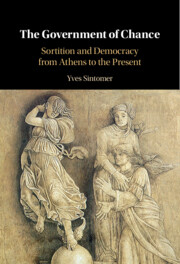 French political scientist Yves Sintomer has published
  Antoine Vergne (of Mission Publique) and I were invited guests on the American cultural center Hamburg’s podcast for two episodes over the last two weeks.
 Adam Cronkright
 Ali
Ali Ahmed R. Teleb
 avanderven
 avergne
 Alex Kovner
 azakaras
 Brett Hennig
 campbellwallace
 Simon Threlkeld
 Nick Coccoma
 codyhipskind
 Common Lot Sortitionist
 Conall Boyle
 constitutionalism
 davidschecter
 Ethan McCutchen
 graytmatter
 gtridimas
 Henry Tuttle
 H.J. Hofkirchner
 HpR
HpR Carl Lundgren
 James Kierstead
 John Burnheim
 jgarry20151
 Jochen Krattenmacher
 johnedwardtaylor
 johnhuang865
 Jonathan Crock
 keithsutherland
 Jacob Richter
 kkoreilly
 lukewhito
 SimonPek
 Nathan El
 Nicholas Gruen
 Owen Shaffer
 Patrick Chalmers
 Paul Gölz
 peterstone
 Pierre-Etienne Vandamme
 pronfeld
 Emil
Emil rcaze
rcaze richwbrown
 Roger Knights
 roslynfuller
 Pierre-Etienne Vandamme
 shaharavin
 tbouricius
 Ted Wachtel
 Joshua Laferriere
 theodorestathis
 towardsautonomyblog
 Wayne Liebman
 Yoram Gat
 Oliver Milne
