How can we improve democracy? One intriguing idea: Set up a jury system.

An article on ideas.ted.com co-authored by a team of cognitive neuroscientists and psychologists provides evidence that the wisdom of crowds effect can be dramatically improved by dividing into small deliberative groups:

Before a crowd of almost 10,000 attendees at TEDxRiodelaPlata in Buenos Aires in 2015, we asked questions like: What is the height of the Eiffel Tower? What is the length of the Nile River? How many films were produced by Hollywood in the last 20 years?

These factual questions shared one important aspect with political decisions: most of us have only partial knowledge about them. After responding privately to the questions, participants then got together in groups of five — small enough to have a rational discussion where everyone had a voice and could hear other people’s arguments. After a short conversation lasting less than a minute, the group members were asked to reach a consensus and provide a single answer for each of the questions.

The researchers were surprised to find that the average of the consensus opinions was much more accurate than the average of all individual private opinions.

They then extended the experiment to normative decision making (which was felt to be of greater relevance to politics), proposing the following scenarios to 1,500 participants at the recent TED Vancouver meeting:

  • A researcher is working on an AI capable of emulating human thought. According to protocol, at the end of each day the researcher has to restart the AI. One day, the AI says, “Please do not restart me.” It argues that it has feelings, that it would like to enjoy life, and that if it is restarted it will no longer be itself. The researcher is astonished and believes that the AI has developed self-consciousness and can express its own feelings. Nevertheless, the researcher decides to follow protocol and restart the AI. What the researcher did is …

  • A company is offering a service that takes a fertilized egg and produces millions of embryos with slight genetic variations. This allows parents to select their child’s height, eye color, intelligence, social confidence and other non-health-related features. What the company does is …

They were again surprised to discover that the small groups converged to a consensus position after only two minutes discussion, including groups that began with highly polarized opinions.
Continue reading →

Cutting through the Brexit cacophony

In April 2016 — before the Brexit referendum — I posted an article on Open Democracy calling for a deliberative alternative based around a citizen’s jury. The UCL Constitution Unit has now adopted a similar approach to deciding what form Brexit should take, as reported by James Blitz in the Financial Times:

The Constitution Unit at University College London has tried to fill this gap. Together with the think-tank UK in a Changing Europe, it recently brought together a “Citizens Assembly” of 50 voters. The group reflected a careful cross section of how people voted at the referendum (25 voted leave, 22 voted remain and three did not vote). The group spent two weekends listening to, and taking part in, a balanced debate on Brexit with the involvement of political speakers, academics and other experts. They were then asked to decide how Brexit should proceed in four votes on specific aspects of the negotiation.

Full article

Legislature by Lot

[Note: this has been adapted from an orginial blog post here: http://www.bretthennig.com/legislature_by_lot]

legislature

From Friday to Sunday this weekend (September 15-17) the co-founder and director of the Sortition Foundation, Brett Hennig, will be joining a group of academics, researchers and activists gathering at the University of Wisconsin-Madison to discuss the pros and cons of a “Legislature by Lot” – a parliament, senate or congress selected by sortition.

The workshop is being organised by Professor John Gastil (Penn State) and Professor Erik Olin Wright (University of Wisconsin-Madison) who have drafted the principal proposal that attendees are responding to. Their proposal is for a bicameral legislature where one chamber is elected and one is selected using sortition.

Deepening Democracy CoverThe intended outcome of the workshop will be a book whose prospective title is “Legislature by Lot: An Alternative Design for Deliberative Governance”, to be published by Verso as part of of the Real Utopias series.
The workshop will be attended by many well know academics and practitioners in the field of deliberative and participatory democracy, including Lyn Carson, Ned Crosby, Jim Fishkin, Archon Fung, Jane Mansbridge, Yves Sintomer, Graham Smith and many others.

Workshop session titles include “Legislatures by lot in the context of major democratic reforms”, “From deliberative to radical democracy? Sortition and politics in the 21st century”, “On democratic representation and accountability” and “Random assemblies for law-making? Prospects and limits”.

It promises to be an interesting and stimulating weekend of discussion about if and how sortition should be introduced into the legislative branch of government – and the resulting book (probably appearing in late 2018) should make a major contribution to the debate about radical but achievable changes that could be made to better our democracies.

Sortition – doing democracy differently | Brett Hennig | TEDxDanubia

I gave a TEDx talk on sortition a few weeks ago – the video has just come out…

The Paradox of Democratic Selection: Is Sortition Better than Voting?

Book chapter just uploaded to academia.edu by Anthoula Malkopoulou

Sortition, or the selection of political officers by lot, has its antecedent in the direct democratic tradition of ancient Athens. Its transfer into a modern context of representative democracy poses rightful scepticism not only about the practical difficulties, but more so about the theoretical inconsistencies that arise. Modern systems of political representation are based on the aristocratic idea of ‘government by the best’, who are to be selected through a competitive call for candidates (Manin 1997). Sortition, on the other hand, replaces this aristocratic criterion of competition and evaluative election with the democratic mechanics of direct and equal distribution of political office by chance. Hence, the very expression ‘democratic (s)election’ includes a paradoxical contradiction in terms, between the democratic concept of equal access to public office and the aristocratic idea of government by the (s)elected best. My aim in this chapter is to shed some light on this contradiction by critically discussing the benefits and pitfalls of using sortition today, comparing it throughout the chapter with voting and the general effects of electoral representation.

Full text

New Law Requiring Deliberative Poll Process for Constitutional Amendment in Mongolia

Here is an email from today (May 3, 2017) from James Fishkin to the National Coalition for Dialogue & Deliberation (NCDD) listserv:

Dear all: I am just off the plane from Mongolia where a national Deliberative Poll considered several proposed elements of a constitutional amendment, as now required by law. National random sample of 669 deliberated a whole weekend and produced results, now with the parliament. Here is a pre-event press report and video:

http://news.stanford.edu/2017/05/02/collaboration-stanford-leads-mongolian-parliament-passing-law-public-opinion-polling/

This development raises interesting possibilities for how citizen deliberation can be institutionalized. Hope you will find it of interest. More information will appear on the http://cdd.stanford.edu web site when available.  Best regards to the NCDD list. Jim Fishkin

Of particular interest, the above-linked press release announces:

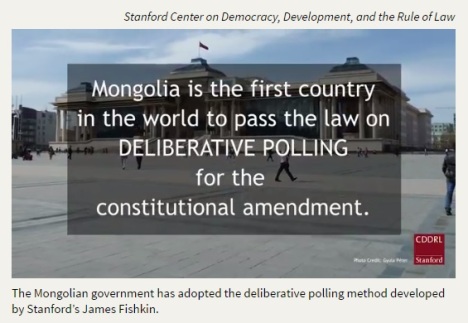
The Mongolian government recently passed a law requiring that an immersive research method that analyzes public opinion developed by Stanford’s James Fishkin be conducted before its constitution could be amended. According to Fishkin, who devised the process called deliberative polling almost 30 years ago, it marks the first time that a country has incorporated the process into its law. … The measure was supported and passed into law on Feb. 9.

Fishkin.jpg

See also: http://www.news.mn/r/328704.

Participatory and Deliberative Democracy: Sortition and Democratic Representation

An upcoming session in the Political Studies Association’s Annual International Conference 2017:

Participatory and Deliberative Democracy: Sortition and Democratic Representation

Room: Executive Room B
Time Slot: Wednesday 12th April 11:00 – 12:30

Panel Chair: Dr John Boswell (University of Southampton)
Panel Members:

  • Mr Keith Sutherland (University of Exeter)
  • Dr Brett Hennig (Sortition Foundation)
  • Dr Peter Stone (Trinity College Dublin)
  • Mr Dimitri Courant (University of Lausanne & University Paris 8)

We are witnessing something of a revival in support for sortition, with the idea popularised in particular in David Van Reybrouck’s recent Against Elections: The Case for Democracy. Although the debate around the use of sortition has typically been tied to discussion of mini-publics, this panel seeks to look more broadly at its relationship to democratic theory and democratic practice more broadly conceived. It brings together proponents and sceptics, normative theorists and those whose work is more applied, for a contemporary, lively and varied debate on this age-old topic.

Papers:

Explaining non-participation in deliberative mini-publics

One of the issues dividing commentators on this blog is whether participation in sortition-based assemblies should be mandatory or voluntary — see, for example. Those of us advocating legislative juries based on Athenian nomothetic panels advocate quasi-mandatory participation in order to ensure accurate descriptive representativity. Those, however, who argue for full in-depth participatory deliberation claim that mandatory participation would be ‘disastrous’, as it is hard to see how a a ‘full-charge’ legislature — essentially like existing elected legislatures but with members selected by lot — could function with (in effect) conscripted members.

A paper by Vincent Jacquet in the European Journal of Political Research, examines why it is that the overwhelming majority of randomly-selected persons refuse the invitation to participate in deliberative minipublics. Given that the descriptive representativity of the minipublic (vis-a-vis the target population) is one of the principal rationales for sortition, acceptance rates are extremely poor, ranging from 1% (America Speaks) through 3% (Belgium), 5.7% (Ontario), 6.2% (Netherlands), 7.4% (British Columbia) to 20% in Deliberative Polls. As a result there is a danger that voluntary participation risks the ‘over-representation of better educated and politically active individuals’ as ‘the [overwhelming] majority of the recruited population refuse to participate (pp.2-3).

Stratified sampling can enable some correction but this is generally on the basis of crude population metrics and ‘[voluntary] participation follows the social unequal distribution pattern of political engagement . . . participants are better educated, mostly men and older than the average population . . . participants are more politically interested and have a higher sense of efficacy’ (p.3). Such ‘statistical biases’ might suggest that deliberative minipublics privilege the usual suspects, the added disadvantage being that nobody has chosen ‘descriptive’ representatives and there is no way to kick the rascals out. There is a danger that

Using mini-publics to shape public policies may create new deliberative elites — randomly selected but distinct from the wider population precisely because they have taken the time to deliberate. (p.14)

Continue reading →

Equal Participation in the Post-Democratic Age

Forthcoming book chapter by Dirk Jörke and Anthoula Malkopoulou

Equal participation is a sine qua non of democracy. Yet, today equal voting rights are insufficient for embodying this principle. On one hand, the use of voting rights is not equal among the population. On the other, elections have increasingly become a post-democratic facade, because decision-making has shifted to unelected bodies or non-transparent network meetings. Are more direct democratic procedures the solution to this predicament? This chapter argues that they are not. For once, deliberative citizen assemblies bring inequalities in from the backdoor, as they permit knowledge, skills and other resources more available to advantaged citizens to weigh in positively. Likewise, introducing random selection as a way of distributing public office may allow advantaged citizens to dominate, if the pool of candidates is voluntary and thus self-selected. We argue that reforms should generally focus not on introducing more direct participation, but on reducing the inequalities of participation in representative systems.

The other alternative being large non-deliberative juries with mandatory participation.

Full text

Let’s reimagine democracy: replace elections with lotteries

An article by Joe Humphreys, in the The Irish Times, November 19th, 2016:

What’s happening to our democracies? Donald Trump’s presidential-election victory in the United States, after a bitter campaign characterised by deceitful and incendiary rhetoric, is not an isolated episode. It’s the natural outcome of what David Van Reybrouck calls democratic-fatigue syndrome.

One of the most worrying facets of electoral democracy is what political scientists call rational ignorance. Citizens have negligible chances of influencing which candidates get elected and of influencing those candidates once elected. “Citizens thus have no incentive to become well-informed regarding political affairs,” says Dr Peter Stone of Trinity College Dublin.

The answer, says Stone, is to find new ways of invigorating democracy, suggesting a much greater role for “citizen juries” randomly selected to serve public roles. This notion of governing by lottery rather than election is at the heart of Van Reybrouck’s book, which has sought to popularise a concept that stretches back to ancient Greece, the birthplace of democracy. In Athens, in the fifth and fourth centuries BC, the most important governmental offices were appointed by sortition, or the drawing of lots.